

.svg)





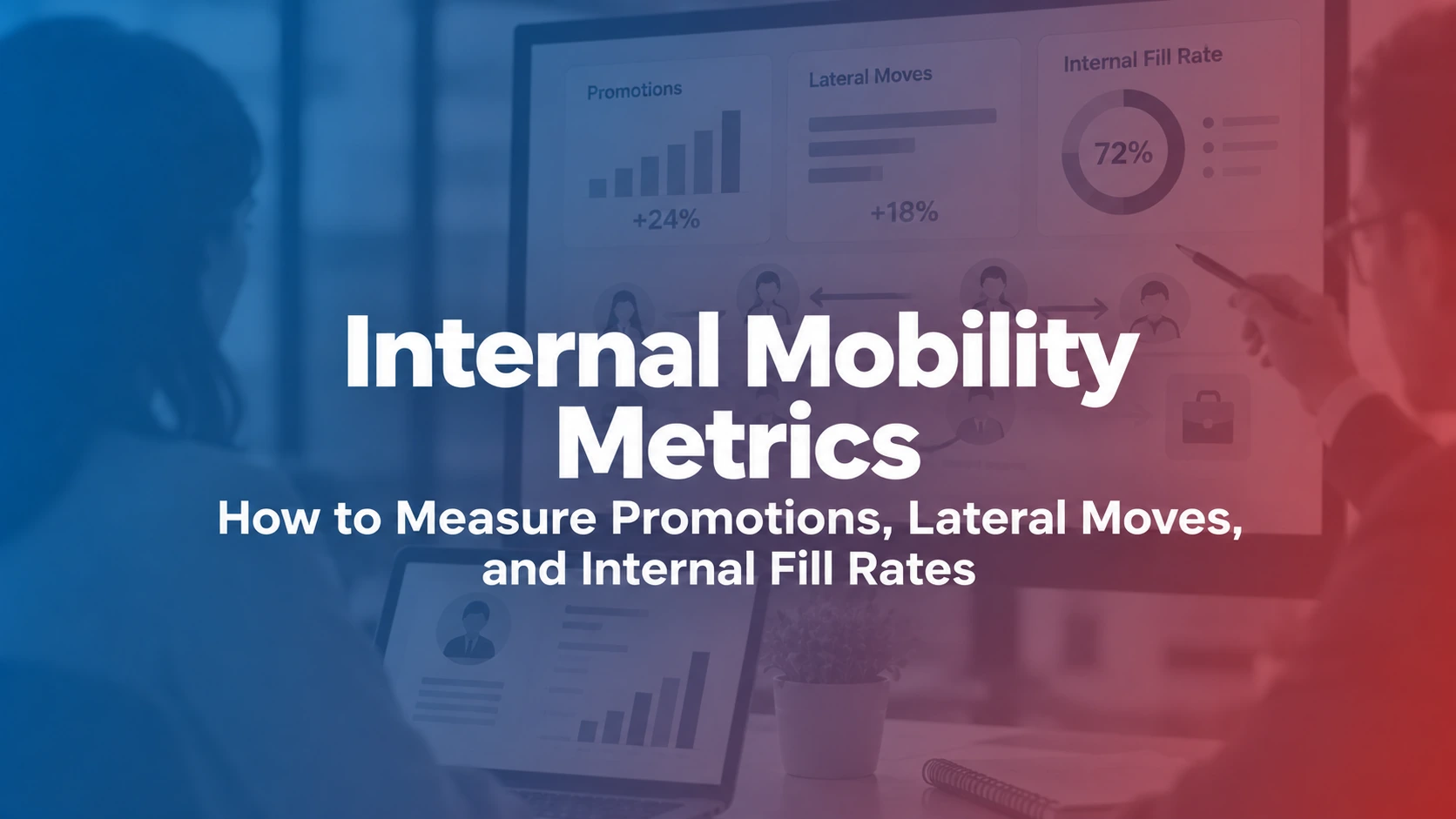

Table of Contents
Quick Takeaways
- Internal mobility includes promotions, lateral moves, transfers, and internal hiring.
- Use meaningful denominators and segment by function, level, location, and other relevant groups.
- Internal fill rate is useful but should not be treated as a universal target.
- Connect mobility data with skills, career paths, talent pools, and readiness to understand why movement occurs.
- Track post-move retention and outcomes so completed transfers are not mistaken for successful mobility.
Internal mobility metrics show whether employees can actually move through the organization—not just whether career paths exist on paper. Promotions matter, but they are only one part of the picture. Lateral moves, transfers, role-family changes, and internal hiring all reveal how effectively an organization converts existing talent into future workforce supply.
A connected approach brings together Career Pathing, Skills Management, Talent Pools and Bench Strength, Succession Planning, and Reporting and Analytics.
Do Not Reduce Internal Mobility to Promotion Rate
Promotion rate is useful, but an organization can have healthy mobility even when many moves are lateral. Employees may build new capabilities, move into scarce functions, relocate, switch role families, or take a temporary stretch assignment without changing level.
This is why a useful career framework should include more than a vertical ladder. See career ladder vs. career lattice vs. career path.
CIPD's 2026 discussion of internal mobility emphasizes the value of helping employees move and develop within the organization rather than relying only on external hiring. That does not create a universal target for mobility, but it supports measuring whether internal pathways are usable in practice. See the CIPD internal mobility discussion.
Core Internal Mobility Metrics
| Metric | What it measures | Interpret with |
|---|---|---|
| Promotion rate | Employees promoted during the period relative to the relevant population | Level mix, eligibility, tenure, function |
| Lateral-move rate | Employees moving to a different role at roughly similar level | Role family, skill transfer, development purpose |
| Internal fill rate | Filled roles won by existing employees | Role type, level, location, external hiring strategy |
| Cross-functional move rate | Movement between functions or role families | Transferable skills and path visibility |
| Time to internal move | Time between expressed interest or eligibility and completed movement | Opportunity volume, approvals, readiness gaps |
Calculate the Metrics With Explicit Denominators
Internal mobility metrics are easy to distort when teams use different populations or time windows. Define the numerator, denominator, eligibility rules, and period before comparing functions or reporting a trend.
| Metric | Illustrative calculation | Definition check |
|---|---|---|
| Promotion rate | Promotions ÷ eligible or relevant employee population × 100 | Define eligibility, level changes, and whether temporary moves count |
| Lateral-move rate | Completed lateral moves ÷ relevant employee population × 100 | Define same-level movement and whether location-only changes count |
| Internal fill rate | Roles filled by existing employees ÷ all filled roles × 100 | Define which openings and worker populations are included |
| Internal selection rate | Internal hires ÷ internal applicants × 100 | Interpret with applicant quality and opportunity mix |
Use Reporting and Analytics to keep these definitions consistent across dashboards and time periods. Treat them as internal operating measures, not universal benchmarks.
1. Promotion Rate
Track promotions relative to a meaningful denominator. A raw promotion count is hard to interpret. Segment by level, function, tenure, location, and other relevant workforce groups so one company-wide average does not hide differences in opportunity.
Use a promotion readiness framework to understand whether low movement is caused by capability gaps, role availability, inconsistent criteria, or something else. Compare promotion patterns with current-role performance and target-role requirements instead of assuming that tenure or strong ratings should automatically lead to movement.
2. Lateral-Move Rate
Lateral moves can build future readiness, reduce retention risk, and move skills to where the business needs them. Track same-level moves separately from promotions so the organization can see development that does not depend on title advancement. The broader internal mobility framework explains why career progress should include more than upward movement.
Career paths should make these adjacent moves visible instead of presenting one upward route.
3. Internal Fill Rate
Internal fill rate measures the share of filled roles that went to current employees. It can indicate whether internal supply is being used, but it should not be treated as a target that must always increase. Some roles require external capability, growth hiring, or new expertise. Compare the pattern with workforce planning so internal hiring is interpreted against future demand rather than in isolation.
Use internal fill rate alongside talent pool depth and bench strength analysis to understand whether low internal filling reflects limited pipeline coverage.
4. Cross-Functional and Role-Family Movement
Track how often employees move across organizational boundaries. Low cross-functional movement may indicate that paths are unclear, skills are difficult to compare, managers hoard talent, or systems make internal candidates hard to discover.
A skills inventory can help identify transferable capabilities that job-title matching alone misses.
5. Internal Application and Selection Rates
If internal job application data is available, measure how many employees apply, how often internal applicants reach interview, and how often they are selected. This reveals friction earlier than completed-move metrics.
6. Time to Move
Measure how long it takes from expressed interest, internal application, or readiness identification to actual movement. Long delays can signal scarce openings, approval bottlenecks, unclear readiness standards, or weak manager support.
7. Retention After Internal Movement
Movement is not successful merely because the transfer occurred. Track whether employees remain, perform, and continue developing after the move. Compare outcomes by move type and function rather than assuming every internal transfer has the same effect.
8. Mobility From Talent Pools and Succession Pipelines
For strategic talent groups, track whether development populations translate into real movement. Talent pools should lead to development and opportunity, while succession pipelines should improve critical-role coverage. Use succession planning metrics to separate general mobility from critical-role coverage and readiness.
Use talent pools vs. succession pipelines to keep those two workflows distinct.
Build a Mobility Funnel, Not Just Outcome Metrics
Completed moves are lagging indicators. Earlier stages can reveal where the process is breaking before the final move disappears from the dashboard.
- Opportunity visibility: can employees see relevant internal roles and paths?
- Interest: are employees viewing or expressing interest in internal opportunities?
- Application: are qualified employees applying?
- Interview or review: are internal candidates progressing through the process?
- Selection: are internal candidates being chosen when their evidence matches the role?
- Completed move: did the employee actually transfer, promote, or change role?
- Post-move outcome: did the employee remain, perform, and continue developing?
A broader Talent Management view helps connect these stages with development, career visibility, and succession instead of treating internal hiring as a standalone recruiting metric.
Segment Before Drawing Conclusions
Internal mobility differs naturally by function, level, geography, tenure, and role type. A single company-wide rate can hide both strong and weak areas. Segment the data and compare like with like.
For example, low mobility in a small specialist function may be structurally normal, while the same pattern in a large role family with many openings may indicate a path or readiness problem.
Connect Mobility Metrics to Skills and Career Paths
Mobility data becomes more useful when HR can see why movement did or did not happen. Connect moves with skills evidence, path visibility, employee interest, and target-role requirements.
A career path framework provides the possible routes; mobility metrics show whether employees are actually using them. Skill proficiency levels can add evidence about whether recurring capability gaps are blocking specific transitions.
Use Talent Review to Investigate Stalled Mobility
Talent Review can surface employees who are ready for movement but remain blocked, as well as functions with weak pipelines or inconsistent promotion standards. A structured talent review meeting can turn the metrics into decisions.
See whether internal talent is actually moving
TraineryHCM connects career paths, skills, talent pools, succession, and reporting so HR can track promotions, lateral moves, pipeline conversion, and internal fill patterns in context.
Explore Reporting and AnalyticsCommon Internal Mobility Measurement Mistakes
- Tracking promotions only: lateral and cross-functional growth disappears.
- Using raw counts without denominators: larger groups always look more mobile.
- Comparing unlike populations: structural differences are mistaken for performance.
- Optimizing for internal fill rate alone: external hiring is treated as failure even when it is strategically necessary.
- Reporting without action: metrics do not change career paths, development, or talent decisions.
Final Takeaway
Measure internal mobility as a system of movement: promotions, lateral moves, transfers, internal hiring, cross-functional transitions, and the time and outcomes around those changes. Segment the data, connect it to skills and readiness, and use it to identify where internal talent supply is strong or blocked.
See Where Internal Mobility Is Working—and Where It Stalls
See how TraineryHCM connects career paths, skills, talent pools, succession, and reporting so HR can measure promotions, lateral moves, internal fill, and post-move outcomes in context.
Book a Demo

.svg)

.svg)
.svg)

