
.svg)






Table of Contents
Quick Takeaways
- Workforce planning aligns workforce capacity and capability with future business needs using documented assumptions.
- The three core methods are demand forecasting, workforce supply analysis, and gap analysis.
- A practical process moves through business direction, current supply, future demand, gap identification, workforce strategies, and ongoing review.
- Use the template to record current state, future requirement, gap or risk, action, owner, timing, and the assumptions behind each forecast.
- Connect workforce planning to budgeting and maintained workforce data, but keep forecasts human-reviewed rather than treating them as deterministic predictions.
Workforce planning is the process of aligning workforce capacity and capability with future business needs. It combines demand forecasting, workforce supply analysis, gap analysis, and an action plan so HR and business leaders can decide when to hire, develop, redeploy, retain, or redesign work.
This guide covers the main workforce planning methods, a practical six-step workforce planning process, common strategic workforce planning models, and a reusable workforce planning template for turning headcount and skills assumptions into an action plan.
The goal is not to predict the future perfectly. It is to document assumptions, compare current supply with future demand, identify the most important gaps, and revisit the plan as business conditions change.
What Is Workforce Planning?
Workforce planning is the process of analyzing an organization’s current workforce, forecasting future talent needs based on business strategy, and identifying the gap between current capability and future need. It covers both headcount, how many people are needed, and capability, what skills those people need to have, and it exists specifically to make talent decisions proactive rather than reactive.
3 Workforce Planning Methods: Demand, Supply, and Gap Analysis
- Demand forecasting. Projecting future talent needs based on business strategy: planned growth, new markets, product launches, or restructuring. This method answers "how many people, and with what skills, will we need?"
- Supply analysis. Assessing the current workforce’s capacity and capability, including anticipated attrition, retirements, and internal mobility. This method answers "what do we already have, and how is it likely to change without intervention?"
- Gap analysis. Comparing demand forecasts against supply analysis to identify specific shortfalls or surpluses, by role, skill, or location. This is where the first two methods convert into an actual action plan: hire, train, redeploy, or restructure.
Workforce Planning Process: 6 Steps
- Set business direction. Define the planning horizon, business priorities, growth assumptions, restructuring plans, and financial constraints that create workforce demand.
- Assess current workforce supply. Review headcount, roles, locations, critical skills, workforce costs, known vacancies, mobility, and relevant attrition patterns.
- Forecast future workforce demand. Estimate the roles, skills, capacity, and locations required under the most relevant business assumptions.
- Identify workforce gaps. Compare future demand with projected supply to find shortages, surpluses, single-person dependencies, and priority capability gaps.
- Choose workforce strategies. Decide where to hire, build skills, redeploy talent, improve retention, use contingent capacity, redesign work, or change the timing of demand. Review internal talent pools and bench strength when assessing available coverage.
- Implement, monitor, and revise. Assign owners, connect the plan to budgeting, track agreed measures, and refresh assumptions on a defined cadence.
Use the same six-step structure whether the plan is focused on annual headcount, skills, a business unit, or a longer-term strategic workforce scenario. The level of detail should match the decision being made.
Strategic Workforce Planning Models and Frameworks
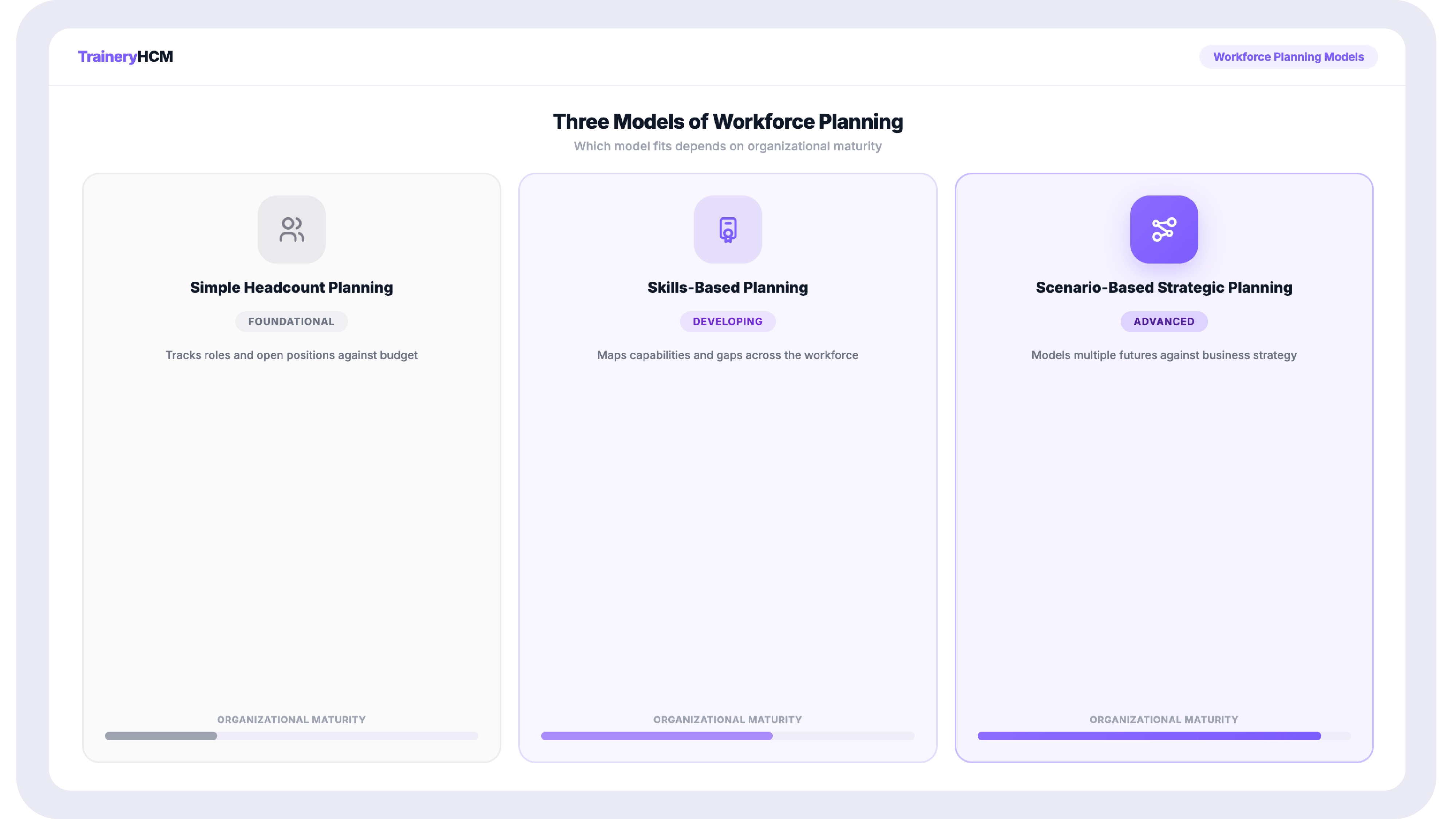
Not every organization needs the same level of workforce planning rigor. The right model depends on size, planning horizon, growth stage, and how much uncertainty the organization is facing.
Public-sector workforce planning toolkits also use a repeatable strategic framework: establish direction, assess current and future workforce needs, identify gaps, develop actions, and monitor the plan. The USGS Workforce Planning Toolkit provides planning models, guides, and workforce-plan templates built around this structured approach.
| Model | Best For | What It Involves |
|---|---|---|
| Simple Headcount Planning | Smaller, stable organizations. | Straightforward projection of hiring needs against budget and known attrition. |
| Skills-Based Workforce Planning | Organizations facing skill gaps or automation shifts. | Mapping current skills inventory against future skill requirements, not just headcount. |
| Scenario-Based Strategic Workforce Planning | Organizations facing significant growth, market uncertainty, or restructuring. | Modeling multiple future scenarios (high growth, flat, contraction) and planning talent needs for each. |
Workforce Planning Template: 6-Step Process
Use TraineryHCM to ground workforce cost planning in current employee, role, department, and location context. TraineryCORE supplies that workforce foundation, while TraineryHCM reporting helps teams review connected information. Finance should reconcile approved pay, benefit, employer-cost, and contractor inputs from the authoritative systems. TraineryHCM’s compensation connection brings relevant workforce context to specialist CompBldr compensation planning. Confirm the configured data flows and reporting scope; do not assume TraineryHCM replaces payroll, a finance forecast, or a complete workforce-cost model.
In the template’s Budget row, record the planning period, currency, filled roles, vacancies, expected start dates, pay changes, and the cost categories Finance includes. Separate recurring employment costs from one-time hiring or employee development costs and avoid counting the same item twice. The BLS employer compensation cost series distinguishes wages and salaries from benefits; national averages are reference context, not your organization’s budget. For an illustrative hiring scenario, compare an approved role starting in January with the same role starting in July using the same annual cost assumptions. Show the different in-period costs alongside the year-end annual run rate, then review capacity and capability implications before choosing a scenario.
| Planning Area | Current State | Future Requirement | Gap / Risk | Action | Owner / Timing |
|---|---|---|---|---|---|
| Headcount | Current FTE by role/team | Forecast demand | Shortage or surplus | Hire, redeploy, redesign | Owner + target quarter |
| Skills | Verified current capability | Required future capability | Priority skill gap | Develop, hire, borrow | Owner + review date |
| Critical roles | Current coverage | Required backup/readiness | Single-point dependency | Succession, cross-train | Owner + milestone |
| Budget | Current workforce cost | Approved/expected envelope | Funding constraint | Sequence or reprioritize | Finance + HR cadence |
Copy these columns into Excel or Google Sheets, then expand the rows by role, department, location, skill group, or scenario. Keep the assumptions beside the numbers so leaders can see what would change the forecast.
- Step 1: Current state inventory. Document current headcount by role, department, and location, along with a skills inventory for critical roles. This is the supply side of the analysis.
- Step 2: Business driver mapping. List the specific business initiatives, growth targets, new products, and expansion plans driving future talent needs, and estimate the headcount and skill implications of each.
- Step 3: Attrition and mobility forecast. Estimate expected attrition by role or department based on historical turnover data and any known retirements or planned departures.
- Step 4: Gap identification. Compare projected demand against projected supply to identify specific shortfalls or surpluses, by role and by skill, not just a single company-wide headcount number.

- Step 5: Action plan by gap type. For each identified gap, decide the appropriate response: external hiring, internal development, critical-role succession coverage, or restructuring, and assign an owner and timeline to each.
- Step 6: Review cadence. Revisit the plan on a recurring cadence tied to the budgeting cycle, typically quarterly or biannually, rather than treating it as a one-time annual exercise that goes stale within a few months.
Step 1 and Step 3 both depend on workforce data that stays current without manual reconstruction, which is where people analytics inside a connected HCM platform becomes the difference between a plan built on real numbers and one built on best guesses.
Connect Workforce Planning to Maintained Workforce Data
See how workforce planning can use maintained headcount, role, skills, and reporting context instead of relying on a disconnected spreadsheet rebuilt from scratch each planning cycle.
Common Workforce Planning Mistakes
- Treating it as an annual, one-time exercise. A plan built once a year and never revisited is stale within a quarter for any organization experiencing meaningful change.
- Planning headcount without planning skills. A gap analysis that only counts heads misses the more common real-world problem: having enough people but not enough of the right capability.
- Building the plan on outdated workforce data. A forecast is only as reliable as the current-state inventory feeding it. Stale headcount or skills data undermines every downstream step in the process.
- Disconnecting the plan from the budgeting cycle. A workforce plan that leadership does not see during actual budget conversations rarely survives contact with real hiring freezes or reallocation decisions.
Workforce planning turns headcount decisions from reactive fire drills into a proactive, structured practice. The three core methods, demand forecasting, supply analysis, and gap analysis, apply regardless of organization size, while the right model and level of formality scale with actual complexity and uncertainty. The template above works as a starting point for most mid-sized organizations building their first formal plan.
The plan is only as reliable as its workforce data and assumptions. Review data connections and access permissions when bringing workforce and cost inputs together. Document forecast assumptions and review the plan on the same cadence as major business and budget decisions.
Build Workforce Plans on Current, Governed Data
Connect workforce planning with maintained employee, role, skills, organizational, and reporting context so assumptions can be reviewed against a more consistent workforce foundation.
Book a Demo


.svg)

.svg)
.svg)

