





Employee Retention Strategies That Actually Work

Updated On:
July 7, 2026
Mahesh Kumar
Founder, TraineryHCM.com
Employee Retention Strategies That Actually Work

Table of Contents

Most retention advice reads like a list of nice things to do: recognize people, offer growth, pay fairly, build culture. None of it is wrong. All of it is also generic enough to apply to almost any organization without actually changing outcomes, because the advice stops at the strategy level and never gets to the system level: how an organization actually operationalizes recognition, growth, and fair pay at scale.

Replacing a mid-level employee typically costs six to nine months of their salary once recruiting, onboarding, and lost productivity are counted. That makes retention one of the highest-leverage areas HR can influence, and it deserves more than a generic tactics list. This guide covers the retention strategies with the strongest evidence behind them, how to spot flight risk before a resignation letter confirms it, and how performance and compensation systems, when connected, become retention tools in their own right.

Why Most Retention Advice Falls Short

Generic retention tactics fail for a specific reason: they treat symptoms without addressing the systems that produce them. Recognizing achievements is good advice, but it does not work if managers have no consistent way to see what employees actually accomplished. Offering development is good advice, but it does not work if development plans live in a document nobody revisits after the goal-setting meeting. The strategies below work because they are tied to specific, operational practices, not just intentions.
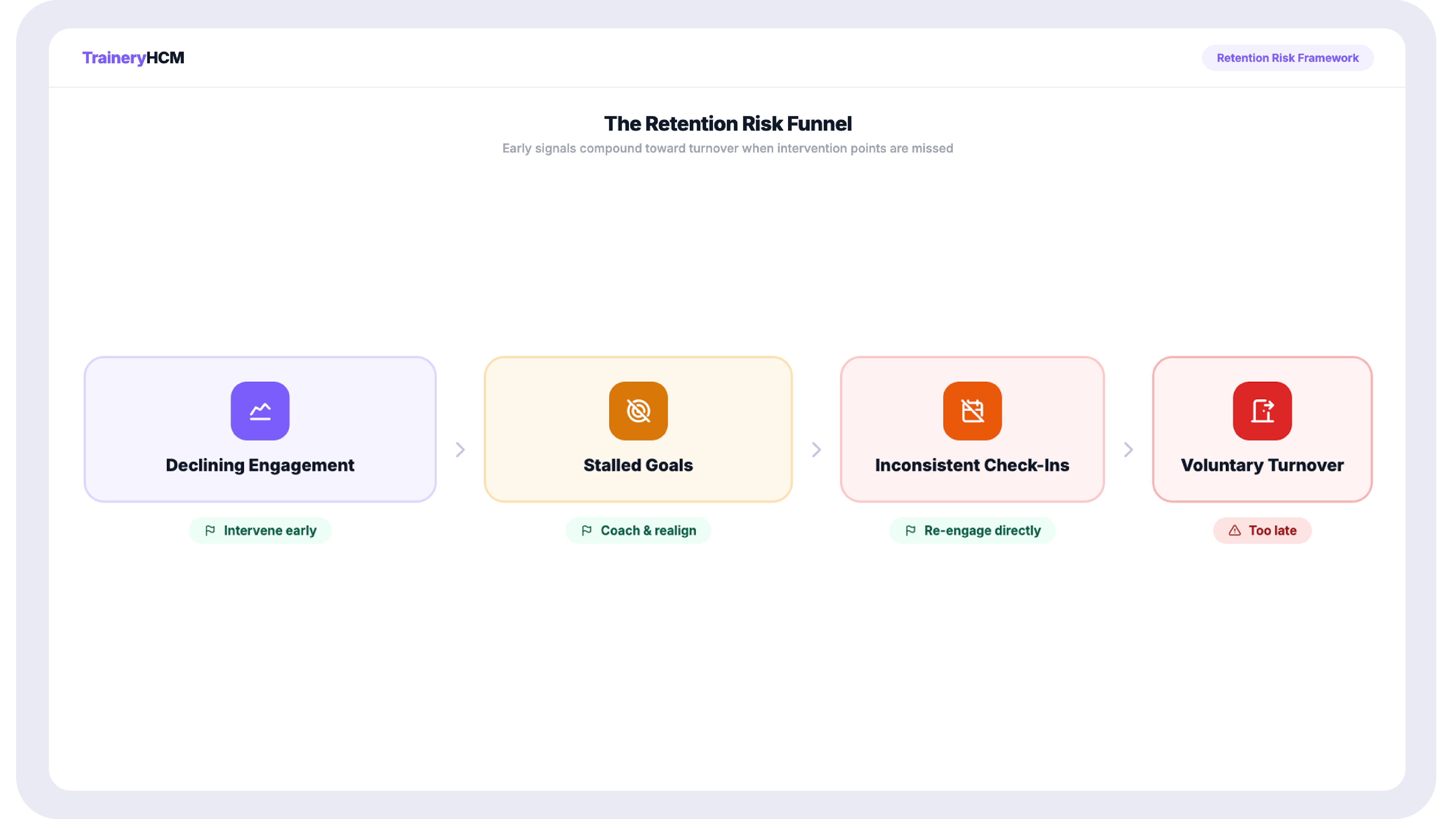
Funnel diagram showing early retention risk signals, declining engagement, stalled goals, inconsistent check-ins, progressing toward voluntary turnover if left unaddressed, with intervention points marked at each stage

Strategy 1: Invest in Manager Quality

Manager quality is consistently the strongest predictor of team-level retention. Employees leave managers more often than they leave companies. Investing in this strategy means giving managers the training, coaching frameworks, and visibility into their own team’s data to actually lead well, not just assigning management as a title without the support to do it effectively.

Strategy 2: Make Growth Visible and Real

Employees who see a credible, specific path to skill growth or advancement inside the organization are significantly less likely to look elsewhere. Vague promises of growth opportunities during recruiting do not retain anyone. A documented development plan, tracked and revisited regularly rather than filed away, is what makes growth feel real rather than aspirational.

Transform Stagnant Development Plans Into Active Performance Drivers

A development plan that lives in a shared document and never gets revisited is not a retention strategy; it is a filing exercise. See how individual development plans stay active and connected to real goal progress.

Book a Demo

Strategy 3: Align Compensation to Performance, Transparently

Compensation generosity matters less for retention than compensation clarity. Employees who understand exactly how their performance connects to their pay, and who see that connection applied consistently, are more likely to trust the system even when a raise is smaller than hoped. Employees who cannot see the connection, even when paid competitively, are more likely to assume unfairness and start looking elsewhere.

This is where performance-linked compensation planning becomes a genuine retention tool rather than an annual budgeting exercise: when a completed review cycle flows directly into merit decisions without a manual export and reconstruction step in between.

Strategy 4: Recognize Specifically and Often

Recognition that is specific, timely, and tied to an actual accomplishment reinforces the behavior it rewards. Recognition that arrives months later as a generic line in an annual review does not carry the same weight. Peer-to-peer recognition, not just top-down, also correlates with stronger engagement and lower voluntary turnover.

Spotting Flight Risk Before It Becomes a Resignation

The most useful retention practice most organizations skip entirely: reading the data that already predicts risk before it becomes a resignation. Three signals matter most.

  • Declining engagement or eNPS trend. A dropping score is a stronger signal than a single low score, since the direction of movement often precedes an actual decision to leave.
  • Stalled goal progress without a clear reason.  An employee who was hitting goals consistently and has quietly stopped, without a workload change to explain it, is showing an early disengagement signal.
  • Inconsistent or skipped 1:1s. A pattern of rescheduled or skipped check-ins, on either side, often precedes a resignation by weeks, since disengaged employees and overwhelmed managers both tend to deprioritize the conversation first.
 Screenshot mock of a manager dashboard flagging retention risk based on combined engagement trend, goal progress, and check-in consistency data for individual team members

Surface Workforce Retention Risk Before It Turns Into a Resignation

See how connecting performance data, development plans, and compensation planning in one system surfaces retention risk before it shows up as a resignation, instead of after.

Book a Demo

Retention strategies that work share a common trait: they are operational, not aspirational. Manager quality, visible growth, transparent compensation alignment, and specific recognition all require a system behind them, not just good intentions from HR. Reading flight risk signals already present in performance and engagement data turns retention from a reactive exit-interview exercise into a proactive practice that catches problems while there is still time to address them.

Compensation deserves particular attention here, since pay decisions disconnected from performance data are one of the more common, avoidable sources of retention risk this guide covers.

Unified Talent Governance

Connect Performance, Development, and Pay in One System

TraineryHCM connects performance reviews, development plans, and compensation planning natively, so retention risk surfaces in the data before it becomes a resignation. Book a demo to see how it works.

Book a Demo

Key Takeaways

  • The strategies with the strongest evidence behind them are manager quality, development opportunity, compensation alignment, and recognition, not surface-level perks like free snacks or casual dress codes.
  • Retention risk is usually visible in the data before a resignation happens: declining engagement scores, stalled goal progress, and inconsistent 1:1s are all early warning signals.
  • Replacing a mid-level employee typically costs six to nine months of their salary in recruiting, onboarding, and lost productivity, making retention one of the highest-leverage areas HR can influence.
  • Compensation alignment matters more than compensation generosity. Employees who understand how their pay connects to performance stay longer than employees paid well but left guessing at the connection.
  • Retention strategy works best when performance, development, and compensation data live in one connected system, so a manager can see risk signals before they compound into a resignation.

Most retention advice reads like a list of nice things to do: recognize people, offer growth, pay fairly, build culture. None of it is wrong. All of it is also generic enough to apply to almost any organization without actually changing outcomes, because the advice stops at the strategy level and never gets to the system level: how an organization actually operationalizes recognition, growth, and fair pay at scale.

Replacing a mid-level employee typically costs six to nine months of their salary once recruiting, onboarding, and lost productivity are counted. That makes retention one of the highest-leverage areas HR can influence, and it deserves more than a generic tactics list. This guide covers the retention strategies with the strongest evidence behind them, how to spot flight risk before a resignation letter confirms it, and how performance and compensation systems, when connected, become retention tools in their own right.

Why Most Retention Advice Falls Short

Generic retention tactics fail for a specific reason: they treat symptoms without addressing the systems that produce them. Recognizing achievements is good advice, but it does not work if managers have no consistent way to see what employees actually accomplished. Offering development is good advice, but it does not work if development plans live in a document nobody revisits after the goal-setting meeting. The strategies below work because they are tied to specific, operational practices, not just intentions.

Funnel diagram showing early retention risk signals, declining engagement, stalled goals, inconsistent check-ins, progressing toward voluntary turnover if left unaddressed, with intervention points marked at each stage

Strategy 1: Invest in Manager Quality

Manager quality is consistently the strongest predictor of team-level retention. Employees leave managers more often than they leave companies. Investing in this strategy means giving managers the training, coaching frameworks, and visibility into their own team’s data to actually lead well, not just assigning management as a title without the support to do it effectively.

Strategy 2: Make Growth Visible and Real

Employees who see a credible, specific path to skill growth or advancement inside the organization are significantly less likely to look elsewhere. Vague promises of growth opportunities during recruiting do not retain anyone. A documented development plan, tracked and revisited regularly rather than filed away, is what makes growth feel real rather than aspirational.

Transform Stagnant Development Plans Into Active Performance Drivers

A development plan that lives in a shared document and never gets revisited is not a retention strategy; it is a filing exercise. See how individual development plans stay active and connected to real goal progress.

Book a Demo

Strategy 3: Align Compensation to Performance, Transparently

Compensation generosity matters less for retention than compensation clarity. Employees who understand exactly how their performance connects to their pay, and who see that connection applied consistently, are more likely to trust the system even when a raise is smaller than hoped. Employees who cannot see the connection, even when paid competitively, are more likely to assume unfairness and start looking elsewhere.

This is where performance-linked compensation planning becomes a genuine retention tool rather than an annual budgeting exercise: when a completed review cycle flows directly into merit decisions without a manual export and reconstruction step in between.

Strategy 4: Recognize Specifically and Often

Recognition that is specific, timely, and tied to an actual accomplishment reinforces the behavior it rewards. Recognition that arrives months later as a generic line in an annual review does not carry the same weight. Peer-to-peer recognition, not just top-down, also correlates with stronger engagement and lower voluntary turnover.

Spotting Flight Risk Before It Becomes a Resignation

The most useful retention practice most organizations skip entirely: reading the data that already predicts risk before it becomes a resignation. Three signals matter most.

  • Declining engagement or eNPS trend. A dropping score is a stronger signal than a single low score, since the direction of movement often precedes an actual decision to leave.
  • Stalled goal progress without a clear reason.  An employee who was hitting goals consistently and has quietly stopped, without a workload change to explain it, is showing an early disengagement signal.
  • Inconsistent or skipped 1:1s. A pattern of rescheduled or skipped check-ins, on either side, often precedes a resignation by weeks, since disengaged employees and overwhelmed managers both tend to deprioritize the conversation first.
 Screenshot mock of a manager dashboard flagging retention risk based on combined engagement trend, goal progress, and check-in consistency data for individual team members

Surface Workforce Retention Risk Before It Turns Into a Resignation

See how connecting performance data, development plans, and compensation planning in one system surfaces retention risk before it shows up as a resignation, instead of after.

Book a Demo

Retention strategies that work share a common trait: they are operational, not aspirational. Manager quality, visible growth, transparent compensation alignment, and specific recognition all require a system behind them, not just good intentions from HR. Reading flight risk signals already present in performance and engagement data turns retention from a reactive exit-interview exercise into a proactive practice that catches problems while there is still time to address them.

Compensation deserves particular attention here, since pay decisions disconnected from performance data are one of the more common, avoidable sources of retention risk this guide covers.

Unified Talent Governance

Connect Performance, Development, and Pay in One System

TraineryHCM connects performance reviews, development plans, and compensation planning natively, so retention risk surfaces in the data before it becomes a resignation. Book a demo to see how it works.

Book a Demo

Frequently Asked Questions

Should small businesses use different retention strategies than large companies?

How does manager quality affect employee retention?

What is the real cost of employee turnover?

Does compensation really affect employee retention?

How can HR predict employee turnover before it happens?

What are the most effective employee retention strategies?

Turn Insight Into Action with TraineryHCM

Modern workforce challenges require more than disconnected HR tools. TraineryHCM helps organizations bring clarity, consistency, and confidence to human capital management, across people, performance, learning, and compliance.