

.svg)






Table of Contents
Quick Takeaways
- Human resources is the organizational function that manages the employment relationship and people processes.
- Human capital is the knowledge, skills, experience, capabilities, and effort employees contribute.
- The terms are related but not synonymous: HR practices can help maintain and develop human capital.
- Human resource management focuses on managing people and HR processes, while human capital management often uses a broader employee-lifecycle and workforce-capability lens.
- Use operational HR metrics and human-capital capability measures together rather than reducing workforce value to a single score.
Human capital and human resources are related, but they are not the same thing. Human resources (HR) is the organizational function that manages the employment relationship, while human capital refers to the knowledge, skills, experience, capabilities, and effort people bring to an organization.
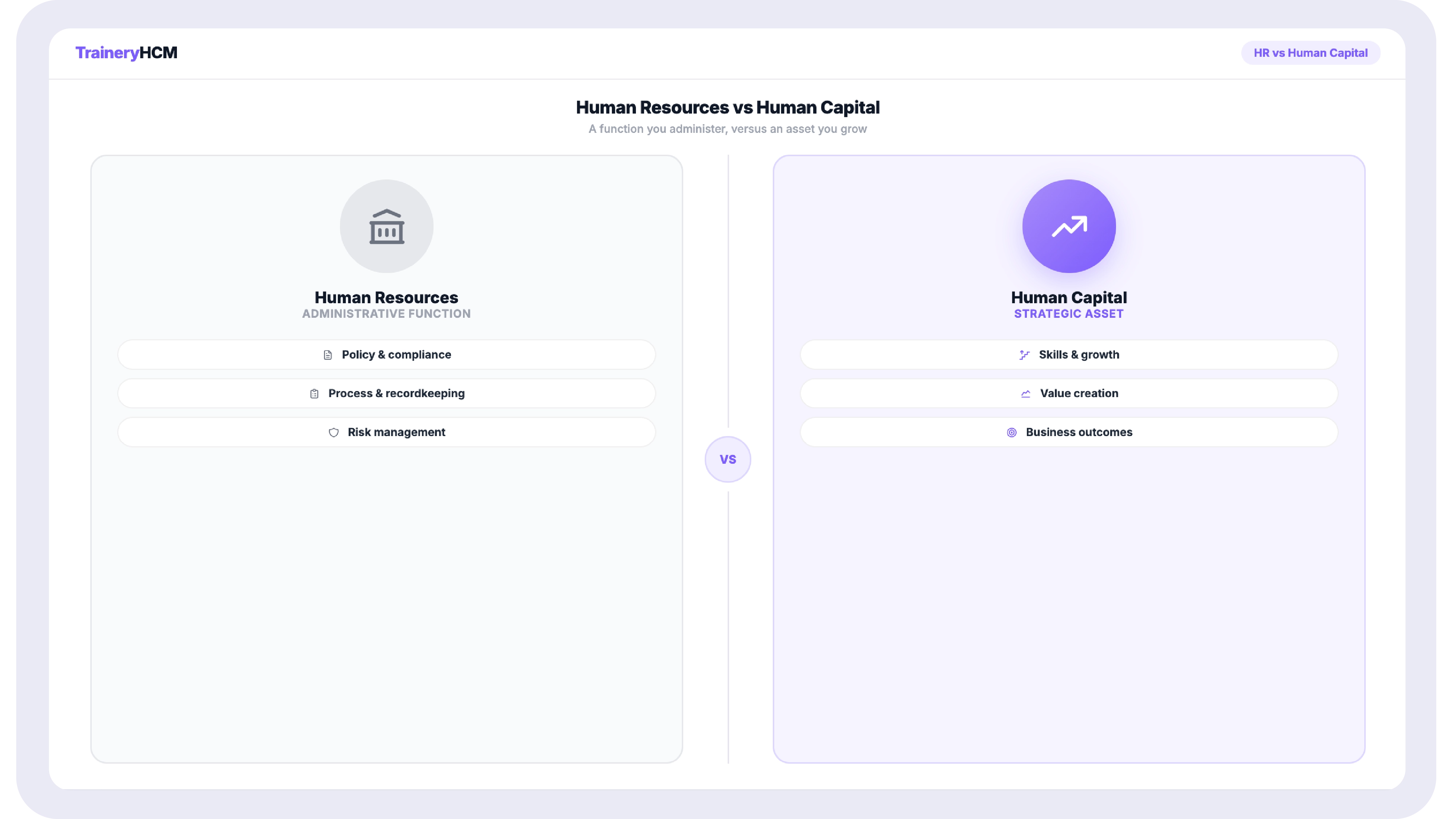
In simple terms: HR manages people processes; human capital describes the workforce capability and value those people contribute. The distinction matters because the two concepts lead to different questions, measures, and management approaches.
This guide explains the difference between human capital and human resources, how human capital management differs from human resource management, where the concepts overlap, and how both fit within modern HCM.
Human Capital vs. Human Resources: Key Differences
| Area | Human Resources | Human Capital |
|---|---|---|
| Meaning | The function, team, and processes that manage the employment relationship. | The knowledge, skills, experience, capabilities, and effort employees contribute. |
| Primary focus | Hiring, employee records, policies, payroll coordination, benefits, employee relations, and HR operations. | Capability, development, performance, mobility, workforce readiness, and long-term value creation. |
| What it describes | How an organization manages its workforce. | What the workforce knows, can do, and can develop. |
| Typical measures | Service levels, process completion, data accuracy, time to fill, turnover, and HR operating metrics. | Skills, proficiency, development, performance, readiness, mobility, and other capability indicators. |
| Relationship | HR processes can help maintain and develop human capital. | Human capital is shaped partly by hiring, learning, work experience, leadership, and development. |
Are Human Capital and Human Resources the Same?
TraineryHCM connects HR processes with workforce capability, but human capital and human resources are not the same. Human resources (HR) is the function and practices that manage the employment relationship; human capital describes the knowledge, skills, and experience people bring to work. In TraineryHCM, TraineryCORE maintains employee and organizational records, while Skills Management organizes skill evidence, role targets, and readiness gaps. For example, HR records an employee’s new role and reporting relationship; a capability review considers evidence of the skills needed for that role. An accurate employee record does not, by itself, establish proficiency.
HR also shapes people strategy, development, and retention, so the distinction is not simply administrative versus strategic work. The CIPD describes HR practices across the employee lifecycle, while the OECD defines human capital through knowledge, skills, and personal characteristics. Use these terms to distinguish people practices from workforce capability, rather than treating human capital as a department or a single software score.
What Is Human Resources?
Human resources is the department, function, and set of processes responsible for managing the employment relationship. That includes recruiting, hiring, payroll coordination, benefits administration, policy administration, employee relations, and employee records.
Modern HR operations depend on accurate employee records, clear permissions, reliable integrations, and consistent reporting. A connected core HR foundation can provide that context while payroll, benefits, performance, learning, compensation, and other workflows remain appropriately governed.
What Is Human Capital?
Human capital is an economic concept describing the knowledge, skills, experience, capabilities, and effort people contribute to an organization. Unlike the HR function, human capital is not a department or software module. Organizations can invest in human capital through development, role clarity, coaching, mobility, and work design, but outcomes should be evaluated with evidence rather than assumed from a single intervention.
To connect capability development with workforce decisions, use employee lifecycle management, people analytics, and strategic workforce planning.
Human Capital Management vs. Human Resource Management
Human resource management (HRM) generally describes the policies and processes used to recruit, employ, support, and manage people. Human capital management (HCM) usually uses a broader workforce lens that combines core HR administration with talent, capability, performance, learning, workforce planning, analytics, and other employee-lifecycle processes.
The terms overlap heavily in practice, and software vendors do not use them consistently. ADP, for example, describes both HRM and HCM as supporting daily HR operations and longer-term strategic goals, while noting that HCM platforms often cover a broader employee-lifecycle scope. For software-category terminology, see HCM vs. HRMS vs. HRIS.
Why the Distinction Matters
- It changes what is being measured. HR operations may focus on record accuracy, process completion, and service delivery. Human-capital analysis may consider capability, development, performance, mobility, and retention. Neither set of measures should be reduced to one universal score.
- It changes leadership questions. A connected HCM context can help leaders interpret workforce analytics and HR metrics, while consequential employment decisions remain subject to human judgment and applicable policy and law.
- It clarifies technology ownership. Core employee data can connect to specialist systems without implying that one platform natively owns every workflow. See HCM vs. HRMS vs. HRIS for the category distinctions.
Explore the Connected HCM Architecture Behind the Employee Lifecycle
See how core employee data, integrations, reporting, and specialist systems can work together without collapsing every workflow into one product.
How Human Resources and Human Capital Work Together
Organizations need both sound administration and deliberate development. Accurate employee data management supports reporting, access governance, and lifecycle processes. Development and performance evidence can then be interpreted alongside that context without automatically determining promotions, succession decisions, or pay.
For performance reviews, goals, check-ins, feedback, calibration, and IDPs, use the specialist workflows in PerformSpark. For learning, coaching, and credentials, use Trainery.ai. For compensation planning, job architecture, market pricing, and related specialist workflows, use CompBldr. TraineryHCM remains the connected employee-lifecycle context layer across onboarding, employee self-service, employee relations, and offboarding.
Connect Employee Context Without Blurring Specialist Ownership
TraineryHCM provides the employee, organizational, integration, and reporting context that specialist systems can use across the lifecycle.
Human Capital Management Is Broader Than a Single Workflow
Human capital management brings employee administration and strategic workforce context into a broader operating model. That does not mean every performance, learning, compensation, credential, or course-library function should be owned by the HCM layer itself. Clear system ownership reduces duplicate intent and makes data governance easier to explain.
For example, talent management can connect performance, development, mobility, and succession context, but specialist execution should remain with the appropriate product. Likewise, learning and development in HCM describes the connected employee context while Trainery.ai owns specialist learning operations.
Questions to Ask When Designing the Architecture
- Which system is authoritative for employee and organizational records?
- Which specialist system owns performance, learning, credentials, job architecture, and compensation workflows?
- Which integrations are required, and how are failures reconciled?
- Who can view, edit, export, or act on sensitive workforce data?
- Which metrics are descriptive, which are predictive, and where is human review required?
- How will changes in the HR technology stack affect reporting and governance?
Human resources is the function that manages the employment relationship. Human capital is the capability, knowledge, experience, and effort people contribute. The concepts overlap in practice, but they are not synonyms. A connected HCM architecture should preserve that distinction while giving HR teams reliable employee context and clear ownership across specialist systems.
See the Employee Lifecycle in Connected Context
Explore how TraineryHCM connects core employee data, integrations, reporting, and lifecycle context while specialist systems retain ownership of performance, learning, and compensation workflows.
Book a Demo
.svg)

.svg)
.svg)

