





Table of Contents
What Should Employee Onboarding Software Set Up in the First 90 Days?
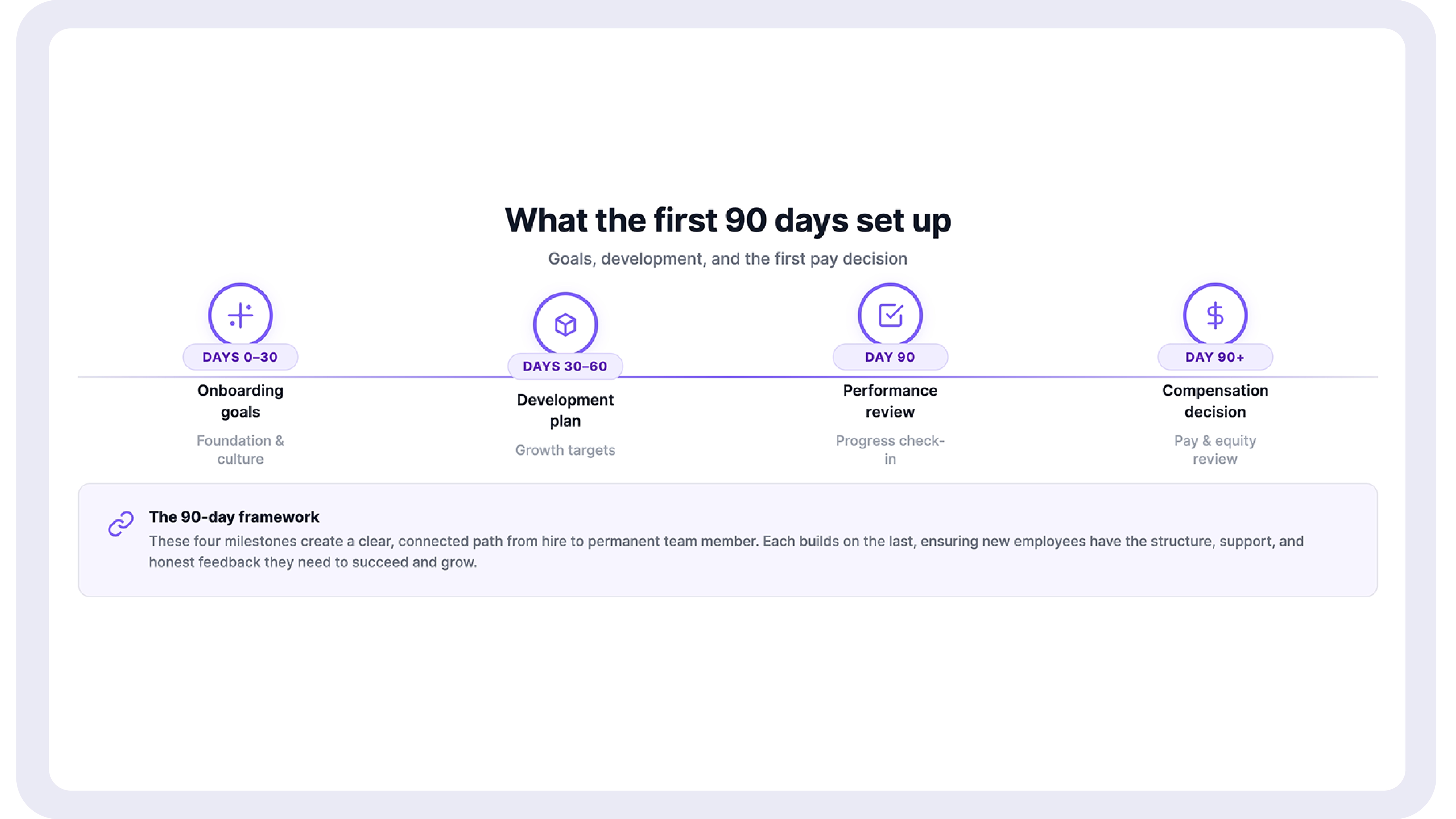
In the first 90 days, employee onboarding software should do more than handle paperwork and portals. It should establish the foundation for everything that follows: clear role expectations and goals the new hire can be measured against, a development plan that connects to learning, and an accurate employee record that the first performance review and the first pay decision will draw on. Strong onboarding sets the baseline for the first performance cycle and ensures that when the first merit or pay review arrives, the manager is working from a documented record of the new hire's goals and progress rather than from memory.
Most advice about employee onboarding software focuses on the first day: the welcome portal, the digital paperwork, the e-signature on the handbook, the equipment checklist. These things matter. A new hire who spends day one chasing forms is not a new hire who feels set up to succeed. But onboarding that ends when the paperwork is done answers only the easiest question.
The harder question is what the first 90 days should set up. A new hire will have a first performance conversation. They will be considered for development, and eventually for a raise. The decisions made in those moments depend on information that either was captured during onboarding or was not. When it was not, managers reconstruct the new hire's early goals from memory, and the first review becomes a guess rather than an assessment.
This guide looks at onboarding through that lens. Not which tool has the nicest portal, but what onboarding needs to set up so the first performance cycle and the first pay decision are grounded in real data. That shift in framing changes what good onboarding software actually looks like.
Why Onboarding Is the Foundation, Not a Standalone Event
The stakes of onboarding are well documented. A large share of new-hire turnover happens in the first weeks, and most employees decide whether they will stay long term within their first few months. Replacing a new hire who leaves early can cost a significant multiple of their salary. These numbers are usually cited to justify a better welcome experience, and they do.
But they point to something deeper. The first 90 days are when an employee forms their understanding of what is expected, how they will be measured, and whether their effort is seen. Those are not onboarding questions. They are performance and pay questions, being answered during onboarding whether or not anyone designed them to be.
This is why onboarding belongs to the wider employee lifecycle rather than sitting off to the side. The way a new hire is set up feeds directly into the first review, the first development plan, and the first compensation decision. When onboarding is treated as a standalone event, those handoffs break, and the cost shows up months later as a vague first review or a pay decision no one can defend.
The Three Things the First 90 Days Should Set Up
Beyond the logistics every onboarding tool handles, three foundations determine whether the first 90 days feed what comes next. These are the things to design for.
1. Clear goals that become the first review's baseline
A new hire should leave their first weeks with documented, specific goals for the ramp period, not a vague sense of what the job involves. These early goals are what the first performance conversation measures against. When onboarding captures them properly, the manager opening the first performance cycle already has a baseline to assess. When it does not, the review starts from nothing, and recency bias fills the gap.
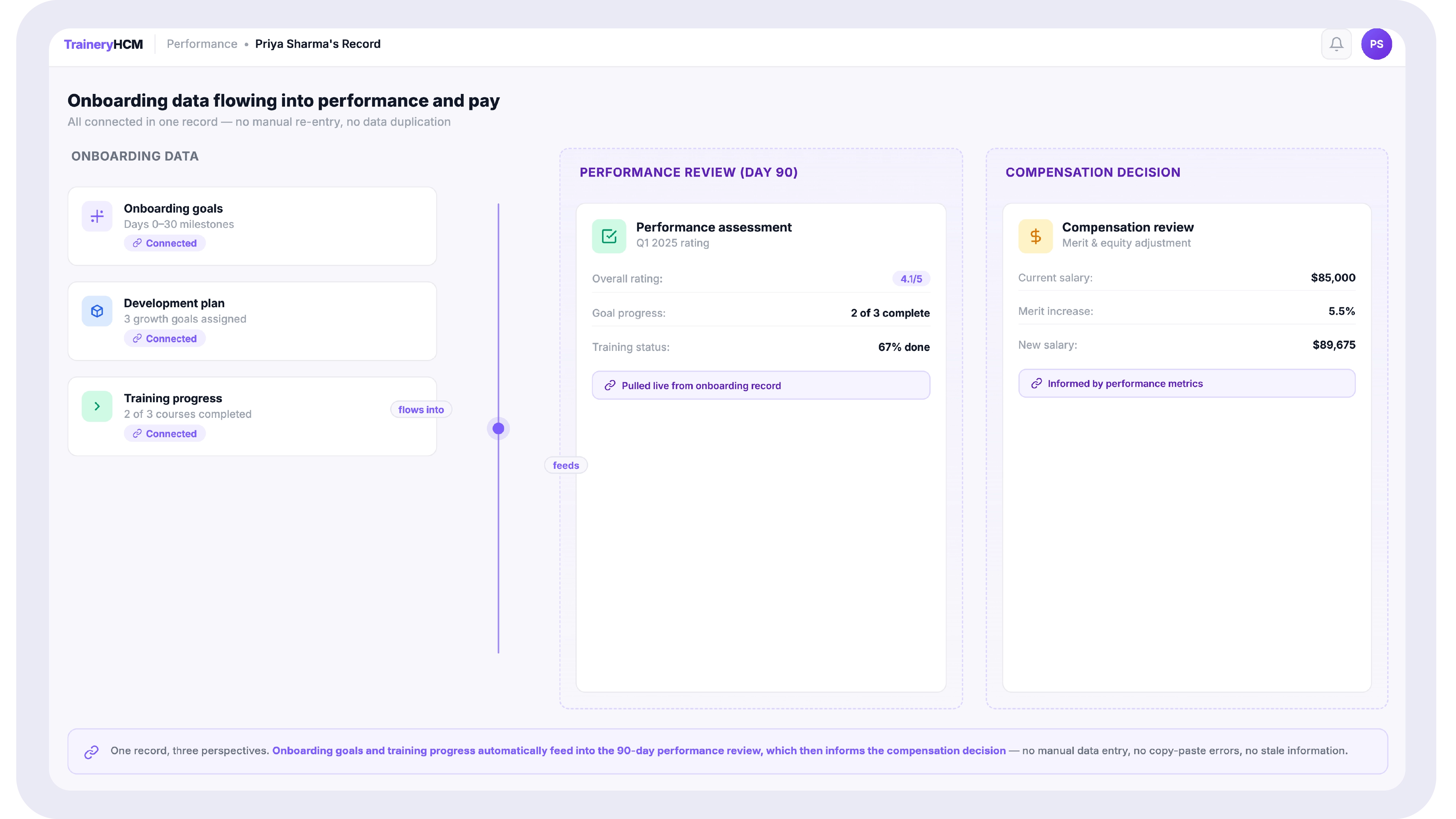
This is the most important handoff in the entire ramp period. The goals set during onboarding should flow directly into the performance system, so the objectives a new hire agreed to in week one are the same objectives their manager reviews at 90 days and beyond.
2. A development plan that connects to actual learning
Onboarding surfaces skill gaps faster than any later stage, because the new hire is encountering the role for the first time. Those early gaps should become a real individual development plan, not a note that gets lost. The plan should connect to specific learning the new hire can start immediately, so development begins during the ramp rather than waiting for an annual cycle that is months away.
A development plan created during onboarding and then forgotten is the most common failure pattern. The plan needs a direct path to learning content, and completion needs to be tracked, so the same gap does not reappear as a surprise in the first formal review.
3. An accurate record that the first pay decision can trust
Every new hire eventually reaches a first compensation decision, whether at an annual merit cycle or an earlier review. That decision should rest on a documented record: the goals set during onboarding, the progress against them, and the calibrated rating from the first review. When onboarding feeds an accurate employee record, the first pay decision is grounded in evidence. When onboarding data lives in a separate system that never connects to compensation, the decision is made from impression, which is exactly how early pay inequities start.

Why Most Onboarding Software Stops Short
Standalone onboarding tools do the visible part of the job well. They automate paperwork, run background checks, deliver a polished portal, and track tasks to completion. The new hire feels welcomed, and HR saves hours. The trouble begins after the welcome ends.
Because most onboarding software is built only for onboarding, the data it captures stays inside onboarding. The goals a new hire set, the early development needs a manager noticed, the role expectations agreed in week one- all of it lives in a tool that the performance system and the compensation system cannot see. When the first review arrives, that information has to be re-entered or, more often, recalled imperfectly.
This is the same disconnect that undermines reviews and pay throughout the talent management strategy, showing up at the very start of the employee's tenure. The fix is not a better onboarding portal. It is onboarding that shares a data foundation with everything downstream, so nothing captured in the first 90 days has to be rebuilt later.
Onboarding That Ends vs. Onboarding That Sets Up
The difference between onboarding as an event and onboarding as a foundation shows up at each handoff.
In a connected HCM suite, the right column is simply how the system works. TraineryHCM treats onboarding as part of the core employee record, so the goals, development needs, and role data captured in the first 90 days are already present when the first performance cycle and the first pay decision arrive. Onboarding is not a separate tool that hands off through an export. It is the first stage of one continuous record.
How to Evaluate Onboarding Software for the First 90 Days
If onboarding should set up performance and pay, then evaluation should test for that, not just for portal polish. These questions surface whether a tool builds a foundation or just a welcome.
- Do onboarding goals carry into the performance system?
- Ask to see a goal set during onboarding appear in the first performance review without re-entry.
- Does a development need become a trackable plan?
- A gap noticed during onboarding should become a development plan connected to learning, not a forgotten note.
- Is the onboarding record shared with compensation?
- The first pay decision should be able to draw on onboarding goals and the first review without a manual export.
- Is onboarding part of one employee record?
- Check whether onboarding data lives in the same system as performance and pay, or in a tool that hands off through integrations.

Onboard for What Comes Next
The first 90 days are not just a welcome. They are the foundation for the new hire's first performance review, first development plan, and first pay decision. Onboarding software that only handles paperwork leaves those foundations to chance, and the cost arrives months later as a review built on memory and a pay decision no one can defend.
Choose onboarding software the way you would choose any stage of the employee lifecycle: by what it hands to the next stage. Ask whether the goals, development needs, and records captured in the first 90 days carry forward into performance and pay, or stop at the edge of the onboarding tool. Onboard for what comes next, and the first review and the first raise become decisions grounded in evidence rather than impressions.
KEY TAKEAWAYS
- Onboarding is not a self-contained event. The first 90 days should set up the new hire's first performance cycle, development plan, and pay decision.
- Most onboarding software stops at paperwork and portals, leaving a gap between hired and evaluated that managers fill from memory months later.
- Goals set in week one should become the baseline a manager reviews at the first cycle, and the record that informs the first merit decision.
- The right question is not which onboarding tool has the best portal, but whether onboarding data carries forward into performance and pay.
What Should Employee Onboarding Software Set Up in the First 90 Days?
In the first 90 days, employee onboarding software should do more than handle paperwork and portals. It should establish the foundation for everything that follows: clear role expectations and goals the new hire can be measured against, a development plan that connects to learning, and an accurate employee record that the first performance review and the first pay decision will draw on. Strong onboarding sets the baseline for the first performance cycle and ensures that when the first merit or pay review arrives, the manager is working from a documented record of the new hire's goals and progress rather than from memory.
Most advice about employee onboarding software focuses on the first day: the welcome portal, the digital paperwork, the e-signature on the handbook, the equipment checklist. These things matter. A new hire who spends day one chasing forms is not a new hire who feels set up to succeed. But onboarding that ends when the paperwork is done answers only the easiest question.
The harder question is what the first 90 days should set up. A new hire will have a first performance conversation. They will be considered for development, and eventually for a raise. The decisions made in those moments depend on information that either was captured during onboarding or was not. When it was not, managers reconstruct the new hire's early goals from memory, and the first review becomes a guess rather than an assessment.
This guide looks at onboarding through that lens. Not which tool has the nicest portal, but what onboarding needs to set up so the first performance cycle and the first pay decision are grounded in real data. That shift in framing changes what good onboarding software actually looks like.
Why Onboarding Is the Foundation, Not a Standalone Event
The stakes of onboarding are well documented. A large share of new-hire turnover happens in the first weeks, and most employees decide whether they will stay long term within their first few months. Replacing a new hire who leaves early can cost a significant multiple of their salary. These numbers are usually cited to justify a better welcome experience, and they do.
But they point to something deeper. The first 90 days are when an employee forms their understanding of what is expected, how they will be measured, and whether their effort is seen. Those are not onboarding questions. They are performance and pay questions, being answered during onboarding whether or not anyone designed them to be.
This is why onboarding belongs to the wider employee lifecycle rather than sitting off to the side. The way a new hire is set up feeds directly into the first review, the first development plan, and the first compensation decision. When onboarding is treated as a standalone event, those handoffs break, and the cost shows up months later as a vague first review or a pay decision no one can defend.
The Three Things the First 90 Days Should Set Up
Beyond the logistics every onboarding tool handles, three foundations determine whether the first 90 days feed what comes next. These are the things to design for.
1. Clear goals that become the first review's baseline
A new hire should leave their first weeks with documented, specific goals for the ramp period, not a vague sense of what the job involves. These early goals are what the first performance conversation measures against. When onboarding captures them properly, the manager opening the first performance cycle already has a baseline to assess. When it does not, the review starts from nothing, and recency bias fills the gap.
This is the most important handoff in the entire ramp period. The goals set during onboarding should flow directly into the performance system, so the objectives a new hire agreed to in week one are the same objectives their manager reviews at 90 days and beyond.
2. A development plan that connects to actual learning
Onboarding surfaces skill gaps faster than any later stage, because the new hire is encountering the role for the first time. Those early gaps should become a real individual development plan, not a note that gets lost. The plan should connect to specific learning the new hire can start immediately, so development begins during the ramp rather than waiting for an annual cycle that is months away.
A development plan created during onboarding and then forgotten is the most common failure pattern. The plan needs a direct path to learning content, and completion needs to be tracked, so the same gap does not reappear as a surprise in the first formal review.
3. An accurate record that the first pay decision can trust
Every new hire eventually reaches a first compensation decision, whether at an annual merit cycle or an earlier review. That decision should rest on a documented record: the goals set during onboarding, the progress against them, and the calibrated rating from the first review. When onboarding feeds an accurate employee record, the first pay decision is grounded in evidence. When onboarding data lives in a separate system that never connects to compensation, the decision is made from impression, which is exactly how early pay inequities start.

Why Most Onboarding Software Stops Short
Standalone onboarding tools do the visible part of the job well. They automate paperwork, run background checks, deliver a polished portal, and track tasks to completion. The new hire feels welcomed, and HR saves hours. The trouble begins after the welcome ends.
Because most onboarding software is built only for onboarding, the data it captures stays inside onboarding. The goals a new hire set, the early development needs a manager noticed, the role expectations agreed in week one- all of it lives in a tool that the performance system and the compensation system cannot see. When the first review arrives, that information has to be re-entered or, more often, recalled imperfectly.
This is the same disconnect that undermines reviews and pay throughout the talent management strategy, showing up at the very start of the employee's tenure. The fix is not a better onboarding portal. It is onboarding that shares a data foundation with everything downstream, so nothing captured in the first 90 days has to be rebuilt later.
Onboarding That Ends vs. Onboarding That Sets Up
The difference between onboarding as an event and onboarding as a foundation shows up at each handoff.
In a connected HCM suite, the right column is simply how the system works. TraineryHCM treats onboarding as part of the core employee record, so the goals, development needs, and role data captured in the first 90 days are already present when the first performance cycle and the first pay decision arrive. Onboarding is not a separate tool that hands off through an export. It is the first stage of one continuous record.
How to Evaluate Onboarding Software for the First 90 Days
If onboarding should set up performance and pay, then evaluation should test for that, not just for portal polish. These questions surface whether a tool builds a foundation or just a welcome.
- Do onboarding goals carry into the performance system?
- Ask to see a goal set during onboarding appear in the first performance review without re-entry.
- Does a development need become a trackable plan?
- A gap noticed during onboarding should become a development plan connected to learning, not a forgotten note.
- Is the onboarding record shared with compensation?
- The first pay decision should be able to draw on onboarding goals and the first review without a manual export.
- Is onboarding part of one employee record?
- Check whether onboarding data lives in the same system as performance and pay, or in a tool that hands off through integrations.

Onboard for What Comes Next
The first 90 days are not just a welcome. They are the foundation for the new hire's first performance review, first development plan, and first pay decision. Onboarding software that only handles paperwork leaves those foundations to chance, and the cost arrives months later as a review built on memory and a pay decision no one can defend.
Choose onboarding software the way you would choose any stage of the employee lifecycle: by what it hands to the next stage. Ask whether the goals, development needs, and records captured in the first 90 days carry forward into performance and pay, or stop at the edge of the onboarding tool. Onboard for what comes next, and the first review and the first raise become decisions grounded in evidence rather than impressions.
Frequently Asked Questions
Is standalone onboarding software or a connected suite better?
It depends on what you need onboarding to accomplish. A standalone onboarding tool can deliver an excellent welcome experience, but its data typically stays inside onboarding, so the goals and development needs captured in the first 90 days have to be re-entered or recalled later. A connected HCM suite keeps onboarding on the same employee record as performance, learning, and compensation, so nothing captured early is lost. If you want the first 90 days to set up the first review and the first pay decision, a connected suite removes the handoffs that otherwise break.
What features should I look for in onboarding software?
Beyond the standard logistics of digital paperwork, portals, background checks, and task tracking, look for features that connect onboarding to what comes next: the ability to set goals during onboarding that flow into the performance system, development planning that links to learning content, and an employee record shared with performance and compensation rather than locked inside the onboarding tool. The deciding question is whether onboarding data carries forward into reviews and pay, or stops when the welcome ends.
How does onboarding affect the first compensation decision?
Every new hire eventually reaches a first pay or merit decision, and the quality of that decision depends on the record behind it. If onboarding captured clear goals and those goals fed into a documented first review with a calibrated rating, the pay decision rests on evidence. If onboarding data lived in a separate tool that never connected to compensation, the decision is made from an impression of a short tenure, which is how early pay inequities begin. Connected onboarding gives the first compensation decision a defensible foundation.
How does onboarding connect to performance management?
Onboarding connects to performance management through the goals and expectations set in the first weeks. When a new hire's onboarding goals are documented in the same system that runs performance reviews, the manager opening the first review already has a baseline to assess, rather than reconstructing it from memory. In a connected platform, the objectives agreed during onboarding become the objectives reviewed at 90 days, which makes the first performance conversation grounded and fair instead of a guess shaped by recency bias.
What should happen in the first 90 days of onboarding?
The first 90 days should cover the logistics of getting set up, but more importantly, they should establish three foundations: clear, documented goals for the ramp period that the first performance review will measure against; a development plan connected to specific learning that addresses early skill gaps; and an accurate employee record that the first pay decision can draw on. A common structure is a 30-60-90 day plan, but the plan only pays off if the goals and progress it captures carry forward into the performance and compensation systems.
What is employee onboarding software?
Employee onboarding software helps organizations bring new hires into the company by automating paperwork, delivering a self-service portal, running background checks and employment verification, and tracking onboarding tasks to completion. The best onboarding software does more than logistics: it captures the goals, role expectations, and development needs established in the first 90 days and carries them forward into performance management and compensation, so onboarding becomes the foundation for the employee's first review and first pay decision rather than a standalone event.