




Table of Contents
What Is a Talent Management Strategy?
A talent management strategy is an organization's plan for how it attracts, develops, rewards, and retains the people it needs to meet its business goals. It connects the stages of the employee lifecycle, including recruiting, onboarding, performance management, learning and development, compensation, and succession, into one coherent system rather than treating them as separate HR programs. A strong strategy starts from business objectives, defines the capabilities the organization needs, and designs each talent stage so its outputs feed the next. The defining quality of an effective talent management strategy is connection: each decision about a person draws on and informs the others.
Most organizations do talent management. Far fewer have a talent management strategy. The difference is not effort or budget. It is whether the individual activities- hiring, reviews, training, pay, succession- are designed to work together, or whether they simply run in parallel and rarely speak to each other.
The symptoms of a missing strategy are familiar. A development plan is written in a performance review and then forgotten because no learning follows it. A high performer leaves because their pay never reflected the rating they earned. A critical role opens, and there is no one ready, because succession was a spreadsheet built once and never updated. None of these are failures of a single program. They are failures of connection between programs.
This guide walks through how to build a talent management strategy that connects, step by step. It is not about which tools to buy. It is about the plan those tools are meant to serve, and the design choices that determine whether your talent programs reinforce each other or quietly work against one another. If you are still defining the basics, our guide to what talent management is covers the foundations.
Why a Connected Strategy Beats a Collection of Programs
It is possible to run excellent individual talent programs and still get poor results. A best-in-class review process produces ratings that go nowhere. A strong learning catalog sits unused because nothing points employees to the right course at the right moment. Each program is well executed, yet the organization sees little improvement in retention, capability, or internal mobility.
The reason is that talent decisions are interdependent. A performance rating should inform a pay decision and a development plan. A development plan should connect to specific learning. Completed learning should update succession readiness. When these links are missing, every program starts from a blank page, and the effort spent in one stage does not compound into the next.
A talent management strategy is the design that creates those links deliberately. It treats the employee lifecycle as a single connected flow rather than a set of disconnected events, and it makes each stage responsible for producing something the next stage can use.
A Talent Management Framework: The Five Connected Stages
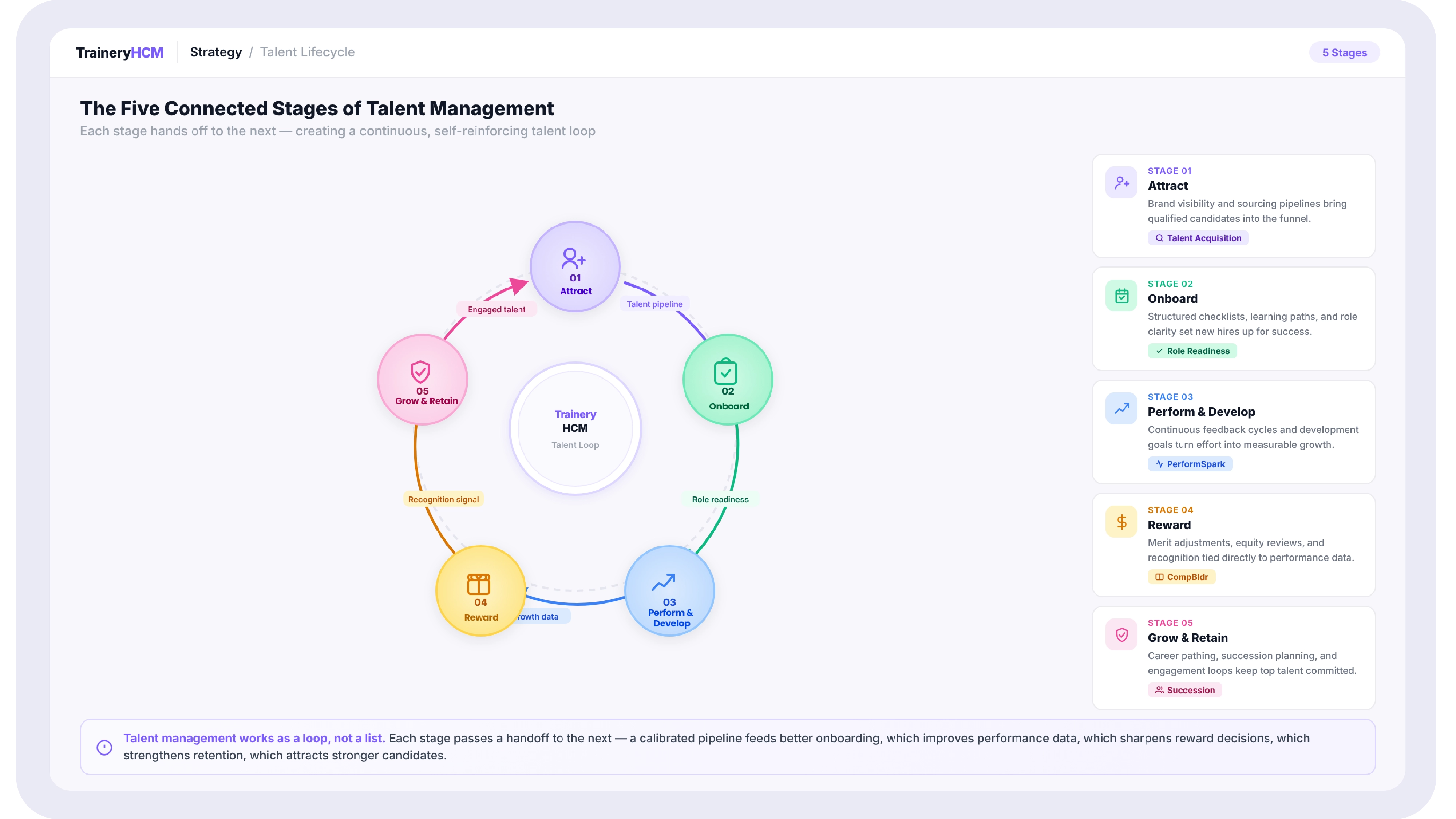
A useful talent management framework organizes the employee lifecycle into five stages. The stages themselves are familiar. What matters is the connection between them, shown in the handoff each stage owes the next.
Read down the third column, and you see the strategy itself. Each stage exists not only to do its own job, but to hand the next stage something it needs. When those handoffs are clean, the lifecycle compounds. When they break, the strategy becomes a list of activities again.
How to Build Your Talent Management Strategy: 6 Steps
Step 1: Start from business goals, not HR activities
A talent strategy exists to serve the business, so begin there. What is the organization trying to achieve in the next one to three years, and what capabilities and roles will that require? A company entering a new market needs different talent than one defending a mature one. Write down the business goals first, because every later decision should trace back to them.
Step 2: Identify the capabilities and roles you need
Translate the business goals into specific workforce requirements. Which skills are critical, which roles are hardest to fill, and where are the gaps between the workforce you have and the one the strategy demands? This capability map becomes the target that hiring, development, and succession all aim at.
Step 3: Map the employee lifecycle and its handoffs
Lay out the five stages for your organization and, for each one, define the handoff it owes the next. Be specific. What exactly should a manager have at the end of a review cycle that compensation planning needs? What should an onboarding process deliver that the first performance cycle depends on? This is where most strategies are won or lost.
Step 4: Design the connections, not just the stages
With handoffs defined, design how each one actually happens. How does a calibrated rating reach a merit decision? How does a development goal become an assigned course? If the answer to any connection is a manual export or a step that depends on someone remembering, that link will break under load. The connections deserve as much design attention as the stages themselves.
Step 5: Define the metrics that prove it is working
Decide how you will know the strategy is succeeding. Useful measures include voluntary retention of high performers, internal mobility rate, development plan completion, time to fill critical roles, and the alignment between performance ratings and pay outcomes. Choose a small set tied directly to the business goals from Step 1.
Step 6: Establish a single source of truth for talent data
A connected strategy needs connected data. If performance lives in one system, learning in another, and pay in a third, the handoffs you designed in Step 4 will be undermined by reconciliation work and stale information. Decide early where your talent data will live and how the stages will share it, because the strategy is only as connected as the data beneath it.

Common Talent Management Strategy Mistakes
- Designing stages in isolation. Each program is built by a different team to its own standard, and no one owns the handoffs between them.
- Starting from tools instead of goals. Buying software before defining the strategy means the tools shape the plan rather than serving it.
- Treating development as aspirational. Development plans that do not connect to specific learning become wish lists that reappear every review.
- Letting data fragment. When talent data lives in separate systems, even a well-designed strategy degrades into manual reconciliation.
From Strategy to Execution
A strategy on paper changes nothing until it runs in daily practice. Execution is where the connections you designed either hold or break, and it is where the choice of platform starts to matter, because the platform is what carries data from one stage to the next.
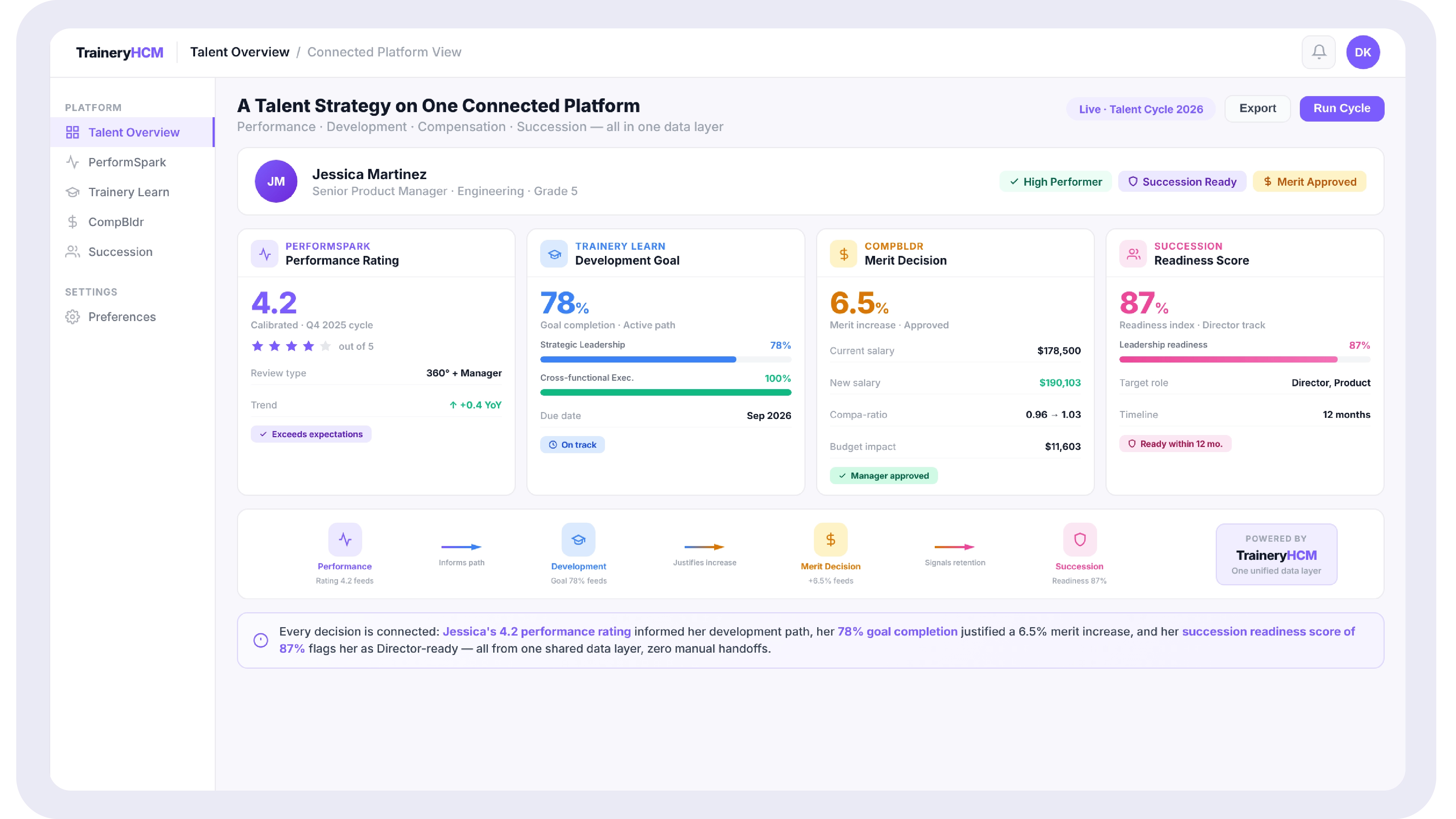
This is the point where a connected HCM suite earns its place. When performance, learning, compensation, and core HR share one data model, the handoffs in your strategy happen automatically: a calibrated rating is present when the merit cycle opens, a development goal links to a course, and completed learning updates succession readiness.
TraineryHCM is built for exactly this: executing a connected talent strategy without the manual handoffs that break strategies in practice. It is not the strategy itself, but it is the system that lets a connected strategy actually run as designed. If your next step is comparing platforms, our guide to the best talent management software walks through the evaluation criteria that matter.

Building a Strategy That Compounds
A talent management strategy is not a longer list of HR programs. It is the design that makes those programs work together, so the effort spent in one stage compounds into the next instead of starting over each time.
Begin from business goals, translate them into the capabilities you need, map the employee lifecycle, and then give your full attention to the handoffs between stages, because that is where strategies succeed or fail. Define the metrics that prove it is working, and put your talent data in one place so the connections you designed survive contact with daily operations. Do that, and talent management stops being a set of parallel activities and becomes a system that builds on itself, which is the entire point of having a strategy at all.
KEY TAKEAWAYS
- A talent management strategy is the plan that connects how you attract, develop, reward, and retain people into one coherent system rather than separate HR activities.
- Most strategies fail not because the pillars are wrong, but because the pillars are disconnected, so performance, learning, and pay never inform each other.
- Start from business goals, map the employee lifecycle, then design each stage so its output feeds the next stage's input.
- A strategy is only as strong as the data connecting its parts. Define your metrics and your single source of truth before you scale.
What Is a Talent Management Strategy?
A talent management strategy is an organization's plan for how it attracts, develops, rewards, and retains the people it needs to meet its business goals. It connects the stages of the employee lifecycle, including recruiting, onboarding, performance management, learning and development, compensation, and succession, into one coherent system rather than treating them as separate HR programs. A strong strategy starts from business objectives, defines the capabilities the organization needs, and designs each talent stage so its outputs feed the next. The defining quality of an effective talent management strategy is connection: each decision about a person draws on and informs the others.
Most organizations do talent management. Far fewer have a talent management strategy. The difference is not effort or budget. It is whether the individual activities- hiring, reviews, training, pay, succession- are designed to work together, or whether they simply run in parallel and rarely speak to each other.
The symptoms of a missing strategy are familiar. A development plan is written in a performance review and then forgotten because no learning follows it. A high performer leaves because their pay never reflected the rating they earned. A critical role opens, and there is no one ready, because succession was a spreadsheet built once and never updated. None of these are failures of a single program. They are failures of connection between programs.
This guide walks through how to build a talent management strategy that connects, step by step. It is not about which tools to buy. It is about the plan those tools are meant to serve, and the design choices that determine whether your talent programs reinforce each other or quietly work against one another. If you are still defining the basics, our guide to what talent management is covers the foundations.
Why a Connected Strategy Beats a Collection of Programs
It is possible to run excellent individual talent programs and still get poor results. A best-in-class review process produces ratings that go nowhere. A strong learning catalog sits unused because nothing points employees to the right course at the right moment. Each program is well executed, yet the organization sees little improvement in retention, capability, or internal mobility.
The reason is that talent decisions are interdependent. A performance rating should inform a pay decision and a development plan. A development plan should connect to specific learning. Completed learning should update succession readiness. When these links are missing, every program starts from a blank page, and the effort spent in one stage does not compound into the next.
A talent management strategy is the design that creates those links deliberately. It treats the employee lifecycle as a single connected flow rather than a set of disconnected events, and it makes each stage responsible for producing something the next stage can use.
A Talent Management Framework: The Five Connected Stages
A useful talent management framework organizes the employee lifecycle into five stages. The stages themselves are familiar. What matters is the connection between them, shown in the handoff each stage owes the next.
Read down the third column, and you see the strategy itself. Each stage exists not only to do its own job, but to hand the next stage something it needs. When those handoffs are clean, the lifecycle compounds. When they break, the strategy becomes a list of activities again.
How to Build Your Talent Management Strategy: 6 Steps
Step 1: Start from business goals, not HR activities
A talent strategy exists to serve the business, so begin there. What is the organization trying to achieve in the next one to three years, and what capabilities and roles will that require? A company entering a new market needs different talent than one defending a mature one. Write down the business goals first, because every later decision should trace back to them.
Step 2: Identify the capabilities and roles you need
Translate the business goals into specific workforce requirements. Which skills are critical, which roles are hardest to fill, and where are the gaps between the workforce you have and the one the strategy demands? This capability map becomes the target that hiring, development, and succession all aim at.
Step 3: Map the employee lifecycle and its handoffs
Lay out the five stages for your organization and, for each one, define the handoff it owes the next. Be specific. What exactly should a manager have at the end of a review cycle that compensation planning needs? What should an onboarding process deliver that the first performance cycle depends on? This is where most strategies are won or lost.
Step 4: Design the connections, not just the stages
With handoffs defined, design how each one actually happens. How does a calibrated rating reach a merit decision? How does a development goal become an assigned course? If the answer to any connection is a manual export or a step that depends on someone remembering, that link will break under load. The connections deserve as much design attention as the stages themselves.
Step 5: Define the metrics that prove it is working
Decide how you will know the strategy is succeeding. Useful measures include voluntary retention of high performers, internal mobility rate, development plan completion, time to fill critical roles, and the alignment between performance ratings and pay outcomes. Choose a small set tied directly to the business goals from Step 1.
Step 6: Establish a single source of truth for talent data
A connected strategy needs connected data. If performance lives in one system, learning in another, and pay in a third, the handoffs you designed in Step 4 will be undermined by reconciliation work and stale information. Decide early where your talent data will live and how the stages will share it, because the strategy is only as connected as the data beneath it.

Common Talent Management Strategy Mistakes
- Designing stages in isolation. Each program is built by a different team to its own standard, and no one owns the handoffs between them.
- Starting from tools instead of goals. Buying software before defining the strategy means the tools shape the plan rather than serving it.
- Treating development as aspirational. Development plans that do not connect to specific learning become wish lists that reappear every review.
- Letting data fragment. When talent data lives in separate systems, even a well-designed strategy degrades into manual reconciliation.
From Strategy to Execution
A strategy on paper changes nothing until it runs in daily practice. Execution is where the connections you designed either hold or break, and it is where the choice of platform starts to matter, because the platform is what carries data from one stage to the next.
This is the point where a connected HCM suite earns its place. When performance, learning, compensation, and core HR share one data model, the handoffs in your strategy happen automatically: a calibrated rating is present when the merit cycle opens, a development goal links to a course, and completed learning updates succession readiness.
TraineryHCM is built for exactly this: executing a connected talent strategy without the manual handoffs that break strategies in practice. It is not the strategy itself, but it is the system that lets a connected strategy actually run as designed. If your next step is comparing platforms, our guide to the best talent management software walks through the evaluation criteria that matter.

Building a Strategy That Compounds
A talent management strategy is not a longer list of HR programs. It is the design that makes those programs work together, so the effort spent in one stage compounds into the next instead of starting over each time.
Begin from business goals, translate them into the capabilities you need, map the employee lifecycle, and then give your full attention to the handoffs between stages, because that is where strategies succeed or fail. Define the metrics that prove it is working, and put your talent data in one place so the connections you designed survive contact with daily operations. Do that, and talent management stops being a set of parallel activities and becomes a system that builds on itself, which is the entire point of having a strategy at all.
Frequently Asked Questions
How does technology support a talent management strategy?
Technology is what carries data between the stages of the strategy. A connected platform, where performance, learning, compensation, and core HR share one data model, makes the handoffs automatic: a calibrated rating is available when pay planning opens, a development goal links to a course, and completed learning updates succession readiness. Technology does not replace the strategy, but it determines whether the connections you designed run automatically or depend on manual work that breaks at scale.
Why do talent management strategies fail?
Most fail at the connections rather than the components. Individual programs, reviews, learning, and compensation are often run well, but they operate in isolation, so a performance rating never reaches a pay decision and a development goal never connects to a course. The effort in each program does not compound into the next. The second common cause is fragmented data: when talent information lives in separate systems, even a well-designed strategy degrades into manual reconciliation and stale information.
What is the difference between a talent management strategy and a talent management framework?
A talent management framework is the structure, typically the stages of the employee lifecycle and how they relate. A talent management strategy applies that framework to a specific organization's goals, deciding which capabilities to prioritize, how the stages should connect, and how success will be measured. The framework is the general model; the strategy is the organization-specific plan built on top of it. You use a framework to build a strategy.
How do you build a talent management strategy?
Start from business goals and the capabilities they require, then map the employee lifecycle and define the handoff each stage owes the next. Design how those handoffs actually happen, since a connection that depends on manual work will break. Define a small set of metrics tied to the business goals, and establish a single source of truth for talent data so the connections survive in practice. The sequence matters: goals first, then capabilities, then lifecycle, then connections, then measurement.
What are the key components of a talent management strategy?
The core components map to the employee lifecycle: attracting and hiring talent, onboarding and goal alignment, performance management and development, compensation and rewards, and learning, succession, and retention. A strategy adds two things on top of these components: a clear link from each component to the business goals it serves, and deliberate connections between components so that, for example, performance ratings inform pay and development plans connect to learning. The components are common; the connections are what make it a strategy.
What is a talent management strategy?
A talent management strategy is an organization's plan for attracting, developing, rewarding, and retaining the people it needs to achieve its business goals. It connects the stages of the employee lifecycle, from hiring through performance, development, compensation, and succession, into one coherent system rather than running them as separate programs. The defining feature of a strong strategy is that each stage produces something the next stage uses, so talent decisions build on each other instead of starting from scratch.