

.svg)





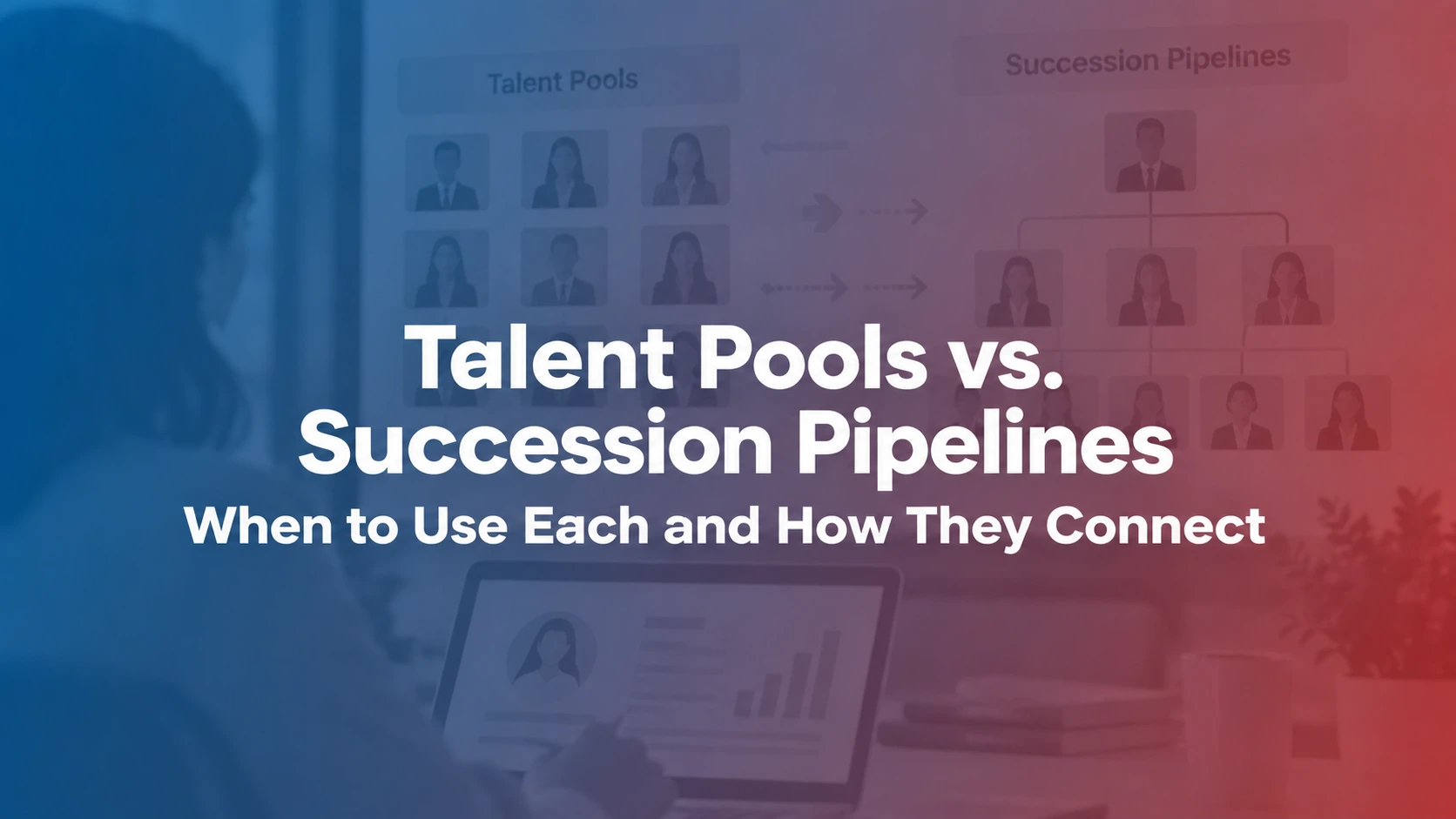

Table of Contents
Quick Takeaways
- Talent pools are broader development populations; succession pipelines are tied more directly to specific critical roles or role sets.
- A talent pool should have a defined purpose, entry criteria, review cadence, and exit rules.
- Move employees into a succession pipeline only when target-role requirements, interest, and readiness can be assessed credibly.
- Career paths and skills can strengthen both workflows without creating a promotion promise.
- Review membership and readiness regularly so pools and pipelines do not become stale lists.
Talent pools and succession pipelines are related, but they solve different talent-management problems. A talent pool keeps a broader group of employees visible for a future capability, role family, leadership need, or development purpose. A succession pipeline is narrower and connects credible successor options to a specific critical role or defined set of roles.
TraineryHCM Talent Pools and Bench Strength supports the broader pool view, while Succession Planning focuses on critical roles and successor readiness. Both connect naturally with Talent Review, Skills Management, Career Pathing, and Reporting and Analytics.
The distinction matters because a broad development population should not automatically become a succession slate. CIPD notes that succession planning can include internal talent pools while remaining focused on future leadership and business-critical roles. The U.S. Office of Personnel Management similarly frames succession management around identifying, assessing, and developing talent for continuity rather than simply maintaining replacement names. See the CIPD succession planning factsheet and OPM succession planning guidance.
Talent Pool vs. Succession Pipeline at a Glance
| Dimension | Talent pool | Succession pipeline |
|---|---|---|
| Primary purpose | Maintain visibility into employees relevant to future needs | Protect continuity and readiness for specific critical roles |
| Scope | Role family, capability, leadership population, location, or strategic need | Specific role or tightly defined role set |
| Readiness precision | May be broad or developmental | Should be tied to target-role requirements and a time horizon |
| Employee expectation | Development relevance, not a promised role | Possible succession consideration, not a guaranteed appointment |
| Main risk | Becoming an ungoverned list with no clear purpose | Becoming a static replacement chart with stale assumptions |
What Is a Talent Pool?
A talent pool is a defined group of employees connected by a future talent need. Examples include emerging leaders, future plant managers, cybersecurity specialists, sales leadership, multilingual customer-support talent, or employees developing toward a particular role family.
A pool should not mean “employees we like.” Define why the pool exists, how employees enter and leave, what evidence is used, what development is available, and how often membership is reviewed. A broader Talent Management strategy helps keep those rules connected to business priorities instead of allowing each function to create a different definition of talent.
What Is a Succession Pipeline?
A succession pipeline connects potential successors with a critical role or role set. It asks more precise questions: does the employee want the path, how closely do current capabilities match the target role, what experience is still missing, and what is the likely readiness horizon?
That is why succession needs role clarity. A person can look strong in a general talent pool while still being several steps away from a specific future role. Use a critical-role assessment to identify where this deeper planning is necessary and a succession planning metrics framework to track coverage, readiness, and pipeline risk after the role is in scope.
How Talent Pools Feed Succession Pipelines
- Define the pool purpose. State the role family, capability, leadership population, or workforce need.
- Set entry criteria. Use relevant evidence instead of informal nomination alone. A structured potential assessment can help leaders explain why someone belongs in a future-talent population.
- Develop and observe. Give employees opportunities to build capability and create new evidence.
- Identify a target role. When a critical role comes into focus, compare interested employees with its specific requirements.
- Assess readiness. Evaluate role-relevant skills, experience, future scope, and remaining gaps.
- Create a succession slate. Move credible options into the role-specific pipeline while keeping the broader pool active for other future needs.
This progression prevents the organization from confusing broad potential with target-role readiness. It also keeps the process separate from simple emergency backup planning. The succession planning versus replacement planning guide explains that boundary in more detail.
When a Talent Pool Is Better Than Naming Successors
Use a pool when the organization knows it needs more capability but cannot yet identify a single target role for every employee. This can happen during rapid growth, early leadership development, future-skill building, expansion into a new location, or when employees have several plausible career routes.
A pool also reduces pressure to declare winners too early. Employees can receive development and visibility without turning every development decision into a succession promise. Where future demand is still uncertain, connect the pool to workforce planning so the organization can revisit whether the capability, location, or role family is still strategically important.
When a Succession Pipeline Is Necessary
Move to role-specific succession when the business needs continuity for a critical position, when role requirements are clear enough to assess readiness, or when the lead time to develop a successor is long.
The pipeline should show more than names. Review whether there is credible depth, how readiness is distributed, whether one employee is carrying several roles, and when the evidence was last refreshed. The bench strength analysis framework focuses specifically on those depth and concentration questions.
A Practical Decision Rule: Pool, Pipeline, or Both?
| Situation | Best starting structure | Why |
|---|---|---|
| The organization needs more future leadership capability, but specific roles are not yet known | Talent pool | Development can begin before role-specific readiness can be assessed |
| A business-critical role has a known continuity risk | Succession pipeline | The decision requires specific successor options and readiness evidence |
| A role family needs broad development and several roles also require named coverage | Both | The pool develops future supply while pipelines protect specific critical roles |
| The immediate concern is only temporary backup coverage | Replacement plan first | Emergency continuity is a narrower decision than long-term pipeline development |
Keep Career Paths Separate From Promises
Career paths can show employees realistic role options and requirements. Talent pools can help HR maintain visibility into employees developing toward those options. Neither should imply that a promotion or succession appointment is guaranteed.
This distinction matters for trust. Development should remain valuable even when the exact future role changes. Use internal mobility to create lateral experiences when they build needed scope, and use role-specific readiness evidence before treating a development path as a succession decision.
Use Skills to Improve Pool and Pipeline Quality
Skills can make a broad talent pool more actionable. Instead of using a vague label such as “future leaders,” define the capabilities that matter for the relevant future scope. A maintained skills inventory can show what capability evidence already exists, while Skills Management can help maintain proficiency context.
Do not use a skill score as an automatic promotion rule. Role readiness also depends on experience, scope, context, employee interest, and judgment.
Govern Membership and Review Cadence
| Governance question | Talent pool | Succession pipeline |
|---|---|---|
| Why is this employee included? | Evidence matches the pool's defined purpose | Evidence supports consideration for the target role |
| What should be reviewed? | Development progress, interest, capability, continued relevance | Readiness, target-role gaps, career interest, coverage risk |
| When should membership change? | Purpose or evidence changes | Role, candidate readiness, interest, or business need changes |
Use Talent Review when leaders need to compare evidence across managers and functions. A structured talent review meeting can help challenge inconsistent standards and convert discussion into documented actions. Do not allow a pool or pipeline to remain unchanged simply because no one scheduled a review.
Measure Whether the Pool and Pipeline Are Working
Do not judge success only by how many employees appear in the system. Review whether the pool still matches future needs, whether credible employees are moving into role-specific pipelines when appropriate, whether readiness is improving, and whether stale memberships are being removed.
- Pool relevance: percentage of members who still match the pool's defined purpose and remain interested in related development.
- Pipeline conversion: how often pool members become credible candidates for defined critical roles. Treat this as an internal trend, not a universal benchmark.
- Readiness distribution: the mix of ready-now, near-term, and longer-term successor options for roles in scope.
- Stale-record rate: memberships or readiness records that have not been reviewed within the organization's required cadence.
- Movement and development: whether employees receive meaningful development, lateral exposure, or role movement instead of remaining on static lists.
Use Reporting and Analytics to review those patterns alongside current role and talent data. The goal is not to force a numeric target. It is to make weak or stale pipelines visible enough for leaders to act.
Connect broad talent visibility with role-specific succession
TraineryHCM helps HR connect talent pools, bench strength, successor readiness, skills, career context, and reporting without treating every employee as a named replacement.
Explore Talent Pools and Bench StrengthCommon Mistakes
- Creating a pool with no defined purpose: membership becomes political or arbitrary.
- Moving every pool member into succession: broad development evidence is mistaken for target-role readiness.
- Keeping employees in a pool indefinitely: stale membership weakens trust and data quality.
- Ignoring employee interest: leaders build pipelines for paths employees do not want.
- Using pools as secret promotion lists: development becomes confused with guaranteed movement.
- Tracking names without development: the organization records future talent but does not create the experiences needed to improve readiness.
Final Takeaway
Talent pools create broad visibility into future capability. Succession pipelines create focused visibility into critical-role readiness. Use pools to develop and observe talent earlier, then move to role-specific succession when the business need and evidence are clear enough. Keep both connected to current role requirements, employee interest, development activity, and regular review.
Turn Talent Visibility Into a More Actionable Succession Process
See how TraineryHCM connects talent pools, critical roles, readiness, skills, career paths, and reporting so HR can move from broad development populations to role-specific succession decisions with clearer evidence.
Book a Demo

.svg)

.svg)
.svg)

