

.svg)





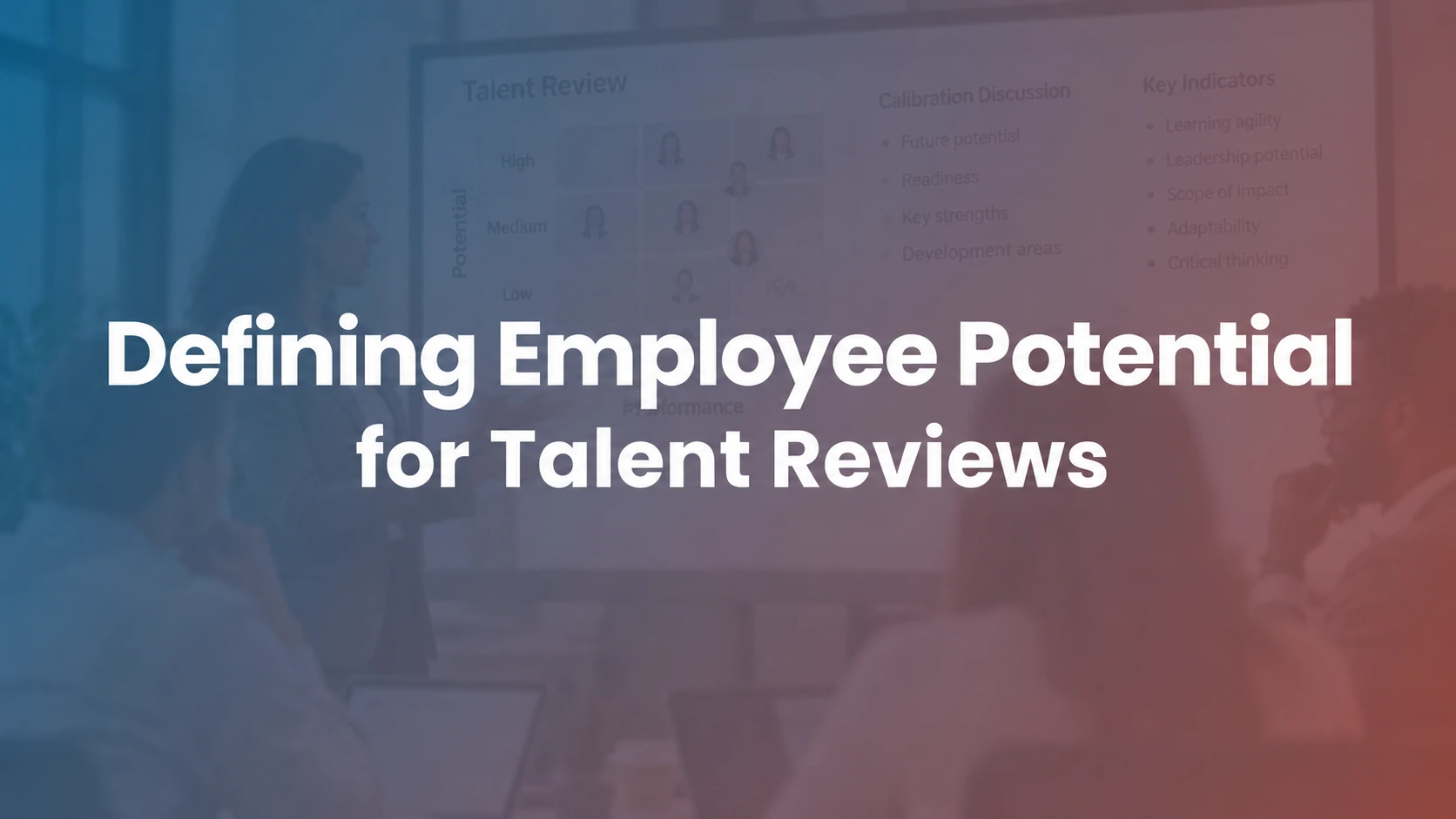

Table of Contents
Quick Takeaways
- Define potential relative to a future role or scope and a time horizon, not as a permanent trait.
- Separate current performance, future potential, and target-role readiness because each answers a different question.
- Use observable evidence such as capability growth, complexity handled, learning agility, employee-stated aspiration, and role-specific requirements.
- Apply job-related criteria consistently and do not use protected characteristics, personal-life assumptions, or visibility as proxies for potential.
- Use calibration, counter-evidence, and a documented next development test so assessments can be challenged and updated.
- Turn potential assessments into development actions and revisit them when evidence, employee interests, or business needs change.
Employee potential is most useful when it answers a specific future-focused question: could this person succeed in a defined broader role or scope, within a meaningful time horizon, if the right experience and development are available? Potential becomes unreliable when it turns into a vague label such as “leadership material.”
In TraineryHCM, the right home for a structured future-talent discussion is Talent Review, with connections to Succession Planning, Career Path, Skills Management, and Talent Pools and Bench Strength where the evidence supports those actions.
This article focuses on defining employee potential and standardizing the evidence used in a talent review. It is not a nomination guide for creating a high-potential employee list. Keeping those intents separate reduces the risk of turning a definition framework into a selection shortcut.
Potential Is Not a Personality Trait
A potential assessment should be relative to a future need. Ask “potential for what role or scope, and over what period?” before asking whether an employee is high potential. A person may have strong potential for a deeper specialist path but not want people management. Another employee may be ready for broader leadership scope but need more exposure to a specific business area.
The Center for Creative Leadership frames the question as “potential for what?” and cautions against treating high potential as a generic label. Its high-potential development guidance reinforces the need to define what is being assessed and why.
The CIPD’s talent management factsheet also notes that organizations vary between selective high-potential approaches and broader inclusive talent models. That makes transparent definitions and consistent evidence standards especially important.
Separate Performance, Potential, and Readiness
| Concept | Primary question | Typical evidence |
|---|---|---|
| Performance | How effectively is the employee delivering in the current role? | Goals, outcomes, behaviors, feedback, sustained contribution |
| Potential | Could the employee grow into a defined broader or different scope? | Capability growth, complexity handled, learning agility, aspiration, relevant experience |
| Readiness | How close is the employee to the requirements of a specific target role? | Role requirements, skills, experience, evidence of next-scope work, remaining gaps |
These dimensions can be related without being interchangeable. A high performer may need substantial development for a different role. An employee with strong future potential may still be early in current-role mastery. A ready-now successor should meet more specific target-role evidence than a general high-potential label requires. Use employee performance metrics for current-role outcomes, and use succession planning metrics when the discussion concerns future-role coverage or readiness. Keep broader future potential separate from immediate promotion eligibility.
A practical evidence test
For every proposed potential assessment, record the future scope, time horizon, two or three supporting examples, one meaningful gap or uncertainty, and the employee's stated career interest. This creates an auditable explanation that can be challenged during calibration rather than relying on a manager's overall impression.
Build the Assessment Around Observable Evidence
1. Capability growth
Look for evidence that the employee has expanded capability over time. Examples include taking on more complex work, improving judgment, learning a new domain, or becoming effective in unfamiliar situations.
2. Complexity handled
Future scope often increases ambiguity, stakeholder range, decision impact, or technical complexity. Evaluate whether the employee has already demonstrated some of the complexity relevant to the target role.
3. Learning agility
Learning agility is not simply speed. Look at how the person responds to feedback, applies lessons, adapts after a setback, and transfers learning into new situations.
4. Career aspiration and mobility
Do not assume that ability equals interest. A future-role discussion should use the employee’s stated interests and willingness for genuine job requirements such as leadership scope, travel, or location. Do not infer ambition, availability, or mobility from personal circumstances. Where accommodations may be relevant, assess the job-related outcome rather than assumptions about how the work must be performed.
5. Role-specific requirements
Potential becomes more reliable when the organization defines the future role. Use skills and proficiency requirements, role scope, decision responsibilities, experience needs, and other relevant criteria to anchor the discussion. A reliable skills inventory and clear skills and proficiency definitions can make capability evidence more consistent without turning skills into an automatic promotion rule.
Use an evidence record, not a hidden score
A structured record makes the reasoning easier to review without pretending potential can be reduced to one universal number. Capture the same evidence categories for each person being discussed in the same talent-review scope.
| Evidence field | What to record | Why it matters |
|---|---|---|
| Future scope | The role, level, specialist path, or complexity band being considered | Prevents “high potential” from becoming a context-free label |
| Supporting evidence | Two or three observable examples relevant to that future scope | Makes the assessment reviewable across managers |
| Gap or uncertainty | A missing experience, untested capability, or conflicting signal | Reduces one-sided narratives and false certainty |
| Employee-stated interest | What type of future work the employee has actually expressed interest in | Separates aspiration from manager assumptions |
| Next development test | A stretch assignment, mentoring goal, exposure, or skill target that can generate new evidence | Turns the review into development rather than labeling |
Weak Proxies vs. Stronger Evidence
| Weak proxy | Stronger question |
|---|---|
| “Looks like a leader” | Which future-role behaviors has the employee demonstrated, in what context, and with what result? |
| “Very visible” | Has the employee handled complexity or impact that is relevant to the target role, regardless of visibility? |
| “Always says yes” | Can the employee prioritize, make tradeoffs, and exercise judgment under pressure? |
| “Has been here a long time” | What relevant experience and capability has been demonstrated for the future scope? |
| “Reminds me of a successful leader” | Which documented criteria does the employee meet, and which gaps remain? |
Example: turn an opinion into reviewable evidence
Instead of recording “this employee looks like a future leader,” document the future scope and the evidence. For example: “For a future cross-functional project-lead role, the employee has independently coordinated work across three teams and resolved competing priorities. Budget ownership is still untested, and the employee has expressed interest in broader project leadership. The next development test is a time-bound cross-functional assignment with defined outcomes.” The point is not to guarantee a promotion; it is to make the reasoning specific enough to challenge and update.
A Structured Potential Assessment Process
Step 1: Define the future scope
Write down the role, role family, leadership level, or complexity band that the assessment concerns. If the organization cannot describe the future scope, it cannot assess potential for that scope consistently.
Step 2: Define evidence criteria
Choose a small set of criteria that reflect the future need. Avoid twenty-item checklists that create false precision. The criteria should be understandable enough that two managers can apply them to similar evidence.
Step 3: Gather examples and counter-examples
Require managers to provide examples that support the proposed assessment and at least one limitation, uncertainty, or gap. This reduces the tendency to build a one-sided narrative around a favored employee.
Step 4: Calibrate across leaders
Use a structured talent review to compare evidence and challenge standards. The facilitator should ask whether the same behavior is being interpreted differently based on manager, function, location, or employee visibility. The talent review meeting guide provides a practical agenda for turning those discussions into documented decisions and follow-up actions.
Step 5: Convert the assessment into development
If the assessment identifies plausible future potential, define the experience needed to test and develop it. That may include a stretch project, mentoring, cross-functional exposure, a skill target, or a career-path action. Use career-path design principles to connect development to realistic role options and internal mobility when lateral experience can build missing scope. Potential without development quickly becomes a label with no operational value.
Document the decision and the next test
A calibrated assessment should end with an action: maintain current scope, test a capability through an assignment, close a defined gap, explore another career direction, or evaluate readiness for a target role. Where the future need is business-critical, connect the decision to critical-role assessment and the relevant succession pipeline.
Governance Guardrails for Fairer Potential Assessments
Because potential assessments can influence development, succession, mobility, and promotion discussions, the process needs explicit governance. Use the assessment as decision-support evidence, not as an automatic employment decision.
- Keep criteria job-related. Define the future scope before reviewing names and use evidence connected to that scope.
- Do not use protected characteristics or personal-life assumptions as proxies. Potential should not be inferred from age, disability, family circumstances, ethnicity, religion, sex, or other protected characteristics under applicable law.
- Use employee-stated aspirations. Do not assume willingness to relocate, travel, manage people, or take a different path.
- Watch opportunity effects. Visibility and access to stretch assignments can affect what evidence exists, so distinguish capability from unequal access to high-profile work.
- Keep human review and an explanation trail. Do not let a score, model, or software field make a promotion, succession, or termination decision automatically.
- Review patterns over time. Use Reporting and Analytics to look for inconsistent standards or follow-through patterns and investigate the process rather than assuming a group-level difference reflects capability.
Bias Controls That Improve the Discussion
- Define criteria before reviewing names.
- Require observable examples rather than adjectives.
- Compare employees in similar role contexts where possible.
- Challenge recency, visibility, similarity, and halo effects.
- Ask what evidence would cause the group to lower or raise the assessment.
- Separate aspiration from assumed ambition.
- Record uncertainty rather than forcing false certainty.
The 9-box grid can support a talent discussion, but it should not replace these evidence rules. A documented talent management strategy also helps leaders apply the same future-capability priorities across functions rather than creating different definitions of potential in each team.
Use calibration to test consistency, not force agreement
Calibration should surface why leaders reached different conclusions. Compare the evidence standard, access to stretch assignments, visibility, role context, and opportunity. Do not force a distribution or raise a rating simply because another function has more employees in a high-potential category.
Potential Should Change When the Evidence Changes
Potential is not a permanent attribute. Employees grow, change direction, take on new experiences, decline opportunities, or become interested in different paths. Business needs also change. Revisit the assessment when the target role, the employee's aspirations, or the evidence changes materially. Use Career Pathing to keep future options visible and Reporting and Analytics to review patterns in assessments, movement, and follow-through.
Make future-talent decisions easier to explain
Use TraineryHCM Talent Review to compare performance, potential, role context, and follow-up actions with a clearer evidence trail.
Explore Talent ReviewFinal Takeaway
A useful potential assessment is specific, evidence-based, future-focused, and revisable. Define the future scope, distinguish potential from current performance and readiness, challenge weak proxies, and turn the result into a development decision rather than a permanent label.
Make Potential Decisions Easier to Defend and Develop
Connect evidence-based talent reviews with succession, career paths, skills, talent pools, and development actions in TraineryHCM.
Book a Demo
.svg)

.svg)
.svg)

