

.svg)





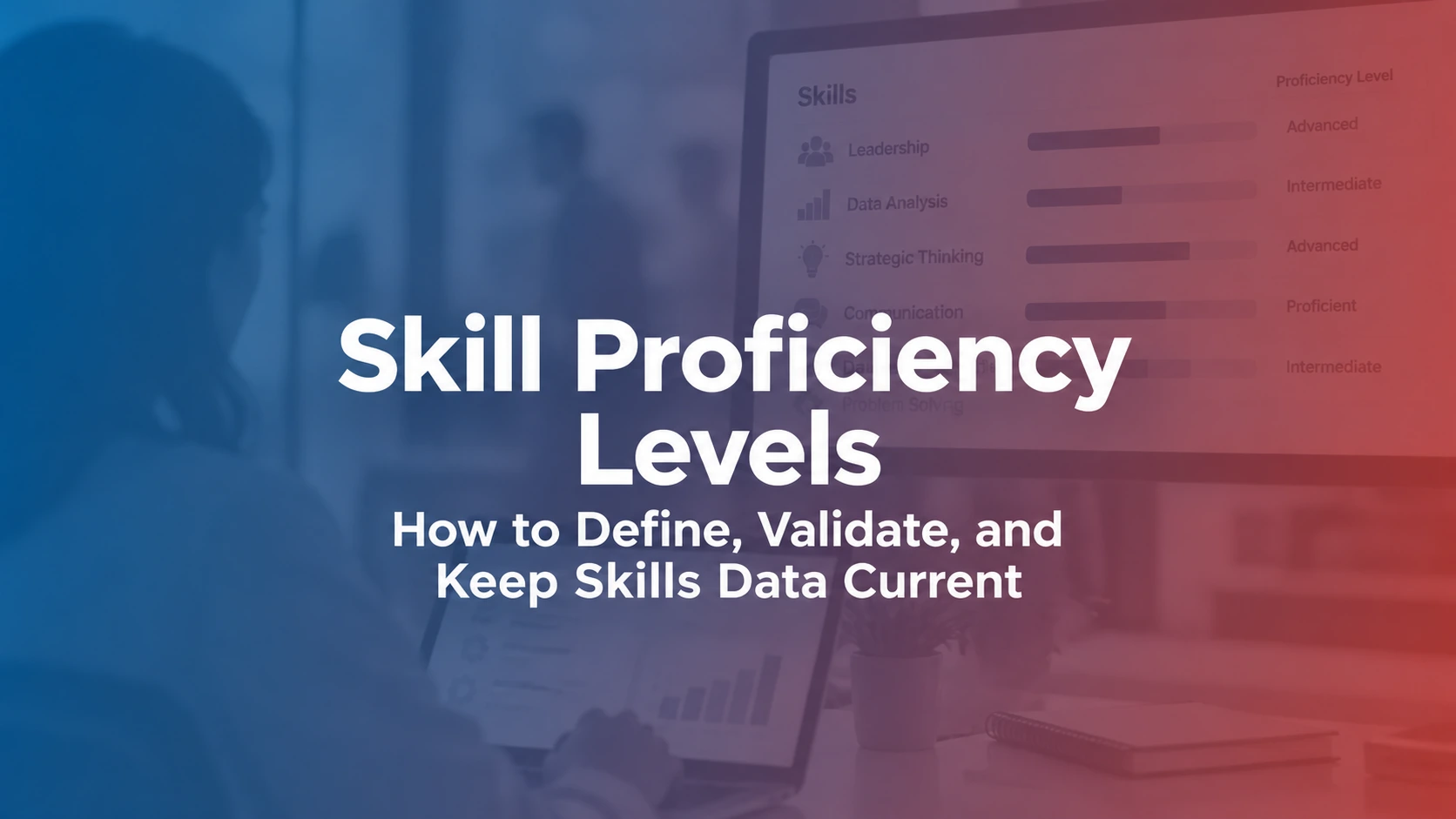

Table of Contents
Quick Takeaways
- Proficiency should describe how a skill is applied, not just whether an employee has it.
- Use observable behavioral differences rather than vague beginner-to-expert labels.
- Choose only as many levels as managers can distinguish consistently.
- Validate important skills with evidence beyond self-assessment and track freshness.
- Use proficiency as one input to career and readiness decisions, not as an automatic promotion formula.
Skill proficiency levels turn a skills list into something more useful. Instead of recording only whether an employee “has” a skill, proficiency describes how independently, consistently, and effectively the person can apply it in real work.
For HR and talent teams, the challenge is not creating more labels. It is defining levels clearly enough that employees, managers, and reviewers can use them consistently. TraineryHCM Skills Management can connect proficiency evidence with career paths, talent reviews, talent pools, and succession planning.
What Skill Proficiency Levels Should Describe
A proficiency level should describe increasing capability, not seniority alone. Useful differences can include independence, complexity, judgment, consistency, range of situations handled, and the ability to guide others.
| Example level | Illustrative meaning | Evidence you might expect |
|---|---|---|
| Foundational | Understands core concepts and applies the skill with guidance | Training completion, supervised practice, basic work outputs |
| Working | Applies the skill independently in common situations | Repeated work examples, manager observation, assessments |
| Advanced | Handles complex situations and exercises judgment | Complex projects, stronger outcomes, peer or expert review |
| Expert | Shapes practice, solves uncommon problems, and guides others | Recognized expertise, high-complexity work, standards or coaching contributions |
The labels themselves are less important than the behavioral meaning behind them. A three-level model can work better than a five-level model if the differences are easier to observe.
O*NET uses separate Importance and Level scales for occupational skills, and its level scale uses element-specific activity anchors to make rating points more concrete. That model is useful as a reference point for HR teams: proficiency becomes more defensible when each level is tied to observable work rather than a vague adjective. See the O*NET scales reference.
Start With a Reliable Skills Inventory
Before adding proficiency, confirm that the skills themselves are useful and governed. A skills inventory should distinguish important workforce capabilities from duplicate, overly narrow, or obsolete skill labels.
Then decide which skills need proficiency levels. Not every minor capability requires a detailed scale. Use workforce planning to prioritize capabilities that matter to future roles, operational risk, or strategic workforce needs.
Use Observable Behavior Instead of Vague Adjectives
Avoid descriptions such as beginner, intermediate, advanced when they are not connected to work. Instead, describe what a person at each level can do, under what conditions, and with how much independence.
For example, rather than “advanced stakeholder management,” define the evidence: manages conflicting priorities across multiple stakeholder groups, anticipates resistance, and reaches decisions without routine escalation.
Choose the Right Number of Levels
More levels create more apparent precision but also more disagreement. Use the smallest number that allows meaningful differentiation. Many organizations choose three to five levels, but the correct number depends on how the data will be used and how confidently people can distinguish adjacent levels.
Separate Required Proficiency From Current Proficiency
A role may require a certain proficiency while an employee currently demonstrates another. Keeping those values separate makes the data useful for career pathing, workforce planning, and development. It also helps performance and talent discussions avoid confusing strong current-role delivery with evidence that a target-role requirement has already been met.
This also helps avoid the mistake of treating one person's proficiency as the definition of the role.
Use Multiple Validation Methods
Self-assessment is useful for coverage and employee reflection, but it should not be the only source for consequential decisions. Validation methods can include:
- manager assessment based on observed work;
- work samples or project outcomes;
- practical demonstrations;
- formal assessments where appropriate;
- credentials or certifications when they genuinely indicate capability;
- peer or expert review for specialist skills;
- evidence from repeated assignments.
The right evidence depends on the skill. Use Talent Review when leaders need to calibrate important capability judgments across managers.
Record enough evidence to make the rating explainable
| Validation field | What to capture |
|---|---|
| Skill and level | The skill assessed and the demonstrated proficiency level |
| Evidence source | Manager observation, work sample, assessment, credential, project, or other evidence |
| Assessor | Who reviewed or validated the evidence |
| Validation date | When the proficiency was last confirmed |
| Review trigger | Scheduled review date or event that should trigger reassessment |
Do Not Turn Proficiency Into a Promotion Formula
Proficiency can support promotion readiness, but it should not determine promotion automatically. Future-role readiness also depends on scope, experience, sustained performance, judgment, role availability, and employee interest.
Likewise, high-potential identification should use skill growth as one evidence source rather than treating high proficiency as proof of potential. A broader Talent Management process can keep skills evidence connected to development and future-role decisions without turning one rating into a universal talent score.
Set a Freshness Rule for Skills Data
Skills data becomes less trustworthy when nobody knows when it was last validated. Store the assessment date, source, assessor, and evidence where practical. Define when important skills need review.
Fast-changing or safety-critical skills may need a shorter review cycle than durable capabilities. The cadence should reflect business risk, not a single organization-wide rule. Use Reporting and Analytics to surface stale assessments, missing validation dates, and capability gaps that need review.
Trigger Updates When New Evidence Appears
Do not rely only on annual review cycles. New project work, training, certification, manager observation, role changes, or completed stretch assignments can create meaningful new evidence. A strong process supports both scheduled review and event-driven updates. Internal mobility can create especially useful evidence because a lateral move or stretch assignment may show whether an employee can apply the skill in a different operating context.
Use Proficiency Data to Improve Career Paths and Talent Pools
Career paths become more actionable when employees can see which capabilities distinguish current and target roles. Career path frameworks can use proficiency to show development direction without promising a move.
Talent pools can also use capability evidence to identify relevant development populations, while succession planning can compare target-role requirements with successor readiness. For succession-critical roles, bench strength analysis can show whether validated capability is translating into credible successor depth.
Govern Changes to Skill Definitions and Levels
Assign ownership for skill names, descriptions, proficiency scales, role requirements, and validation rules. When a level definition changes, decide whether existing employee assessments still mean the same thing.
This is part of broader HCM data governance: definitions, ownership, permissions, and audit history determine whether people can trust the data. Record who owns each skill definition, who can change a rating, and how material changes are traced.
Minimum governance checklist
- Definition owner: who owns the meaning of the skill and each level.
- Role mapping owner: who decides which proficiency is required for a role.
- Validation rule: what evidence is acceptable for consequential use cases.
- Change rule: what happens to old assessments when a definition or scale changes.
- Freshness rule: when an assessment should be reviewed or treated as stale.
Make skills data useful for real talent decisions
TraineryHCM connects skills, proficiency, roles, career paths, talent reviews, and succession context so capability data stays actionable instead of becoming a static inventory.
Explore Skills ManagementCommon Skill Proficiency Mistakes
- Using vague level labels: managers cannot distinguish one level from another.
- Creating too many levels: the framework implies precision the evidence cannot support.
- Relying on self-ratings alone: important decisions rest on unvalidated data.
- Ignoring assessment freshness: old evidence remains active indefinitely.
- Using proficiency as an automatic promotion rule: role scope and experience disappear from the decision.
Final Takeaway
Skill proficiency levels are useful when they describe observable differences in application, independence, complexity, and judgment. Keep the model simple enough to assess consistently, validate important skills with real evidence, and refresh the data as work changes.
Make Skills Evidence Useful Across Talent Decisions
See how TraineryHCM connects skill definitions, proficiency evidence, role requirements, career paths, talent reviews, and succession so capability data stays current and actionable.
Book a Demo
.svg)

.svg)
.svg)

