

.svg)





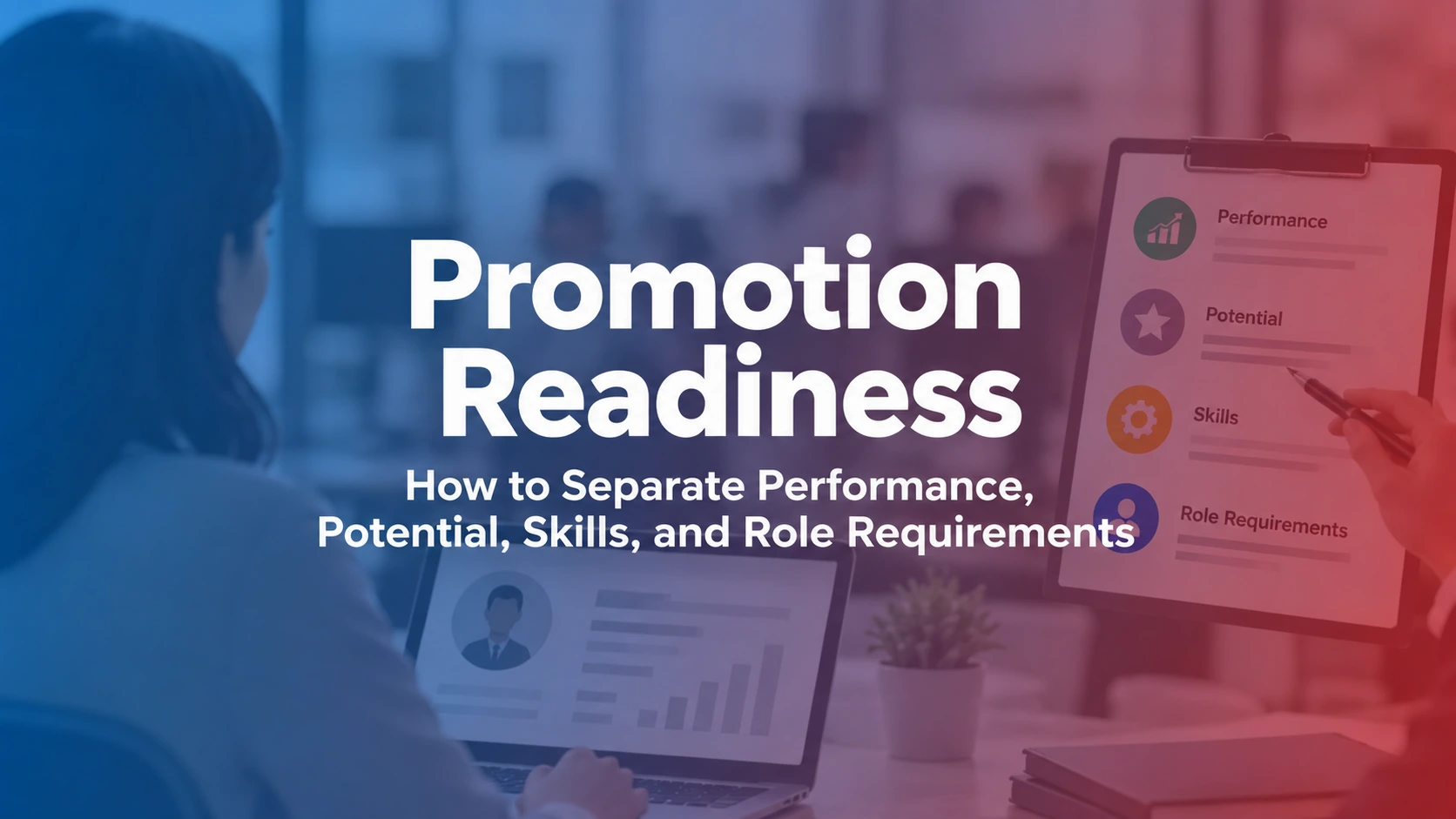

Table of Contents
Quick Takeaways
- Promotion readiness should be assessed against a specific target role.
- Performance, potential, skills, and future-role requirements are distinct inputs.
- Validated skill evidence helps, but it should not become an automatic promotion score.
- Career interest and missing experiences matter as much as knowledge gaps.
- Every “not yet” decision should identify the evidence or experience needed next.
Promotion readiness should answer a role-specific question: does this employee have enough evidence to take on the scope and requirements of a defined next role? It is not the same as rewarding strong performance, identifying broad future potential, or deciding that someone has waited long enough for a title change.
A defensible process connects performance, Talent Review, Skills Management, Career Pathing, and clear role requirements so managers can explain both the decision and the remaining development gap.
Separate Four Inputs Before Making a Promotion Decision
| Input | What it tells you | What it does not prove |
|---|---|---|
| Performance | How well the employee delivers in the current role | That the employee can handle a materially larger role |
| Potential | Capacity to grow into broader or different future work | Immediate readiness for one specific role |
| Skills | Current capability evidence relevant to the target role | Complete readiness without experience, scope, and judgment |
| Role requirements | What the next role actually requires | That every strong employee wants the path |
This separation prevents the common mistake of using a performance rating as a promotion formula. For broader potential decisions, see employee potential assessment.
Step 1: Define the Target Role Before Assessing the Employee
Promotion readiness cannot be evaluated in the abstract. Clarify the target role's purpose, level, scope, key responsibilities, decision authority, stakeholder complexity, experience expectations, and required capabilities.
Use career paths to show realistic next roles and connect progression requirements to the role architecture employees can actually see. Where future demand is still changing, use workforce planning to confirm which roles and capabilities matter most before treating one path as the default next step.
Step 2: Compare Current Scope With Future Scope
Look beyond title. Compare the complexity, autonomy, decision impact, cross-functional reach, and scale of work the employee handles today with what the target role requires. An employee can perform exceptionally within current scope and still need experience at a larger scale.
Step 3: Review Performance Evidence Without Letting It Dominate
Use sustained performance as a foundation. Look for consistency, quality, judgment, and contribution over time. Avoid overweighting one high-profile project or one recent cycle. Strong performance should support the decision, not replace target-role evidence.
Step 4: Validate Role-Relevant Skills
Map the target role to relevant capabilities and compare them with evidence from Skills Management. A skills inventory can show what capability data exists and where evidence is missing. Define proficiency expectations for the target role in observable terms rather than relying on one generic score.
Do not make promotion automatic when someone reaches a score. Skills are one part of readiness alongside scope, experience, results, judgment, and business context.
Step 5: Check Experience and Exposure Gaps
Promotion readiness often fails because the gap is experiential rather than informational. A person may know what to do but have limited evidence that they can do it at the scale, ambiguity, or stakeholder complexity of the next role.
Some gaps are not knowledge gaps. A future manager may need experience leading through conflict. A future functional leader may need budget ownership or executive communication. A specialist may need more complex cases rather than people-management experience.
Translate these missing experiences into concrete development assignments rather than generic training requests. Internal mobility, cross-functional projects, temporary assignments, or scoped leadership responsibilities can create evidence that a classroom course cannot.
Step 6: Confirm Career Interest
Do not assume that promotion is the employee's preferred direction. Use career path conversations to confirm whether the person wants the role, location, schedule, people responsibility, travel expectations, or functional shift involved.
Step 7: Calibrate Across Managers
Bring evidence into talent review so leaders can compare the standard being applied across teams. A structured talent review meeting should ask what makes the employee ready, what evidence is missing, and whether the same bar is being used elsewhere.
For U.S. employers, EEOC guidance recommends objective, job-related qualification standards that are applied consistently in promotion decisions. That does not turn readiness into a purely mechanical score, but it strengthens the case for defining the target role before comparing employees. See the EEOC best-practices guidance for recruitment, hiring, and promotion.
Use Readiness Categories Carefully
Readiness labels should summarize evidence, not replace it. The organization should be able to explain what changed between categories and what would need to happen for an employee to move from one category to another.
Organizations often use categories such as ready now, ready soon, or longer-term. These can be useful only when each category has defined criteria. "Ready in one year" should not mean "manager feels good about them." It should reflect identifiable remaining gaps and a plausible development path.
| Readiness status | Useful interpretation | Next action |
|---|---|---|
| Ready now | Evidence substantially matches the target role's core requirements | Confirm interest, business need, and transition plan |
| Near term | A small number of addressable gaps remain | Assign targeted stretch experience and review again |
| Developing | The path is plausible, but several important requirements are not yet demonstrated | Build a longer development plan and avoid premature promises |
Connect Promotion Readiness With Succession Without Confusing the Two
For critical roles, promotion readiness can inform succession planning. But being a possible successor does not mean a promotion has been approved. Use a critical-role assessment to focus deeper readiness reviews where continuity risk matters most, and use succession planning metrics to monitor whether the organization is actually building credible ready-now and near-term coverage.
Document the Reason for “Ready” and “Not Yet”
A good readiness decision should be explainable. If the employee is not ready, identify the specific role requirement or evidence gap. This makes development more actionable and reduces the risk that “not ready” becomes an indefinite, subjective label.
Promotion readiness decision record
- Target role: the specific role or level being assessed.
- Current-role evidence: sustained performance and scope already handled.
- Target-role evidence: capabilities and experiences already demonstrated at the next level.
- Remaining gaps: concrete skills, experiences, or scope that are not yet demonstrated.
- Career interest: whether the employee wants the path and understands the role conditions.
- Development action: the assignment, exposure, coaching, or practice that could close the gap.
- Review date: when the organization will reassess based on new evidence.
Use Reporting and Analytics to keep readiness decisions, review dates, and pipeline patterns visible rather than relying on disconnected notes.
Make promotion decisions easier to explain
TraineryHCM connects performance, skills, career paths, talent reviews, and succession context so HR can evaluate readiness against the role instead of relying on one rating or manager opinion.
Explore Career PathingCommon Promotion Readiness Mistakes
- Promoting the best current performer automatically: current-role success is mistaken for next-role readiness.
- Assessing readiness without a target role: managers use vague ideas of “next level.”
- Ignoring employee interest: the organization prepares someone for a path they do not want.
- Using skills as a single score: proficiency data replaces judgment about scope and experience.
- Giving vague “not yet” feedback: employees cannot see what evidence would change the decision.
Final Takeaway
Promotion readiness becomes more consistent when HR separates performance, potential, skills, experience, career interest, and target-role requirements. Define the role first, gather multiple forms of evidence, calibrate the decision, and turn every gap into a concrete development action. For succession-critical roles, connect the result with bench strength analysis so leaders can see whether readiness decisions are improving actual successor depth.
Make Promotion Readiness Easier to Explain
See how TraineryHCM connects performance context, skills, career paths, talent reviews, succession planning, and reporting so HR can assess readiness against the role instead of relying on one rating or manager opinion.
Book a Demo
.svg)

.svg)
.svg)

