
.svg)





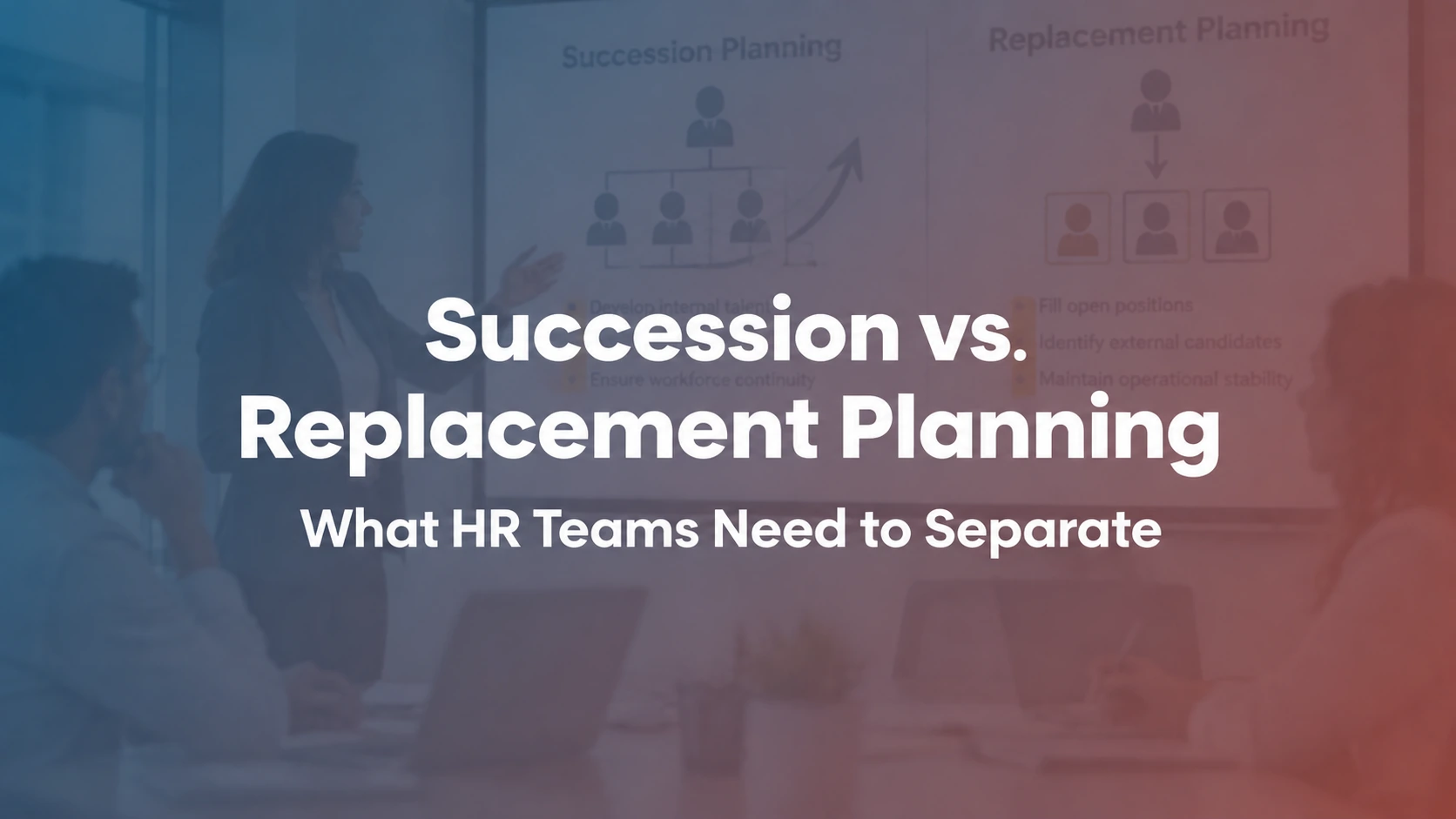

Table of Contents
Quick Takeaways
- Replacement planning answers the short-term continuity question; succession planning builds a future-ready pipeline.
- A named backup does not prove that a role has strong successor depth or readiness.
- Use replacement plans for immediate coverage and succession plans for critical-role, readiness, and development decisions.
- Future-role requirements, employee interest, multiple successor options, and development actions distinguish a stronger succession process.
- Organizations can use both approaches together as separate layers instead of forcing one model to do both jobs.
Replacement planning and succession planning both protect workforce continuity, but they solve different problems. Replacement planning asks, “Who can cover this role if the incumbent leaves?” Succession planning asks, “Which roles and capabilities matter in the future, who could grow into them, how ready are they, and what development will strengthen the pipeline?”
Organizations often need both. The mistake is treating a replacement chart as if it were a complete succession system. TraineryHCM Succession Planning is designed around critical roles, successor pipelines, readiness, and broader talent management context, with Talent Pools and Bench Strength supporting pipeline depth. The U.S. Office of Personnel Management's succession planning guidance likewise frames succession as a strategic process involving key positions, talent risks, bench strength, readiness, and development rather than a list of emergency replacements.
Succession Planning vs. Replacement Planning at a Glance
| Dimension | Replacement planning | Succession planning |
|---|---|---|
| Primary purpose | Maintain continuity if a role becomes vacant | Build future capability and credible pipelines for important roles |
| Time horizon | Immediate or short term | Near term plus longer-term development |
| Typical output | Backup or replacement names | Critical roles, successor slates, readiness, development gaps, and pipeline risk |
| Development focus | Often limited | Explicit actions to improve future readiness |
| Business context | Current role continuity | Future roles, strategy, capabilities, and organizational risk |
What Is Replacement Planning?
Replacement planning identifies who could temporarily or permanently step into a role if it becomes vacant. It is especially useful for emergency continuity, key-person risk, operational handoffs, and positions where the organization needs a named backup.
A replacement plan can be as simple as a role, first backup, second backup, and a short readiness note. That simplicity is useful in a continuity context. It becomes a problem when the organization assumes that a backup name means the talent pipeline is healthy. Keep immediate continuity aligned with workforce planning so emergency coverage does not become disconnected from changes in headcount, role design, or future capability demand.
What Is Succession Planning?
Succession planning is a broader process that starts with business-critical roles and future capabilities. It considers more than who could cover the job today. Leaders define what future success requires, identify possible successors or talent pools, assess readiness, and convert gaps into development actions. A talent management strategy helps connect those decisions to the organization's broader priorities instead of treating succession as an isolated annual exercise.
The TraineryHCM succession planning guide covers the wider operating process. This article focuses specifically on the boundary between succession and replacement planning.
Why Replacement Charts Create False Confidence
A chart with two names under every executive can look complete while hiding several risks. The named employee may not want the role, may lack critical experience, may be the only successor to several roles, or may have been added years ago without a current review.
A replacement chart also says little about future roles that do not yet exist. If strategy changes the capabilities the organization needs, copying today's hierarchy forward can protect the wrong jobs. Use strategic workforce planning to challenge whether today's role structure still represents tomorrow's critical work.
When Replacement Planning Is the Right Tool
- Emergency or temporary coverage must be clear.
- A role has a formal deputy or designated acting authority.
- Business continuity requires a simple handoff plan.
- The organization needs immediate backup before a deeper succession process is mature.
- A transition is already expected and the short-term risk is the priority.
Replacement planning is not inferior. It is simply narrower. Use it for the continuity problem it is designed to solve.
When Succession Planning Is Needed
- The role is critical to future strategy or continuity.
- Readiness requires several years of experience or development.
- The organization needs more than one internal option.
- Future role requirements are changing.
- Leadership wants visibility into pipeline depth and risk.
- Development, career paths, or talent pools need to connect to the plan.
A Practical Two-Layer Model
Organizations can use replacement planning as the immediate continuity layer and succession planning as the capability-development layer. The two layers should share reliable employee and role context from Core HR, but they should retain different decision rules.
| Question | Use replacement planning when... | Use succession planning when... |
|---|---|---|
| What happens tomorrow? | A named backup or acting owner is needed | The broader pipeline still needs review after continuity is covered |
| Who could grow into the role? | Not the main purpose | Compare several plausible successors and readiness horizons |
| What capability gap exists? | Record only what is needed for immediate coverage | Create development actions tied to future-role criteria |
| How strong is the pipeline? | A backup list does not answer this well | Track depth, readiness, concentration, and coverage risk |
Which Approach Should HR Use?
The right answer is often not “replacement planning or succession planning.” Use the method that matches the decision, and use both when immediate continuity and longer-term pipeline health matter at the same time.
| Situation | Best starting approach | Why |
|---|---|---|
| An executive may leave unexpectedly and an acting owner is required immediately | Replacement planning | The urgent question is operational continuity |
| A critical role takes years to prepare for and the organization has only one plausible successor | Succession planning | The risk is pipeline depth, readiness, and development lead time |
| A role needs an emergency backup today and a stronger long-term pipeline | Both | Replacement covers the immediate gap while succession builds future depth |
| The future operating model may change the role itself | Succession planning tied to workforce planning | Protecting today’s role alone may prepare talent for work the organization no longer needs |
This decision logic also keeps replacement charts from expanding into a pseudo-succession process without the evidence, readiness, and development discipline that a real pipeline requires.
Five Steps to Move From Replacement Lists to Succession Pipelines
1. Identify critical roles
Use a consistent role-risk method rather than treating every senior role as equally critical. The critical-role assessment framework provides a focused method.
2. Define future-role requirements
Clarify scope, capabilities, experience, and important skills. Use Skills Management where explicit proficiency requirements improve the discussion.
3. Build more than one option where realistic
Use talent pools and successor slates to reduce dependence on one person. A single named replacement can disappear through promotion, resignation, relocation, or a change in career interest. Track succession planning metrics such as coverage, readiness, and concentration risk so leaders can see whether a pipeline is actually getting stronger.
4. Assess readiness and interest
Evaluate the gap between the employee and the future role. Use Talent Review to compare evidence across leaders, and separate current performance from future-role readiness evidence. Confirm career interest rather than assuming every strong employee wants the same path.
5. Track development and revisit
Assign actions, owners, and review dates. Connect capability gaps to Career Pathing, Skills Management, or other development workflows where appropriate. Reassess when roles, employees, or business needs change. Succession planning is an ongoing process rather than a one-time chart.
Move beyond backup names
Use TraineryHCM Succession Planning to connect critical roles, successor options, readiness, talent pools, and development context in one planning workflow.
Explore Succession PlanningA Worked Example: Replacement Coverage vs. Succession Depth
Consider a regional operations director role that is classified as critical. The current replacement plan names the deputy director as the immediate acting owner. That answers the first continuity question, but it does not show whether the organization has a durable pipeline.
| Question | Replacement view | Succession view |
|---|---|---|
| Who covers tomorrow? | Deputy director is the acting backup | Immediate continuity is covered |
| Who could own the role long term? | Not established | Deputy plus two potential successors are assessed |
| What gaps remain? | Not captured | Commercial exposure, multi-site leadership, and stakeholder management |
| What happens next? | Maintain backup designation | Assign development, review readiness, and monitor bench depth |
The example shows why the two methods are complementary. The replacement plan protects today's operating continuity; the succession plan tests whether the organization can sustain leadership capacity beyond the first handoff. A bench strength view can then show whether that depth exists across roles and functions rather than only for one position.
Use evidence before assigning readiness
A successor should not be labeled “ready now” solely because a manager trusts them. Compare the target role's requirements with demonstrated experience, validated capabilities, career interest, and relevant outcomes. A skills matrix can make capability evidence more explicit, while internal mobility can create lateral or cross-functional experiences that close important readiness gaps.
Common Mistakes
- Renaming a replacement chart “succession planning”: the underlying process has not changed.
- Using one successor for every role: concentration risk stays hidden.
- Ignoring employee interest: the backup may never intend to take the job.
- Skipping development: readiness gaps remain year after year.
- Protecting only today's org chart: future strategy may require different roles and capabilities.
Final Takeaway
Replacement planning protects immediate continuity. Succession planning builds future capability. Use a replacement layer where named backups are operationally necessary, then use succession planning to build deeper, evidence-based pipelines for the roles and capabilities that matter most.
Build Beyond the Replacement Chart
Connect critical roles, successor depth, readiness, talent pools, and development actions in one governed TraineryHCM succession workflow.
Book a Demo
.svg)

.svg)
.svg)

