




Table of Contents
Most organizations that take pay equity seriously run an audit. Once or twice a year, the compensation team pulls a snapshot of pay data, runs a statistical analysis, and identifies gaps that cannot be explained by legitimate factors. They remediate the gaps they find, document the process, and move on until the next cycle. This is responsible, and it is far better than doing nothing.
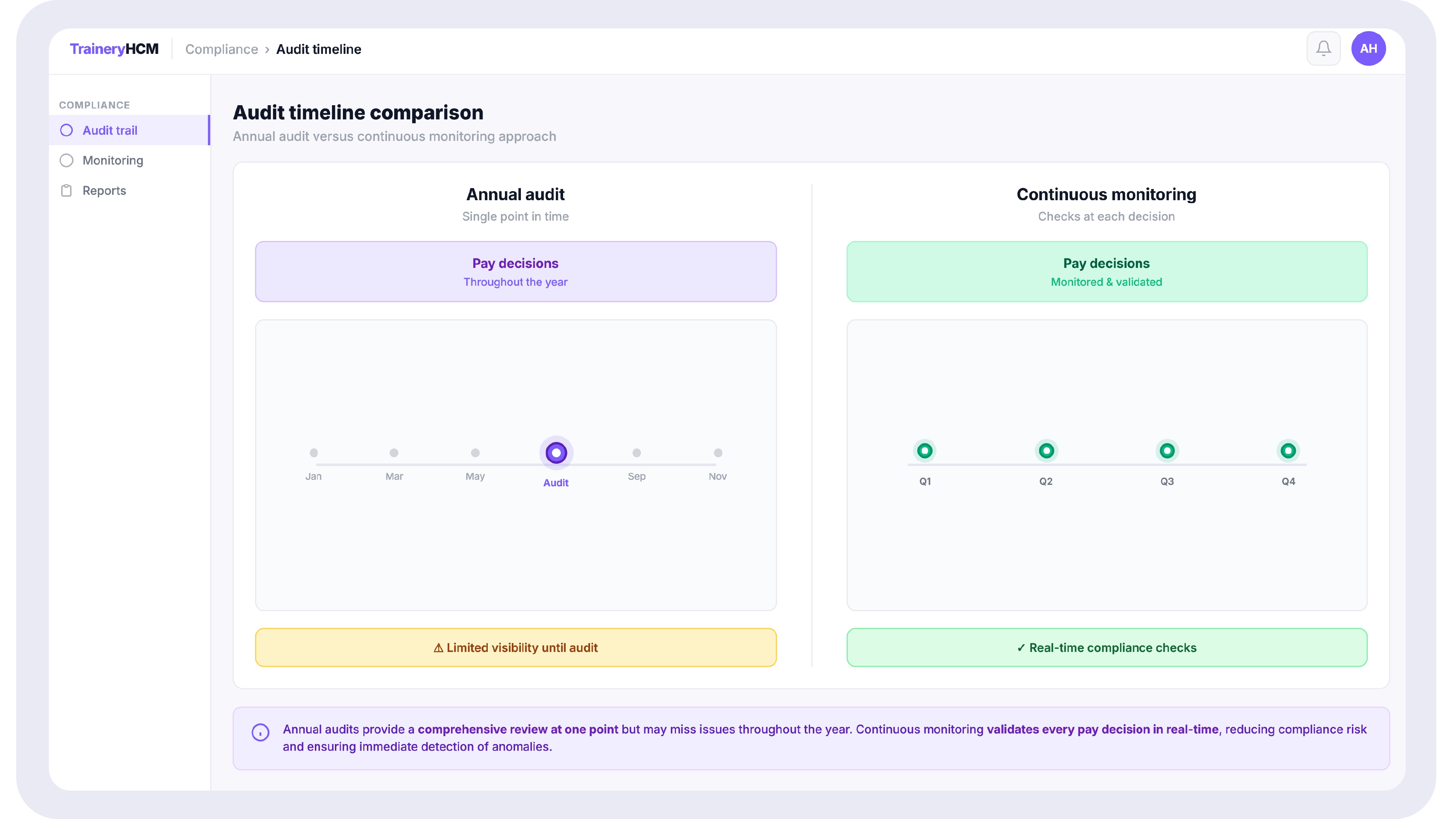
It also has a structural blind spot. Pay decisions do not happen once a year. They happen continuously, every merit cycle, every promotion, every counteroffer, every new hire. Each of those decisions can open a new pay gap the moment it is approved. An annual audit catches that gap months later, after it has compounded and after the affected employee has spent half a year underpaid. The audit model is always looking at a photograph of a situation that has already changed.
This guide is about closing that blind spot: how to move from periodic audits to continuous pay equity monitoring, why the shift matters, and what makes it possible. It builds on the foundations in our pay equity analysis guide, which covers how to run the analysis itself.
Why Annual Audits Always Run Behind
The audit model has three weaknesses, and all of them come from the same root cause: it is periodic, while the thing it measures is continuous.
Gaps open the day after the audit closes
The moment an audit is complete, the data behind it begins to age. The next merit cycle adjusts hundreds of salaries. A few promotions change levels. A handful of new hires come in at negotiated rates. Any of these can introduce a gap, and none of them will be examined until the next audit, potentially eleven months away.
Remediation is more expensive than prevention
Fixing a gap after it has existed for months means back-pay considerations, harder conversations, and a larger correction than if the decision had simply been adjusted when it was made. Catching a gap before a merit increase is finalized costs a small adjustment. Catching it a year later costs far more, in money and in trust.
The audit cannot see intent at the point of decision
An audit examines outcomes in aggregate, after the fact. It cannot tell a manager, at the moment they propose a merit increase, that this specific decision will widen a gap. By the time the analysis runs, the decision is already in payroll. The most useful moment to influence equity, the point of decision, has passed.

What Continuous Pay Equity Monitoring Looks Like
Continuous monitoring does not replace the analysis behind an audit. It moves that analysis to the moment each pay decision is made, so equity is checked before a decision is finalized rather than after. Three capabilities define it.
Equity checks built into the pay decision
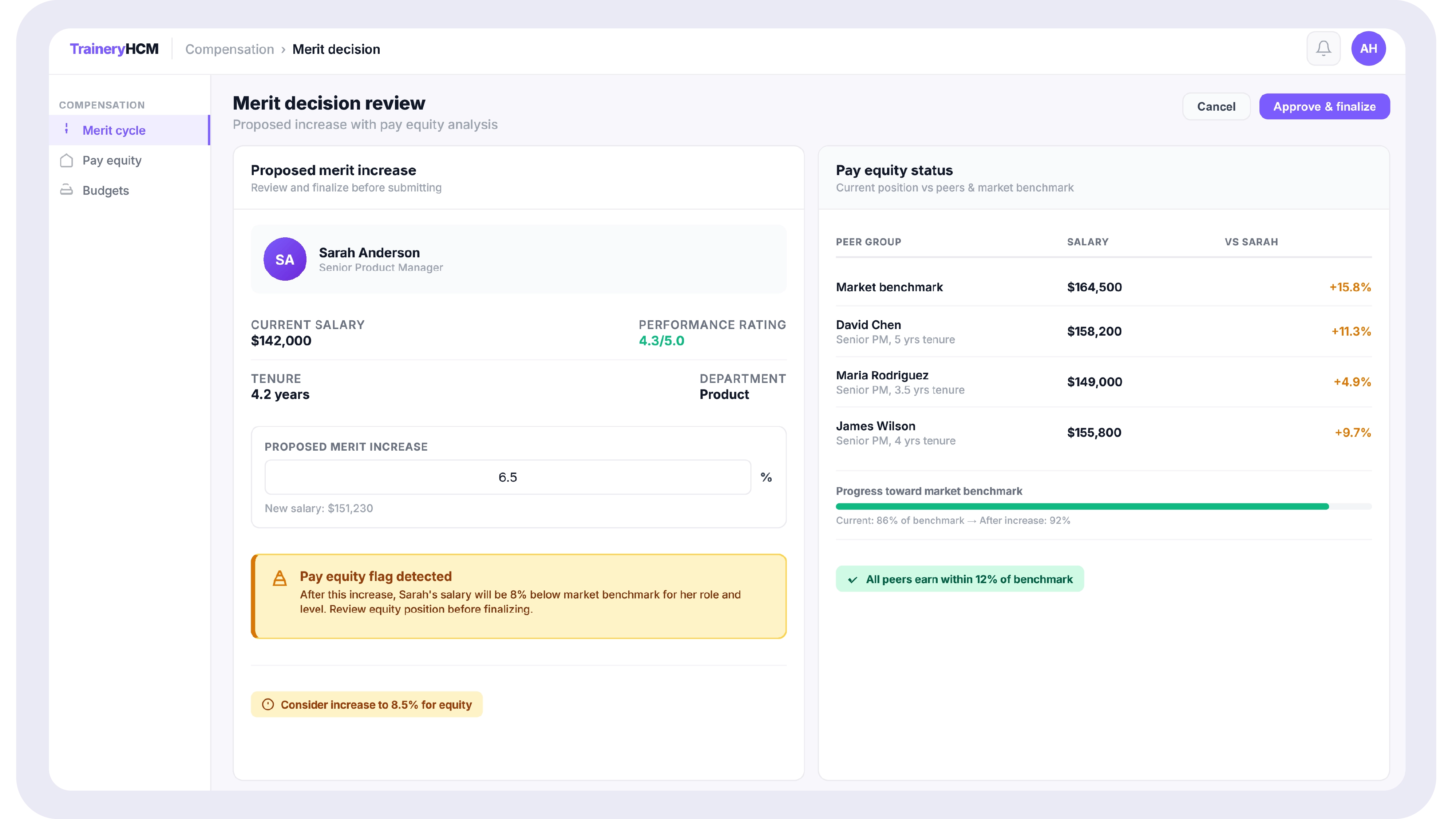
As a manager enters a merit increase or a new hire offer, the system checks whether that specific decision widens or narrows existing gaps and flags it before approval. This is the core shift: the equity check moves from a separate annual project into the compensation planning workflow itself.
Live monitoring across every cycle
Rather than a snapshot, the system maintains a current view of pay equity that updates as decisions are made. HR can see drift as it happens, across merit cycles, promotions, and off-cycle adjustments, instead of discovering it all at once at year-end.
Prevention is built into the merit cycle
Because the check happens before decisions are finalized, the merit cycle itself becomes a point of prevention. Proposed increases that would worsen equity are surfaced while they can still be adjusted, which is exactly the connection described in our guide to running compensation cycles, applied to equity specifically.
Audit vs. Continuous Monitoring: Side by Side
Continuous monitoring is only possible when pay equity analysis runs where pay decisions are made. That requires the equity capability and the compensation workflow to share the same data. In TraineryHCM, pay equity checks are part of the compensation module, so each merit, promotion, and offer decision can be checked against equity before it is finalized. The shift from annual audit to continuous monitoring is not a new tool bolted on. It is equity analysis living inside the place where pay is actually decided.
How to Make the Shift
Moving from audits to continuous monitoring is a staged change, not a single switch. A practical path looks like this.
- Keep your audit, then shorten the gap between them. Continuous monitoring complements the formal audit rather than replacing it. Start by reducing the blind period between audits.
- Move the equity check into the compensation workflow. Ensure the analysis can run against proposed decisions before they are finalized, not just against historical data.
- Connect equity to live pay and performance data. The check is only as good as the data behind it, so it should draw on current salary, level, and calibrated performance, not a stale export.
- Make prevention part of every cycle. Build the equity flag into merit, promotion, and offer approvals, so no pay decision is finalized without an equity check.

From Catching Gaps to Preventing Them
Annual pay equity audits are a responsible practice, but they are always looking backward at data that has already changed. Pay decisions are continuous, so the gaps they create are continuous too, and a once-a-year audit will always find them late and fix them at a higher cost.
Continuous monitoring changes the posture from catching gaps to preventing them. By moving the equity check into the moment each pay decision is made, drift becomes visible as it happens and unfair decisions are flagged while they can still be adjusted. Keep your formal audit, but stop relying on it as your only line of defense. Run equity where pay is decided, and pay equity becomes something you maintain continuously rather than repair once a year. For the analysis fundamentals behind it, our pay equity analysis guide is the place to start.
KEY TAKEAWAYS
- Annual pay equity audits find gaps months after they open, because pay decisions happen continuously while audits happen once or twice a year.
- Every merit cycle, promotion, and new hire offer can introduce a new pay gap the moment it is approved, long before the next audit would catch it.
- Continuous pay equity monitoring checks each pay decision against equity as it is made, turning remediation from an annual cleanup into prevention.
- The shift requires pay equity capability connected to where pay decisions actually happen, not a separate audit run on exported data.
Most organizations that take pay equity seriously run an audit. Once or twice a year, the compensation team pulls a snapshot of pay data, runs a statistical analysis, and identifies gaps that cannot be explained by legitimate factors. They remediate the gaps they find, document the process, and move on until the next cycle. This is responsible, and it is far better than doing nothing.
It also has a structural blind spot. Pay decisions do not happen once a year. They happen continuously, every merit cycle, every promotion, every counteroffer, every new hire. Each of those decisions can open a new pay gap the moment it is approved. An annual audit catches that gap months later, after it has compounded and after the affected employee has spent half a year underpaid. The audit model is always looking at a photograph of a situation that has already changed.
This guide is about closing that blind spot: how to move from periodic audits to continuous pay equity monitoring, why the shift matters, and what makes it possible. It builds on the foundations in our pay equity analysis guide, which covers how to run the analysis itself.
Why Annual Audits Always Run Behind
The audit model has three weaknesses, and all of them come from the same root cause: it is periodic, while the thing it measures is continuous.
Gaps open the day after the audit closes
The moment an audit is complete, the data behind it begins to age. The next merit cycle adjusts hundreds of salaries. A few promotions change levels. A handful of new hires come in at negotiated rates. Any of these can introduce a gap, and none of them will be examined until the next audit, potentially eleven months away.
Remediation is more expensive than prevention
Fixing a gap after it has existed for months means back-pay considerations, harder conversations, and a larger correction than if the decision had simply been adjusted when it was made. Catching a gap before a merit increase is finalized costs a small adjustment. Catching it a year later costs far more, in money and in trust.
The audit cannot see intent at the point of decision
An audit examines outcomes in aggregate, after the fact. It cannot tell a manager, at the moment they propose a merit increase, that this specific decision will widen a gap. By the time the analysis runs, the decision is already in payroll. The most useful moment to influence equity, the point of decision, has passed.

What Continuous Pay Equity Monitoring Looks Like
Continuous monitoring does not replace the analysis behind an audit. It moves that analysis to the moment each pay decision is made, so equity is checked before a decision is finalized rather than after. Three capabilities define it.
Equity checks built into the pay decision
As a manager enters a merit increase or a new hire offer, the system checks whether that specific decision widens or narrows existing gaps and flags it before approval. This is the core shift: the equity check moves from a separate annual project into the compensation planning workflow itself.
Live monitoring across every cycle
Rather than a snapshot, the system maintains a current view of pay equity that updates as decisions are made. HR can see drift as it happens, across merit cycles, promotions, and off-cycle adjustments, instead of discovering it all at once at year-end.
Prevention is built into the merit cycle
Because the check happens before decisions are finalized, the merit cycle itself becomes a point of prevention. Proposed increases that would worsen equity are surfaced while they can still be adjusted, which is exactly the connection described in our guide to running compensation cycles, applied to equity specifically.
Audit vs. Continuous Monitoring: Side by Side
Continuous monitoring is only possible when pay equity analysis runs where pay decisions are made. That requires the equity capability and the compensation workflow to share the same data. In TraineryHCM, pay equity checks are part of the compensation module, so each merit, promotion, and offer decision can be checked against equity before it is finalized. The shift from annual audit to continuous monitoring is not a new tool bolted on. It is equity analysis living inside the place where pay is actually decided.
How to Make the Shift
Moving from audits to continuous monitoring is a staged change, not a single switch. A practical path looks like this.
- Keep your audit, then shorten the gap between them. Continuous monitoring complements the formal audit rather than replacing it. Start by reducing the blind period between audits.
- Move the equity check into the compensation workflow. Ensure the analysis can run against proposed decisions before they are finalized, not just against historical data.
- Connect equity to live pay and performance data. The check is only as good as the data behind it, so it should draw on current salary, level, and calibrated performance, not a stale export.
- Make prevention part of every cycle. Build the equity flag into merit, promotion, and offer approvals, so no pay decision is finalized without an equity check.

From Catching Gaps to Preventing Them
Annual pay equity audits are a responsible practice, but they are always looking backward at data that has already changed. Pay decisions are continuous, so the gaps they create are continuous too, and a once-a-year audit will always find them late and fix them at a higher cost.
Continuous monitoring changes the posture from catching gaps to preventing them. By moving the equity check into the moment each pay decision is made, drift becomes visible as it happens and unfair decisions are flagged while they can still be adjusted. Keep your formal audit, but stop relying on it as your only line of defense. Run equity where pay is decided, and pay equity becomes something you maintain continuously rather than repair once a year. For the analysis fundamentals behind it, our pay equity analysis guide is the place to start.
Frequently Asked Questions
What data does continuous pay equity monitoring need?
Continuous monitoring needs current, connected data: live salary and pay band information, job level and role data, and calibrated performance ratings, all available at the moment a pay decision is made. Because the check runs against proposed decisions before they are finalized, it cannot rely on a stale export. This is why continuous monitoring works best inside a connected platform where pay equity, compensation planning, and performance share one data model, so the equity check always reflects the latest information.
Does pay equity software replace a formal audit?
No. Continuous pay equity monitoring complements a formal audit rather than replacing it. The formal audit provides a rigorous, documented analysis that supports compliance and reporting. Continuous monitoring closes the gap between audits by catching new disparities as they arise. The strongest approach keeps the periodic audit for depth and documentation while using continuous monitoring to prevent gaps from opening and compounding in the months between audits.
How does continuous pay equity monitoring work?
Continuous monitoring embeds the equity analysis into the compensation workflow. As a manager enters a merit increase, promotion, or offer, the system checks whether that specific decision widens or narrows existing gaps and flags it before approval. It maintains a live view of pay equity that updates as decisions are made, rather than a once-a-year snapshot. This requires the pay equity capability and the compensation workflow to share the same current data, so checks run against live salary, level, and performance information.
Why are annual pay equity audits not enough?
Annual audits run behind because pay decisions are continuous while audits are periodic. The day after an audit closes, the next merit cycle, promotion, or new hire offer can open a new gap that will not be examined until the following audit, potentially eleven months later. By then the gap has compounded, the affected employee has been underpaid for months, and remediation is more expensive than a small adjustment at the point of decision would have been. Continuous monitoring closes that blind period.
What is the difference between a pay equity audit and continuous monitoring?
A pay equity audit is a periodic analysis: it examines a snapshot of pay data once or twice a year, identifies gaps, and produces a remediation plan. Continuous monitoring moves that analysis to the point of each pay decision, checking merit increases, promotions, and offers against equity before approval. The audit is retrospective and finds gaps months after they open; continuous monitoring is preventive and catches gaps as decisions are made. The two work best together, with monitoring closing the blind period between formal audits.
What is pay equity software?
Pay equity software analyzes compensation data to find and help correct unexplained pay differences across gender, race, and other protected groups, after accounting for legitimate factors like role, level, and experience. Traditional pay equity tools run a periodic audit on a data snapshot and produce a remediation list. Continuous pay equity software instead checks each pay decision as it is made, flagging merit increases, promotions, and offers that would widen gaps before they are finalized, so equity is maintained continuously rather than corrected once or twice a year.