

.svg)






Table of Contents
Quick Takeaways
- Merit, bonus, and equity are different compensation operations with different budget logic, eligibility rules, timing, and approvals.
- TraineryHCM should own the employee and organizational context that feeds those cycles, not the specialist compensation-planning workflow itself.
- PerformSpark should own reviews and calibration where finalized performance data is an approved compensation input.
- CompBldr should own cycle configuration, budgets, recommendations, approvals, exceptions, audit history, and final compensation decisions.
- Moving off spreadsheets is primarily a governance change: one source of truth, current budgets, controlled permissions, structured approvals, and traceable decisions.
Merit, Bonus, and Equity Cycles
Merit, bonus, and equity cycles are three common compensation operations, but they do not use exactly the same rules. A merit cycle adjusts base salary. A bonus cycle generally awards one-time cash payments according to defined plan rules. An equity cycle manages ownership-based awards or refreshes. They differ in timing, budget logic, inputs, eligibility, and approvals.
The HCM connection is equally important. Compensation cycles depend on trusted employee, job, manager, location, and organizational data. Some organizations also use finalized performance outcomes as an input. That surrounding context belongs in the TraineryHCM platform, while the specialist compensation workflow belongs in CompBldr Compensation Planning. Where performance is used, PerformSpark owns reviews and calibration.
Most HR and compensation teams recognize the operational problem: a pay cycle lives in a workbook with multiple tabs, formulas inherited from prior years, separate manager copies, and approvals scattered across email. That setup can work for a small population, but it becomes harder to govern as employee counts, managers, cycle types, and approval layers increase. A connected HCM suite helps keep the surrounding employee context consistent even when specialist systems own the actual performance and compensation workflows.
The Three Compensation Cycles Are Not the Same Operation
The first mistake is treating merit, bonus, and equity as one process with three columns. Each needs its own controls.
Because the budget logic and approval focus differ, each cycle needs its own controls. A spreadsheet tends to flatten those differences into the same grid. The TraineryHCM compensation-planning connection can explain how employee context reaches the cycle, while CompBldr remains the specialist owner of configuration, budgets, recommendations, approvals, and decision controls.
How the HCM Data Handoff Should Work
Removing cannibalization does not mean stripping out compensation-cycle depth. It means being clear about which system owns which part of the workflow.
This ownership model lets TraineryHCM remain a useful HCM resource without becoming a second compensation-planning product destination. The HCM layer is especially useful for cross-pillar reporting and analytics, where leaders may need to interpret compensation outcomes alongside workforce and performance context.
Why Spreadsheets Break Compensation Cycles
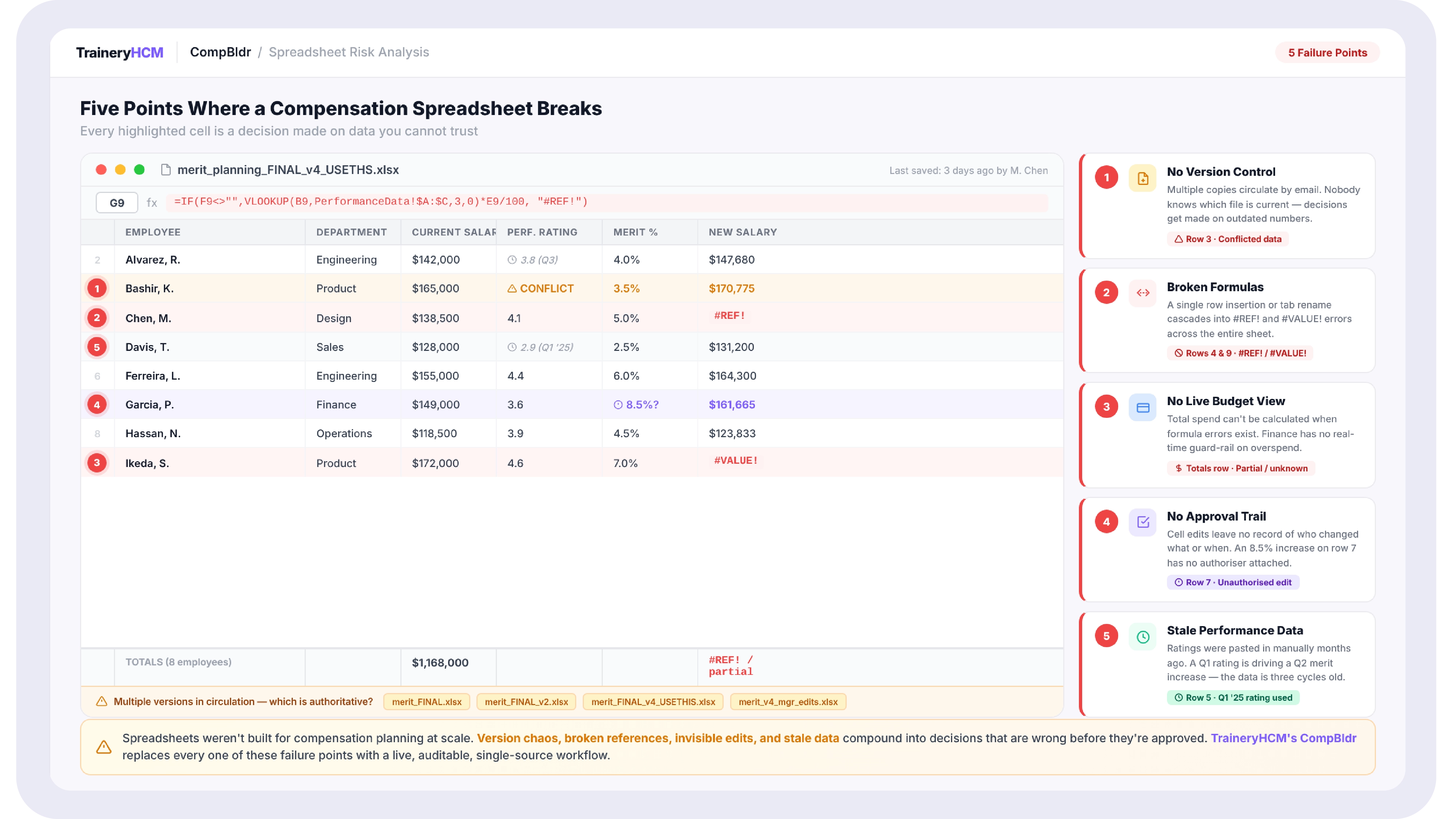
Spreadsheets do not fail because people are careless. They fail because compensation cycles demand version control, permissions and sensitive-data controls, live budgets, approvals, and audit history that a general-purpose file was not designed to manage.
1. Version control collapses
The moment a workbook is distributed to multiple managers, multiple versions can exist. HR then has to reconcile which recommendations are current. Reliable HR data integrations can reduce manual handoffs around the cycle, but the compensation decision workflow still needs one governed source of truth.
2. Formulas can break silently
A pasted value can overwrite a formula or a new row can fall outside a calculation range. The total may still show a number, so the problem may not appear until later in the cycle.
3. There is no reliable real-time budget view
When managers work in separate files, they may not see the same current budget position. That creates rebalancing work after recommendations have already been made.
4. Approval history is fragmented
Approvals over email or chat make it harder to answer who approved a recommendation, what changed, and when. Centralized HR notifications and reminders can support deadlines and follow-up, while the approval decision itself remains inside the specialist compensation workflow.
5. Performance data can be stale or absent
Where performance is an approved input to merit or bonus decisions, a one-time export can become outdated. The internal HCM view of performance review cycles should stay connected to the wider employee context, while the specialist performance process itself stays in PerformSpark, with finalized context moving to CompBldr only when needed.
What a Connected Workflow Replaces the Spreadsheet With
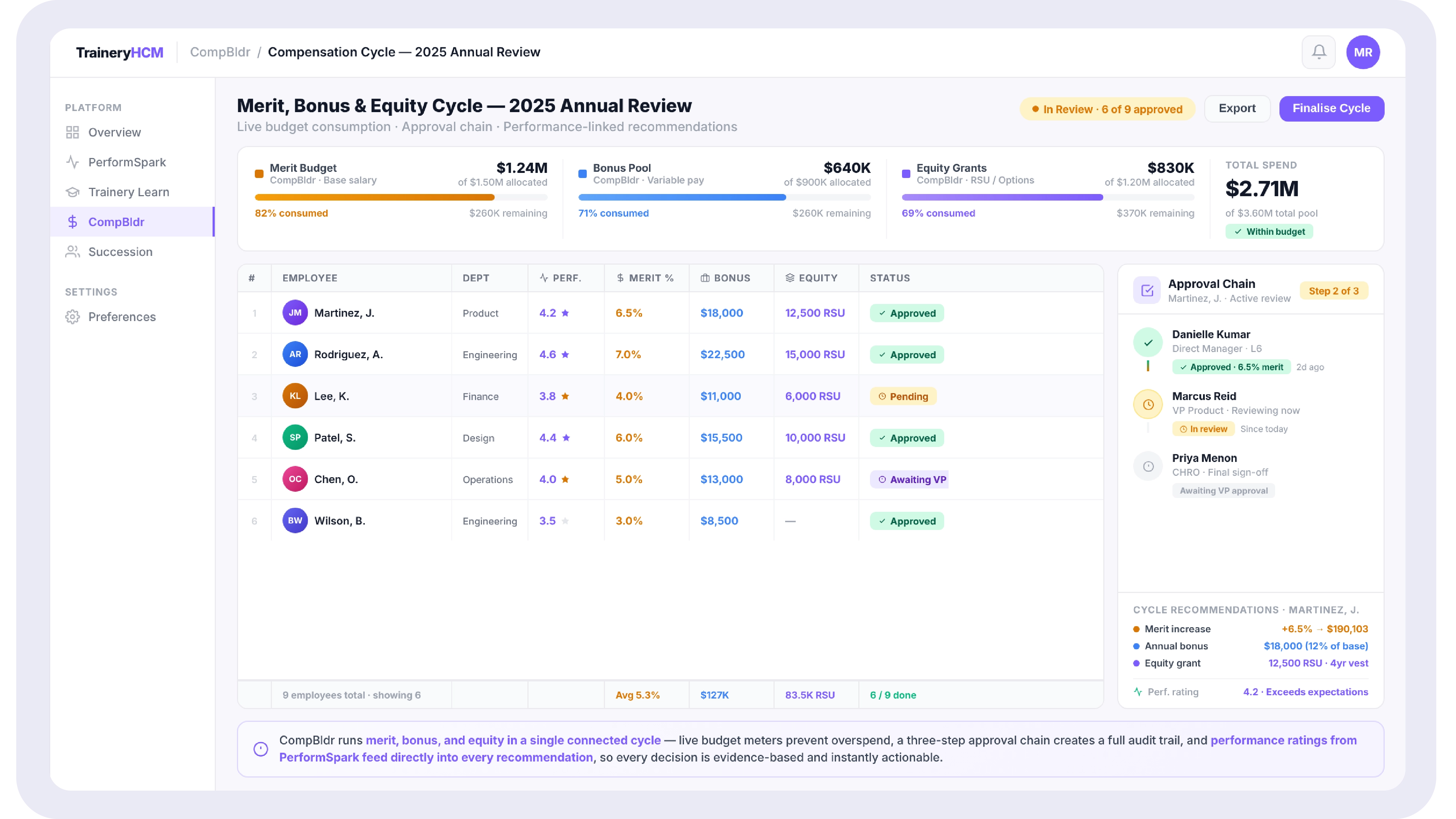
One source of truth instead of many versions
Managers work in one governed compensation environment instead of separate copies. There is one current set of recommendations and budget data.
Live budget tracking as decisions are made
Budget consumption should update as recommendations are entered so exceptions and over-allocation are visible before the cycle closes.
Structured approvals with decision history
Recommendations, changes, and approvals should be recorded inside the workflow so HR and Finance can trace how a decision was made.
Performance context available when policy requires it
Where performance is used as an input, finalized context should come from PerformSpark rather than manager memory or an uncontrolled copy. A governed calibration process helps explain where that finalized context comes from before it reaches compensation.
Different controls for all three cycle types
Merit, bonus, and equity can share employee data while still using different budget logic, eligibility rules, and approvals inside CompBldr.
What Each Cycle Needs From HCM Data
Merit cycles
Merit cycles commonly need employee status, current salary, job or grade, salary-range position and market context, manager hierarchy, eligibility, and any approved performance input. The HCM layer helps ensure the right employee population and organizational relationships are available before managers begin making recommendations.
Bonus cycles
Bonus cycles may need eligibility, target opportunity, plan assignment, organizational results, individual results, and payout rules. When company or individual goals are part of the plan, the broader goal-management context should remain connected without turning TraineryHCM into the specialist bonus-calculation system. The exact logic depends on the incentive plan, so teams should avoid assuming that the same fields used for merit automatically apply to bonuses.
Equity cycles
Equity cycles may depend on role, level, existing holdings, grant policy, retention context, eligibility, leadership review, or board governance. Because equity introduces different approvals and controls, it should not be treated as a second bonus column inside the merit workbook.
The important TraineryHCM role is consistent employee and organizational context across all three cycles. The detailed compensation calculations and approvals remain in CompBldr. After final decisions, some organizations also connect compensation outcomes to broader total rewards communication.
How to Move Off Spreadsheets Without Disrupting a Cycle
- Map the three cycles first. Document timing, budget logic, eligibility, inputs, and approval flow for merit, bonus, and equity.
- Clean employee and compensation data. Confirm manager relationships, salary data, ranges, eligibility, and any approved performance inputs.
- Define system ownership. Confirm which employee fields come from HCM, which performance fields come from PerformSpark, and which compensation rules live in CompBldr.
- Configure the specialist compensation workflow. Use CompBldr for budget rules, recommendations, approvals, exceptions, and audit controls.
- Run one cycle in parallel if needed. Compare outputs against the existing process before fully retiring the spreadsheet.
- Retire the spreadsheet from the critical path. Keep historical exports only where required for records rather than as the active operating system.
If the organization needs help redesigning salary structures, merit governance, pay-equity review, or cycle rules before implementation, compensation consulting can support the policy and operating-model work.
Performance and Compensation Should Connect Without Becoming the Same Product
This is the TraineryHCM hub principle. PerformSpark owns performance management. CompBldr owns compensation planning. TraineryHCM connects employee data and the governed handoff between them.
That distinction matters particularly during merit cycles. A performance rating or calibration outcome can be an input when policy requires it, but compensation still needs salary-range position, eligibility, budget, equity considerations, guidelines, and approvals. The two domains should connect without collapsing into one process. Related TraineryHCM use cases can show how these cross-pillar workflows fit together in practice.
Closing the Spreadsheet for Good
Merit, bonus, and equity are different operations, and a single spreadsheet can force them into a fragile process with version problems, formula risk, missing budget visibility, fragmented approvals, and stale inputs.
Replacing that workbook means introducing controls designed for compensation: one current source of decision data, live budgets, structured approvals, decision history, and the relevant employee context. TraineryHCM should supply and interpret the broader HCM context; CompBldr should govern the specialist cycle; PerformSpark should supply finalized performance context where required.
To review the connected HCM layer around these handoffs, teams can book a TraineryHCM demo while keeping detailed compensation-cycle execution routed to CompBldr.




.svg)

.svg)
.svg)

