




Table of Contents
If employees do not trust how pay is decided, they will question how the organization is led. That is the quiet risk hiding inside every merit cycle. Pay transparency laws are expanding across the United States and the European Union; finance teams want defensible forecasts, and managers want fewer spreadsheets and fewer last-minute corrections. Compensation has moved from a back-office task to a strategic function that boards now ask about by name.
The software market has responded with dozens of platforms, and most buyer guides published this year read the same way: a long list of vendors, with the author's own product ranked first. That format tells you what exists. It rarely helps you decide.
This guide takes a different approach. Before comparing any vendor, it answers the question that actually shapes a shortlist: do you need a standalone compensation tool, or compensation built into a connected HCM suite? That single decision determines which platforms belong on your list and which do not.
Why Compensation Management Software Matters in 2026
Four forces have pushed compensation software from a convenience to a requirement.
Pay transparency is now a legal obligation, not a value statement.
More than a dozen US states require salary ranges in job postings, and the EU Pay Transparency Directive requires member states to act by mid-2026, including gender pay gap reporting for larger employers. Defensible pay structures, audit trails, and documented salary bands are no longer optional. Spreadsheets cannot produce them reliably.
Finance expects forecast accuracy.
Merit and bonus budgets are among the largest controllable line items in most organizations. When planning happens in disconnected spreadsheets, budget overruns and reconciliation errors are common. Software with real-time budget tracking gives finance the predictability it now demands.
Managers are the weak point in every cycle.
Compensation decisions are made by line managers who run a review cycle once or twice a year. If the tool is confusing, they default to across-the-board increases that ignore performance differences. Adoption and usability are not nice-to-haves. They determine whether the investment produces fairer pay or just faster spreadsheets.
Employees expect to understand their total rewards.
Base salary is only part of the package. Employees increasingly expect visibility into bonuses, equity, and benefits. Total rewards statements have become a retention tool, and the platforms that generate them will turn a compliance task into an engagement opportunity.
The Decision That Comes Before the Shortlist: Standalone Tool or HCM Suite
Most buyer guides skip this question, which is why so many shortlists end up mixing platforms that were never built for the same job. There are two distinct categories of compensation software, each solving different problems.
Standalone compensation tools
These platforms specialize in pay. They tend to offer the deepest benchmarking data, the most configurable merit and bonus logic, and strong equity and market-pricing features. They are the right choice when compensation is your primary problem, and your performance and learning data either live elsewhere or do not need to influence pay decisions directly.
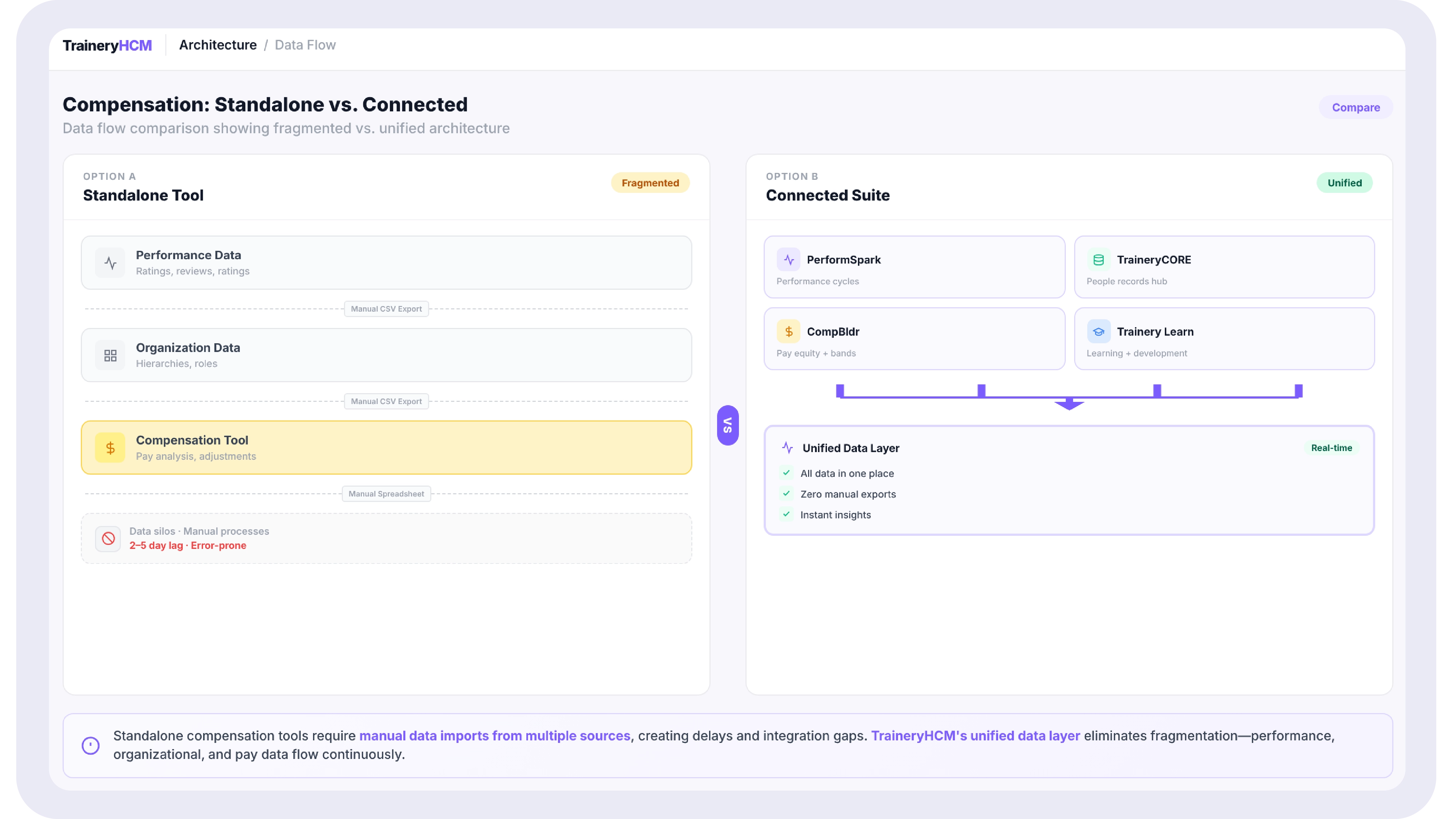
The trade-off is integration. A standalone tool reads performance ratings through an import or an integration, which means pay decisions depend on data that was prepared in another system and may be out of date by the time the merit worksheet opens.
Compensation inside a connected HCM suite
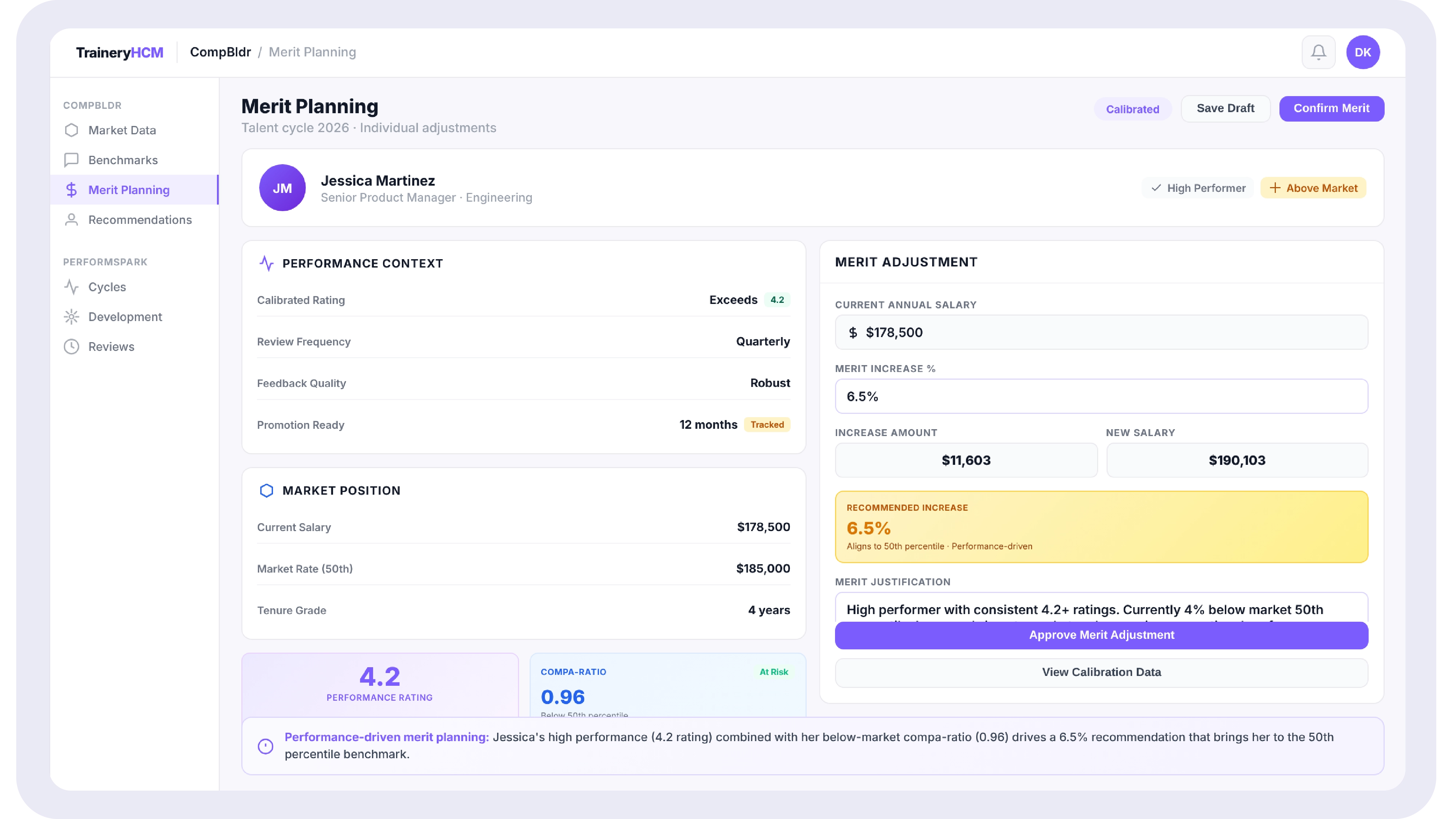
In a connected Human Capital Management suite, compensation shares a data layer with performance management, learning, and core HR. A calibrated performance rating is already present when the merit cycle opens. There is no export, no reconciliation, and no risk that managers are making pay decisions against preliminary ratings.
The trade-off runs the other way. A suite may offer slightly less benchmarking depth than a specialist benchmarking vendor, and it asks the organization to commit to a broader platform rather than a single best-of-breed tool. For teams whose pay decisions genuinely depend on performance and development context, that trade is usually worth it.
TraineryHCM sits in this second category. It is a connected HCM suite where compensation works alongside performance, learning, and core HR rather than as an isolated module. That design matters most when a merit decision should reflect a calibrated rating, a completed development plan, or a documented performance trend, because all of that context is already in the same system.
Standalone Tool vs HCM Suite: A Decision View

How to Evaluate Compensation Management Software: 7 Criteria
Once you know which category you are buying in, these seven criteria separate a platform that will serve you for years from one you will replace in eighteen months.
1. Where performance data comes from
Ask each vendor to show exactly how a performance rating reaches the merit worksheet. If the answer involves an export or a scheduled sync, your pay decisions depend on data freshness that you do not control. In a connected suite, this question disappears.
2. Salary band and market data strategy
Decide whether you need benchmarking built in or whether you will bring your own market data from a provider like Mercer or Salary.com. Some platforms lead with proprietary data, others ingest external surveys cleanly. Confirm the approach matches your philosophy before you shortlist.
3. Pay equity analysis depth
Pay equity should run during the merit cycle, not as a separate annual audit after increases are locked. Look for the ability to flag disparities against proposed increases before they are approved, with the role and performance context needed to explain or correct them.
4. Manager experience
The manager’s view is where cycles succeed or fail. Real-time budget impact, clear guidance, and a layout that managers can complete in minutes determine whether you get differentiated pay decisions or lazy across-the-board increases.
5. Budget controls and approvals
Confirm the platform enforces budgets in real time, supports your approval hierarchy, and handles mid-cycle changes such as eligibility shifts without forcing a restart.
6. Total rewards communication
Personalized total rewards statements turn a pay change into a retention moment. Check whether statements are built in, how customizable they are, and whether employees can access them directly.
7. Total cost of ownership
Compare the all-in cost at your projected headcount over the contract term, including implementation, integration, maintenance, and support tiers. A platform that replaces several tools can be cheaper overall, even when its sticker price looks higher.
The Compensation Software Landscape: Five Vendor Types
Rather than rank platforms one through twenty, it is more useful to understand the five types of vendors in this market. Most shortlisting mistakes come from comparing tools that belong to different types.
Within this landscape, TraineryHCM is a connected HCM suite built for mid-market organizations, typically 100 to 5,000 employees, that want compensation to work alongside performance and learning rather than in a separate tool. It is the right fit when a pay decision should reflect a calibrated rating or a completed development plan, and the wrong fit when an organization wants a single isolated comp tool and nothing more.
Common Mistakes When Buying Compensation Software
- Buying based on benchmarking depth alone. Market data matters, but if managers cannot run a clean cycle, the best data in the world will not produce fair pay.
- Ignoring where performance data lives. Pay decisions made against stale or manually exported ratings undermine the credibility of the entire cycle.
- Treating pay equity as an afterthought. Running equity analysis after increases are approved means catching problems too late to fix them cleanly.
- Underestimating implementation. Ask for a written implementation plan and a named owner for each step before signing, not after.

Choosing the Right Platform for Your Team
The best compensation management software is not the one with the longest feature list. It is the one that matches how your organization actually makes pay decisions.
Start with the category question. If compensation is an isolated problem and your performance data lives elsewhere, a standalone tool or a benchmarking-led platform may serve you well. If your pay decisions should reflect performance, calibration, and development, and you are tired of moving data between disconnected systems, a connected HCM suite removes the friction that makes merit cycles painful.
From there, shortlist two or three platforms in the right category, run demos with your real scenarios, and involve finance, HR business partners, and a few managers. Ask each vendor to show the merit worksheet with performance data already in it. The platform that makes that look effortless is usually the one that will serve you for years.
KEY TAKEAWAYS
- Compensation management software centralizes pay planning, merit and bonus cycles, salary bands, pay equity analysis, and total rewards communication within a single governed workflow.
- The first decision is not which vendor, but whether you need a standalone compensation tool or compensation built into a connected HCM suite.
- Standalone tools win on benchmarking depth and configuration. Suites win when compensation decisions depend on live performance, calibration, and development data.
- Match the platform to your data strategy, company size, and compliance footprint, not to a feature checklist.
If employees do not trust how pay is decided, they will question how the organization is led. That is the quiet risk hiding inside every merit cycle. Pay transparency laws are expanding across the United States and the European Union; finance teams want defensible forecasts, and managers want fewer spreadsheets and fewer last-minute corrections. Compensation has moved from a back-office task to a strategic function that boards now ask about by name.
The software market has responded with dozens of platforms, and most buyer guides published this year read the same way: a long list of vendors, with the author's own product ranked first. That format tells you what exists. It rarely helps you decide.
This guide takes a different approach. Before comparing any vendor, it answers the question that actually shapes a shortlist: do you need a standalone compensation tool, or compensation built into a connected HCM suite? That single decision determines which platforms belong on your list and which do not.
Why Compensation Management Software Matters in 2026
Four forces have pushed compensation software from a convenience to a requirement.
Pay transparency is now a legal obligation, not a value statement.
More than a dozen US states require salary ranges in job postings, and the EU Pay Transparency Directive requires member states to act by mid-2026, including gender pay gap reporting for larger employers. Defensible pay structures, audit trails, and documented salary bands are no longer optional. Spreadsheets cannot produce them reliably.
Finance expects forecast accuracy.
Merit and bonus budgets are among the largest controllable line items in most organizations. When planning happens in disconnected spreadsheets, budget overruns and reconciliation errors are common. Software with real-time budget tracking gives finance the predictability it now demands.
Managers are the weak point in every cycle.
Compensation decisions are made by line managers who run a review cycle once or twice a year. If the tool is confusing, they default to across-the-board increases that ignore performance differences. Adoption and usability are not nice-to-haves. They determine whether the investment produces fairer pay or just faster spreadsheets.
Employees expect to understand their total rewards.
Base salary is only part of the package. Employees increasingly expect visibility into bonuses, equity, and benefits. Total rewards statements have become a retention tool, and the platforms that generate them will turn a compliance task into an engagement opportunity.
The Decision That Comes Before the Shortlist: Standalone Tool or HCM Suite
Most buyer guides skip this question, which is why so many shortlists end up mixing platforms that were never built for the same job. There are two distinct categories of compensation software, each solving different problems.
Standalone compensation tools
These platforms specialize in pay. They tend to offer the deepest benchmarking data, the most configurable merit and bonus logic, and strong equity and market-pricing features. They are the right choice when compensation is your primary problem, and your performance and learning data either live elsewhere or do not need to influence pay decisions directly.
The trade-off is integration. A standalone tool reads performance ratings through an import or an integration, which means pay decisions depend on data that was prepared in another system and may be out of date by the time the merit worksheet opens.
Compensation inside a connected HCM suite
In a connected Human Capital Management suite, compensation shares a data layer with performance management, learning, and core HR. A calibrated performance rating is already present when the merit cycle opens. There is no export, no reconciliation, and no risk that managers are making pay decisions against preliminary ratings.
The trade-off runs the other way. A suite may offer slightly less benchmarking depth than a specialist benchmarking vendor, and it asks the organization to commit to a broader platform rather than a single best-of-breed tool. For teams whose pay decisions genuinely depend on performance and development context, that trade is usually worth it.
TraineryHCM sits in this second category. It is a connected HCM suite where compensation works alongside performance, learning, and core HR rather than as an isolated module. That design matters most when a merit decision should reflect a calibrated rating, a completed development plan, or a documented performance trend, because all of that context is already in the same system.
Standalone Tool vs HCM Suite: A Decision View

How to Evaluate Compensation Management Software: 7 Criteria
Once you know which category you are buying in, these seven criteria separate a platform that will serve you for years from one you will replace in eighteen months.
1. Where performance data comes from
Ask each vendor to show exactly how a performance rating reaches the merit worksheet. If the answer involves an export or a scheduled sync, your pay decisions depend on data freshness that you do not control. In a connected suite, this question disappears.
2. Salary band and market data strategy
Decide whether you need benchmarking built in or whether you will bring your own market data from a provider like Mercer or Salary.com. Some platforms lead with proprietary data, others ingest external surveys cleanly. Confirm the approach matches your philosophy before you shortlist.
3. Pay equity analysis depth
Pay equity should run during the merit cycle, not as a separate annual audit after increases are locked. Look for the ability to flag disparities against proposed increases before they are approved, with the role and performance context needed to explain or correct them.
4. Manager experience
The manager’s view is where cycles succeed or fail. Real-time budget impact, clear guidance, and a layout that managers can complete in minutes determine whether you get differentiated pay decisions or lazy across-the-board increases.
5. Budget controls and approvals
Confirm the platform enforces budgets in real time, supports your approval hierarchy, and handles mid-cycle changes such as eligibility shifts without forcing a restart.
6. Total rewards communication
Personalized total rewards statements turn a pay change into a retention moment. Check whether statements are built in, how customizable they are, and whether employees can access them directly.
7. Total cost of ownership
Compare the all-in cost at your projected headcount over the contract term, including implementation, integration, maintenance, and support tiers. A platform that replaces several tools can be cheaper overall, even when its sticker price looks higher.
The Compensation Software Landscape: Five Vendor Types
Rather than rank platforms one through twenty, it is more useful to understand the five types of vendors in this market. Most shortlisting mistakes come from comparing tools that belong to different types.
Within this landscape, TraineryHCM is a connected HCM suite built for mid-market organizations, typically 100 to 5,000 employees, that want compensation to work alongside performance and learning rather than in a separate tool. It is the right fit when a pay decision should reflect a calibrated rating or a completed development plan, and the wrong fit when an organization wants a single isolated comp tool and nothing more.
Common Mistakes When Buying Compensation Software
- Buying based on benchmarking depth alone. Market data matters, but if managers cannot run a clean cycle, the best data in the world will not produce fair pay.
- Ignoring where performance data lives. Pay decisions made against stale or manually exported ratings undermine the credibility of the entire cycle.
- Treating pay equity as an afterthought. Running equity analysis after increases are approved means catching problems too late to fix them cleanly.
- Underestimating implementation. Ask for a written implementation plan and a named owner for each step before signing, not after.

Choosing the Right Platform for Your Team
The best compensation management software is not the one with the longest feature list. It is the one that matches how your organization actually makes pay decisions.
Start with the category question. If compensation is an isolated problem and your performance data lives elsewhere, a standalone tool or a benchmarking-led platform may serve you well. If your pay decisions should reflect performance, calibration, and development, and you are tired of moving data between disconnected systems, a connected HCM suite removes the friction that makes merit cycles painful.
From there, shortlist two or three platforms in the right category, run demos with your real scenarios, and involve finance, HR business partners, and a few managers. Ask each vendor to show the merit worksheet with performance data already in it. The platform that makes that look effortless is usually the one that will serve you for years.
Frequently Asked Questions
What size company needs compensation management software?
Most organizations outgrow spreadsheets between 50 and 150 employees, or earlier if their bonus and equity programs are complex. The trigger is usually cycle pain: version-control problems, budget overruns, or an inability to produce defensible pay equity documentation. Mid-market organizations of 100 to 5,000 employees are the most common buyers, especially those consolidating several disconnected HR tools into one platform.
Should compensation software connect to performance management?
If your pay decisions are meant to reflect performance, then yes. When compensation and performance live in separate systems, ratings are exported manually and may be out of date by the time managers plan increases. A platform where compensation and performance share a data layer ensures merit decisions are made against current, calibrated ratings, which protects both fairness and the credibility of the cycle.
How much does compensation management software cost?
Pricing depends on headcount, features, and integrations. Smaller organizations may spend in the low five figures annually, mid-market buyers in the mid five figures, and enterprises into six figures. When comparing costs, ask for an all-in price at your projected headcount over the contract term, and factor in implementation, integration maintenance, and support tiers. A suite that replaces several separate tools can lower total cost even when its sticker price looks higher.
Does compensation management software include pay equity analysis?
Most modern platforms include pay equity analysis, but the depth and timing vary. The most useful implementations run equity analysis during the merit cycle, flagging disparities against proposed increases before they are approved rather than auditing them after the fact. In a connected suite, equity analysis also carries performance and role context, which makes it easier to explain or correct a flagged gap.
What is the difference between standalone compensation software and an HCM suite?
A standalone compensation tool specializes in pay and reads performance data through an import or integration. A connected HCM suite holds compensation, performance, learning, and core HR in one data layer, so a calibrated rating is already present when the merit cycle opens. The practical difference is data freshness and effort: a suite removes the export and reconciliation steps that standalone tools require to bring performance into pay decisions.
What is the best compensation management software in 2026?
There is no single best platform, because the right choice depends on whether you need a standalone compensation tool or compensation inside a connected HCM suite. Standalone tools are strongest when pay is your only gap and benchmarking depth is the priority. A connected suite like TraineryHCM is the better fit for mid-market teams whose pay decisions should reflect live performance, calibration, and development data without manual exports between systems.


.webp)