




What Is the Difference Between an Integrated HR Platform and Standalone HR Tools?

Updated On:
June 24, 2026
Mahesh Kumar
Founder, TraineryHCM.com
What Is the Difference Between an Integrated HR Platform and Standalone HR Tools?

Table of Contents

Integrated HR Platform vs Standalone Tools:

An integrated HR platform is a single system that runs multiple HR functions, such as core HR, performance, learning, and compensation, on one shared data model, so a change in one function is immediately reflected everywhere relevant. Standalone HR tools are separate, specialized applications, each excellent at one function, that must be connected through integrations to share data. The core difference is the data model: an integrated platform has one source of truth, while standalone tools each maintain their own data that has to be synced and reconciled. Standalone tools offer best-of-breed depth in each function; an integrated platform offers connection across functions with less integration overhead.

Every HR team eventually faces this choice. You can assemble the best individual tool for each job, a specialist for performance, another for learning, another for compensation, or you can adopt a single platform that does all of it in one place. The first approach is often called best-of-breed or standalone tools. The second is an integrated HR platform, or a connected suite. Both are legitimate, and the marketing on each side insists it is obviously superior.

It is not obvious, and the honest answer depends on one variable. This guide explains what each model actually is, where each genuinely wins, and the single question that should decide which one fits your team. It avoids the usual trap of declaring one model universally better, because that claim is never true for everyone.

This comparison sits underneath every HR software decision, from talent management to compensation, so understanding it clearly makes every later choice easier.

What Each Model Actually Is

Standalone HR tools (best-of-breed)

Standalone tools are specialized applications, each built to do one HR function exceptionally well. A dedicated performance platform, a dedicated learning system, a dedicated compensation tool. You select the best option for each need and connect them so data can move between them. The appeal is depth: because each tool focuses on one job, it often has more features and more refinement in that area than any single module of a suite.

The cost of this model is at the seams. Each tool holds its own copy of employee data, and keeping those copies consistent requires integrations, which must be built, monitored, and maintained. When data moves between tools, through an integration or a manual export, that handoff is where information goes stale, and reconciliation work accumulates.

Integrated HR platform (connected suite)

An integrated platform runs multiple HR functions on one shared data model. Core HR, performance, learning, and compensation all draw on the same employee record, so a calibrated performance rating is immediately available to compensation, and a completed course immediately updates the development record. There is one source of truth, not several copies.

The trade-off is that any single function in an integrated platform may not be as deep as the very best standalone specialist in that area. You are trading maximum depth in each function for connection across all of them, and less integration overhead to maintain.

The Real Difference Is Data, Not Features

Feature comparisons miss the point. The deciding difference between the two models is not which has more capabilities. It is how they handle data.

With standalone tools, every function maintains its own data. The performance tool knows ratings, the compensation tool knows salaries, and connecting them means syncing two systems that were never designed to share a record. With an integrated platform, there is one record. The rating and the salary live in the same place, so connecting performance to pay is not an integration project; it is simply how the system works. This is the same distinction that separates a true talent management system from a bundle of tools, and it determines whether your reporting will ever be consistent.

How many copies of your employee data exist right now?

If your performance, learning, and pay tools each hold their own version, you are paying to keep them in sync. See what one shared data model looks like in TraineryHCM.

Book a Demo
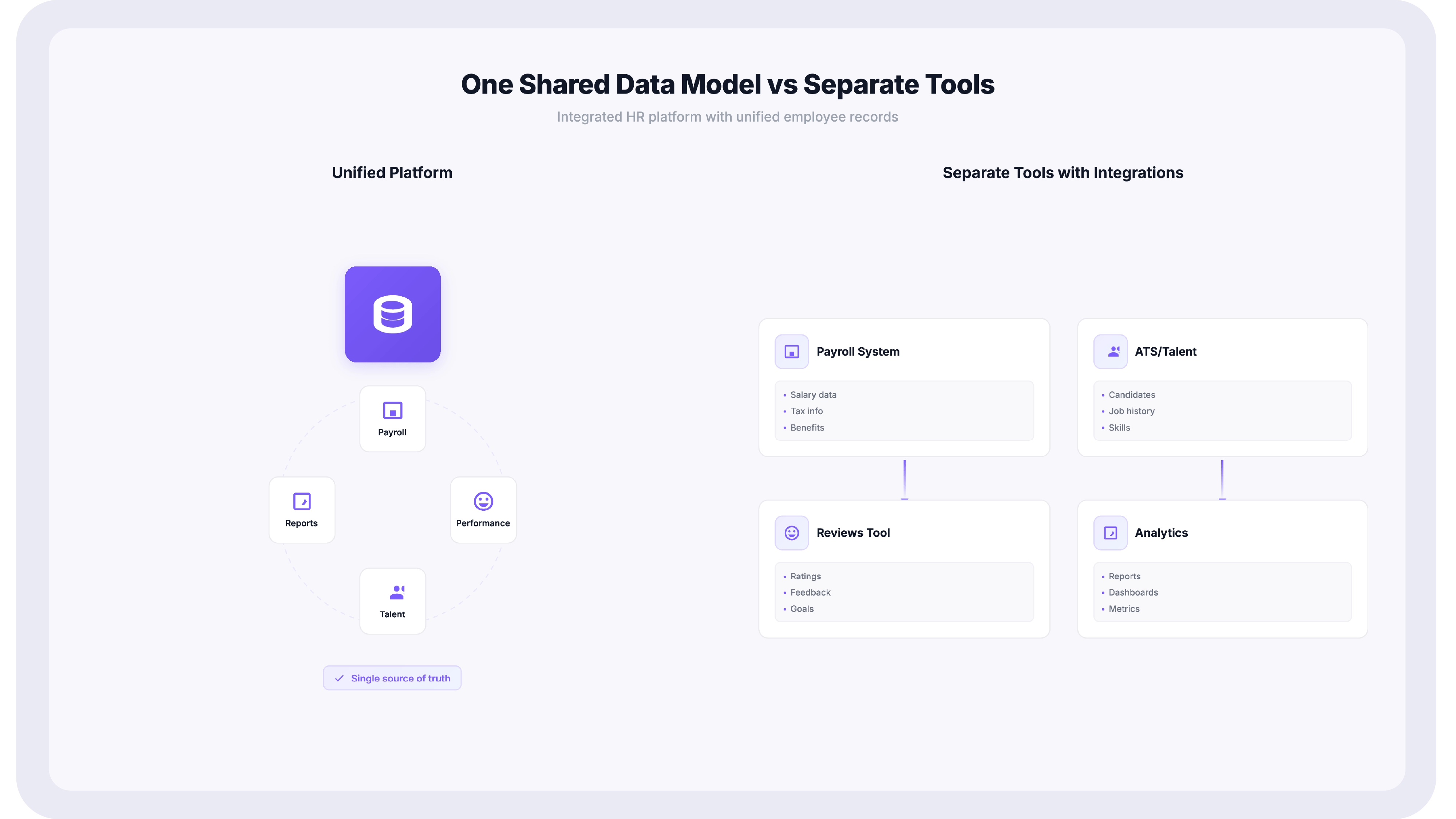
Diagram contrasting an integrated HR platform with a single employee record at the center against standalone tools, each holding its own data copy, connected by integration arrows

Integrated Platform vs Standalone Tools: Side by Side

HR Tools Comparison Table
Dimension Standalone HR Tools Integrated HR Platform
Data model Separate copy per tool One shared source of truth
Depth per function Best-of-breed, often deeper Strong, may be less deep than a specialist
Connecting functions Build and maintain integrations Native, no integration needed
Reporting Stitched across systems Consistent across one record
Total cost Subscriptions plus integration upkeep One platform, fewer integrations
Best when One function is the priority Decisions must build on each other

When Standalone Tools Are the Right Choice

An integrated platform is not always the answer, and it is worth being honest about that. Standalone tools are the better choice when one function dominates your needs, and the others are minor. If performance management is the only thing you genuinely need to do well, and learning and compensation are afterthoughts, the best standalone performance tool may serve you better than the performance module of a suite.

Standalone tools also fit when you have a strong reason to keep an existing specialist system, when a niche requirement is met only by a dedicated product, or when you have the technical capacity to own integrations deliberately. The key is that you are choosing to manage the seams, with eyes open, in exchange for depth in the function that matters most.

When an Integrated Platform Wins

An integrated platform wins when HR decisions need to build on each other. If you want performance-linked compensation, where a calibrated rating informs a merit decision, the connection is the value, and an integrated platform delivers it natively. If you want development needs from reviews to become assigned learning, or succession readiness to update as performance changes, those handoffs only work cleanly on a shared record.

The integrated model also wins on total cost more often than buyers expect, because it eliminates the integration build and maintenance that a standalone stack carries for the life of every connection. When several HR functions need to share a core HR record, an integrated platform is usually the lower-overhead and lower-risk choice.

This is the category TraineryHCM was built for: a connected HR platform where performance, learning, compensation, and core HR share one data model. For mid-market teams that want HR decisions to build on each other without managing a web of integrations, that connection is the entire value proposition. For a team that needs only one function done at maximum depth, a standalone specialist may still be the better fit, and that is an honest place to land.

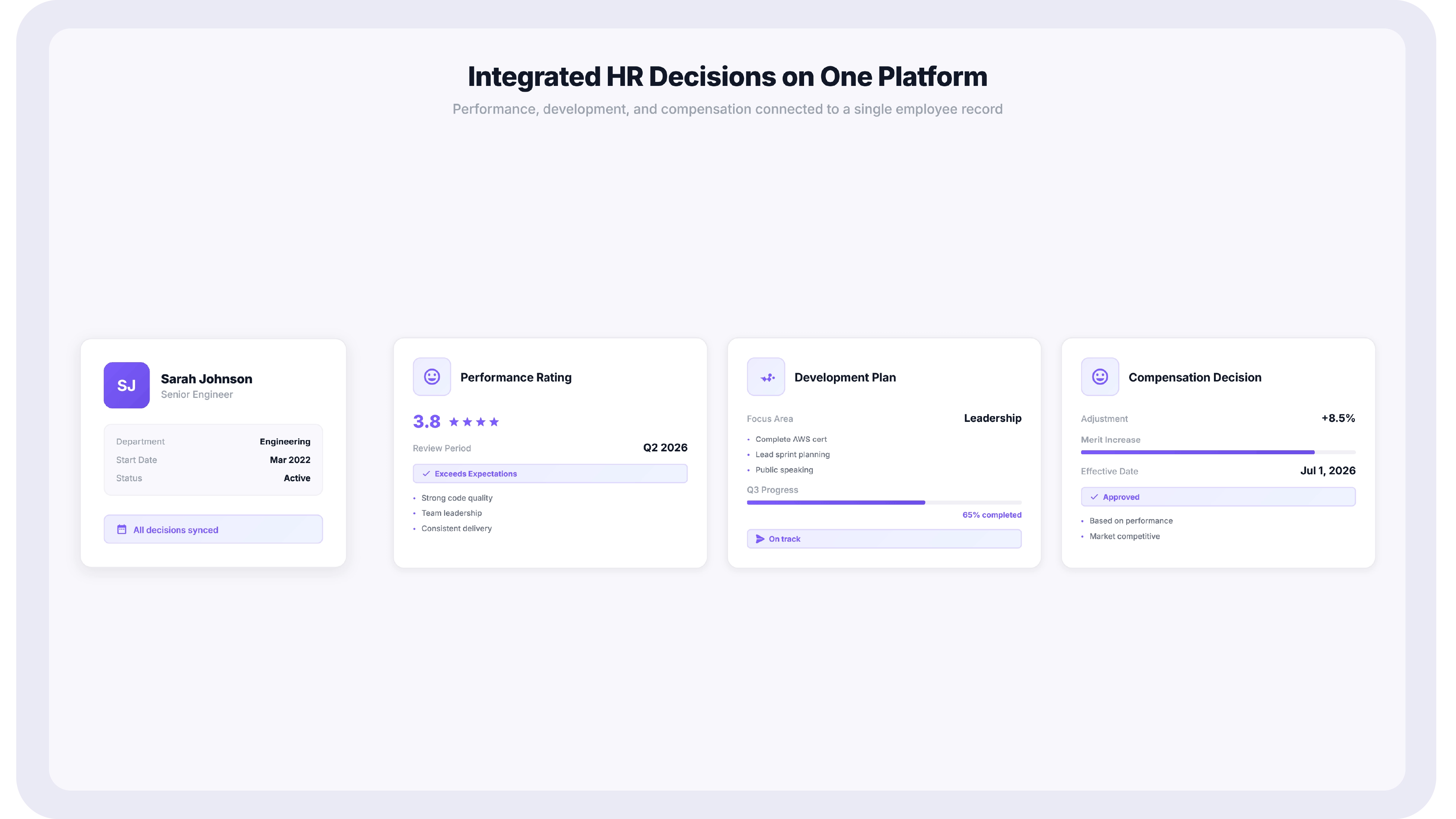
Screenshot showing a performance rating, a development plan, and a compensation decision connected on one employee record in TraineryHCM

Choosing the Right Model for Your Team

The difference between an integrated HR platform and standalone HR tools comes down to data, not features. Standalone tools give you best-of-breed depth in each function and ask you to manage the integrations between them. An integrated platform gives you one shared record and connection across functions, trading some per-function depth for far less integration overhead.

Decide with one question: do your HR functions need to share data, or can they operate independently? If a decision in one area should inform another, an integrated platform removes the seams that otherwise break those handoffs. If one function dominates and the rest are minor, a standalone specialist may serve you better. Answer that question honestly, and the model follows. For the broader context, our overview of talent management shows how these functions connect across the employee lifecycle.

One Data Model, One HR System

See What a Connected HCM Looks Like

TraineryHCM brings performance, learning, compensation, and core HR together on one data model, so every HR decision builds on the last instead of living in a separate tool. Book a demo to see it in action.

Book a Demo

KEY TAKEAWAYS

  • An integrated HR platform runs multiple HR functions on one shared data model; standalone HR tools are separate best-of-breed apps joined by integrations.
  • The real trade-off is data, not features: an integrated platform shares one source of truth, while standalone tools each hold their own copy that must be reconciled.
  • Standalone tools can be the right choice when one function is your overwhelming priority; an integrated platform wins when HR decisions need to build on each other.
  • Decide by asking whether your HR functions need to share data, because that single question settles the model.

Integrated HR Platform vs Standalone Tools:

An integrated HR platform is a single system that runs multiple HR functions, such as core HR, performance, learning, and compensation, on one shared data model, so a change in one function is immediately reflected everywhere relevant. Standalone HR tools are separate, specialized applications, each excellent at one function, that must be connected through integrations to share data. The core difference is the data model: an integrated platform has one source of truth, while standalone tools each maintain their own data that has to be synced and reconciled. Standalone tools offer best-of-breed depth in each function; an integrated platform offers connection across functions with less integration overhead.

Every HR team eventually faces this choice. You can assemble the best individual tool for each job, a specialist for performance, another for learning, another for compensation, or you can adopt a single platform that does all of it in one place. The first approach is often called best-of-breed or standalone tools. The second is an integrated HR platform, or a connected suite. Both are legitimate, and the marketing on each side insists it is obviously superior.

It is not obvious, and the honest answer depends on one variable. This guide explains what each model actually is, where each genuinely wins, and the single question that should decide which one fits your team. It avoids the usual trap of declaring one model universally better, because that claim is never true for everyone.

This comparison sits underneath every HR software decision, from talent management to compensation, so understanding it clearly makes every later choice easier.

What Each Model Actually Is

Standalone HR tools (best-of-breed)

Standalone tools are specialized applications, each built to do one HR function exceptionally well. A dedicated performance platform, a dedicated learning system, a dedicated compensation tool. You select the best option for each need and connect them so data can move between them. The appeal is depth: because each tool focuses on one job, it often has more features and more refinement in that area than any single module of a suite.

The cost of this model is at the seams. Each tool holds its own copy of employee data, and keeping those copies consistent requires integrations, which must be built, monitored, and maintained. When data moves between tools, through an integration or a manual export, that handoff is where information goes stale, and reconciliation work accumulates.

Integrated HR platform (connected suite)

An integrated platform runs multiple HR functions on one shared data model. Core HR, performance, learning, and compensation all draw on the same employee record, so a calibrated performance rating is immediately available to compensation, and a completed course immediately updates the development record. There is one source of truth, not several copies.

The trade-off is that any single function in an integrated platform may not be as deep as the very best standalone specialist in that area. You are trading maximum depth in each function for connection across all of them, and less integration overhead to maintain.

The Real Difference Is Data, Not Features

Feature comparisons miss the point. The deciding difference between the two models is not which has more capabilities. It is how they handle data.

With standalone tools, every function maintains its own data. The performance tool knows ratings, the compensation tool knows salaries, and connecting them means syncing two systems that were never designed to share a record. With an integrated platform, there is one record. The rating and the salary live in the same place, so connecting performance to pay is not an integration project; it is simply how the system works. This is the same distinction that separates a true talent management system from a bundle of tools, and it determines whether your reporting will ever be consistent.

How many copies of your employee data exist right now?

If your performance, learning, and pay tools each hold their own version, you are paying to keep them in sync. See what one shared data model looks like in TraineryHCM.

Book a Demo
Diagram contrasting an integrated HR platform with a single employee record at the center against standalone tools, each holding its own data copy, connected by integration arrows

Integrated Platform vs Standalone Tools: Side by Side

HR Tools Comparison Table
Dimension Standalone HR Tools Integrated HR Platform
Data model Separate copy per tool One shared source of truth
Depth per function Best-of-breed, often deeper Strong, may be less deep than a specialist
Connecting functions Build and maintain integrations Native, no integration needed
Reporting Stitched across systems Consistent across one record
Total cost Subscriptions plus integration upkeep One platform, fewer integrations
Best when One function is the priority Decisions must build on each other

When Standalone Tools Are the Right Choice

An integrated platform is not always the answer, and it is worth being honest about that. Standalone tools are the better choice when one function dominates your needs, and the others are minor. If performance management is the only thing you genuinely need to do well, and learning and compensation are afterthoughts, the best standalone performance tool may serve you better than the performance module of a suite.

Standalone tools also fit when you have a strong reason to keep an existing specialist system, when a niche requirement is met only by a dedicated product, or when you have the technical capacity to own integrations deliberately. The key is that you are choosing to manage the seams, with eyes open, in exchange for depth in the function that matters most.

When an Integrated Platform Wins

An integrated platform wins when HR decisions need to build on each other. If you want performance-linked compensation, where a calibrated rating informs a merit decision, the connection is the value, and an integrated platform delivers it natively. If you want development needs from reviews to become assigned learning, or succession readiness to update as performance changes, those handoffs only work cleanly on a shared record.

The integrated model also wins on total cost more often than buyers expect, because it eliminates the integration build and maintenance that a standalone stack carries for the life of every connection. When several HR functions need to share a core HR record, an integrated platform is usually the lower-overhead and lower-risk choice.

This is the category TraineryHCM was built for: a connected HR platform where performance, learning, compensation, and core HR share one data model. For mid-market teams that want HR decisions to build on each other without managing a web of integrations, that connection is the entire value proposition. For a team that needs only one function done at maximum depth, a standalone specialist may still be the better fit, and that is an honest place to land.

Screenshot showing a performance rating, a development plan, and a compensation decision connected on one employee record in TraineryHCM

Choosing the Right Model for Your Team

The difference between an integrated HR platform and standalone HR tools comes down to data, not features. Standalone tools give you best-of-breed depth in each function and ask you to manage the integrations between them. An integrated platform gives you one shared record and connection across functions, trading some per-function depth for far less integration overhead.

Decide with one question: do your HR functions need to share data, or can they operate independently? If a decision in one area should inform another, an integrated platform removes the seams that otherwise break those handoffs. If one function dominates and the rest are minor, a standalone specialist may serve you better. Answer that question honestly, and the model follows. For the broader context, our overview of talent management shows how these functions connect across the employee lifecycle.

One Data Model, One HR System

See What a Connected HCM Looks Like

TraineryHCM brings performance, learning, compensation, and core HR together on one data model, so every HR decision builds on the last instead of living in a separate tool. Book a demo to see it in action.

Book a Demo

Frequently Asked Questions

What is a shared data model in HR software?

When should a company choose standalone HR tools?

Are standalone HR tools cheaper than an integrated platform?

What does best-of-breed mean in HR software?

Is an integrated HR platform better than best-of-breed tools?

What is the difference between an integrated HR platform and standalone HR tools?

Turn Insight Into Action with TraineryHCM

Modern workforce challenges require more than disconnected HR tools. TraineryHCM helps organizations bring clarity, consistency, and confidence to human capital management, across people, performance, learning, and compliance.