
.svg)






Table of Contents
Key Takeaways
- PerformSpark owns specialist OKR, goal, check-in, and performance workflows.
- TraineryHCM connects goals with employee data, development, learning, compensation context, and reporting.
- Goal progress can inform performance conversations without becoming an automatic rating or pay formula.
- Use goal-management context, check-ins, and reporting to keep handoffs understandable and governed.
- Trainery.ai owns specialist learning workflows and CompBldr owns downstream compensation planning where policy requires those connections.
Search for the best OKR software and you will find dozens of comparisons focused on setup speed, dashboards, check-ins, integrations, and price. Those questions matter, but they are only part of the decision. The bigger HCM question is what happens to a goal after it is created: how it appears in performance conversations, whether it surfaces development needs, and how approved performance context reaches downstream people processes.
That distinction also clarifies product ownership. PerformSpark is the specialist destination for OKR and goal-management workflows, including goal creation, progress tracking, check-ins, reviews, and related performance activity. TraineryHCM is the umbrella HCM layer that connects those outcomes with employee data, learning, compensation, and broader reporting.
This guide keeps the full OKR evaluation framework because buyers still need it. The difference is that TraineryHCM should not act as a second standalone OKR software product page. It should help buyers understand both the goal-management workflow and the connections around it.
Why Most OKR Rollouts Fail (And Why Software Choice Matters)
The subscription fee is usually the smallest part of an OKR rollout. The larger investment includes executive sponsorship, planning workshops, manager training, operating rhythms, and the change management required to make goal updates part of normal work.
Adoption is the hidden variable. Strong programs usually maintain a consistent check-in rhythm, make progress visible to leaders, help teams write measurable Key Results, and bring reminders into the places people already work. When those habits disappear after the planning cycle, the software itself cannot rescue the program.
The connection to performance matters because goals stay more relevant when managers can use them as evidence and context in check-ins and reviews. The internal goal-management connection explains where OKRs sit in HCM, while the specialist workflow belongs in PerformSpark. TraineryHCM adds the surrounding employee and HCM context so development, learning, and downstream decisions do not become disconnected handoffs.
The Question Most Comparisons Skip: Standalone Tracker or Connected Platform
Before comparing products feature by feature, decide which operating model you need. The two common categories solve different problems.
Standalone OKR trackers
Standalone trackers focus heavily on objectives, Key Results, alignment, check-ins, and progress reporting. They can be an excellent fit when the main problem is scattered goals and the organization is comfortable keeping performance, development, and compensation in separate systems.
The trade-off is structural. When review season arrives, goal progress may need to be exported, summarized, or reconciled with another system. That does not make the tracker wrong; it simply means the integration and handoff model matters.
Connected platforms where OKRs sit inside performance and the wider HCM lifecycle
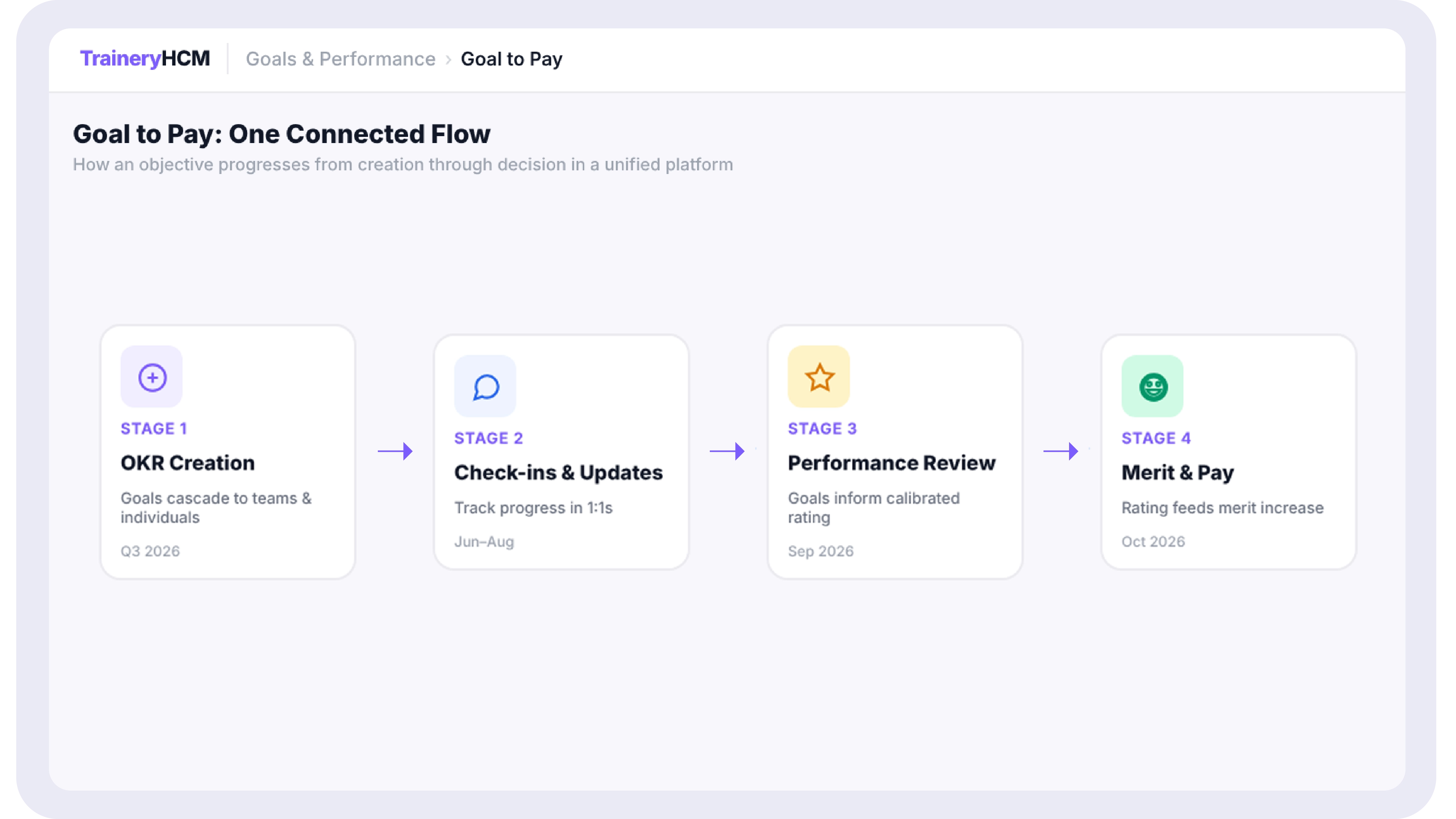
In a connected model, goals live close to the performance workflow. Progress can be discussed during check-ins and review cycles, development needs can move into an IDP or learning activity, and finalized performance context can be available to compensation where the organization's policy requires it.
For Trainery's product architecture, PerformSpark owns the specialist goal and performance experience. TraineryHCM owns the cross-functional connection to core employee data, Trainery.ai for learning workflows, and CompBldr for specialist compensation planning.
Two Categories, Side by Side
| Consideration | Standalone OKR Tracker | Connected HCM Model |
|---|---|---|
| Primary focus | Goal setting, tracking, and check-ins | Goals connected to performance and wider HCM context |
| Review season | Progress may require export or integration | Goal context can remain available inside the performance workflow |
| Development | Usually handled elsewhere | Goal-related skill gaps can become development or learning actions |
| Compensation | Handled in a separate system | Finalized performance context can move into specialist compensation planning |
| Best when | Goal tracking is the primary gap | Goals need to connect with the employee lifecycle |
| Specialist owner | Varies by vendor | PerformSpark for OKRs/performance; TraineryHCM for HCM connections |
Where do your goals go after the quarter ends?
Keep the goal workflow in PerformSpark, then connect performance context to development, learning, employee data, and downstream HCM decisions without rebuilding the story in spreadsheets.
How to Evaluate OKR Software: 7 Criteria That Matter
Once you know which category fits, use the same evaluation criteria for every shortlisted product. This section stays because it provides useful buyer depth; the specialist product evaluation itself should ultimately lead to PerformSpark rather than positioning TraineryHCM as a competing OKR platform.
1. Goal authoring and check-in workflow
How quickly can a team create a clear objective with measurable Key Results? How easy is it for employees and managers to update progress? If the weekly or biweekly check-in feels like extra administration, the data will become stale.
2. Alignment and cascading
Can company objectives connect to team and individual goals so employees understand how their work contributes to higher-level priorities? Test how the system handles changing priorities, ownership changes, shared objectives, and visibility.
3. Reporting and leadership visibility
Leadership attention helps sustain an OKR program. Look for reporting that makes progress, blocked objectives, ownership, and risk visible without forcing HR or managers to rebuild dashboards manually. TraineryHCM's cross-HCM reporting should help interpret goal and performance context alongside workforce data.
4. Connection to performance reviews
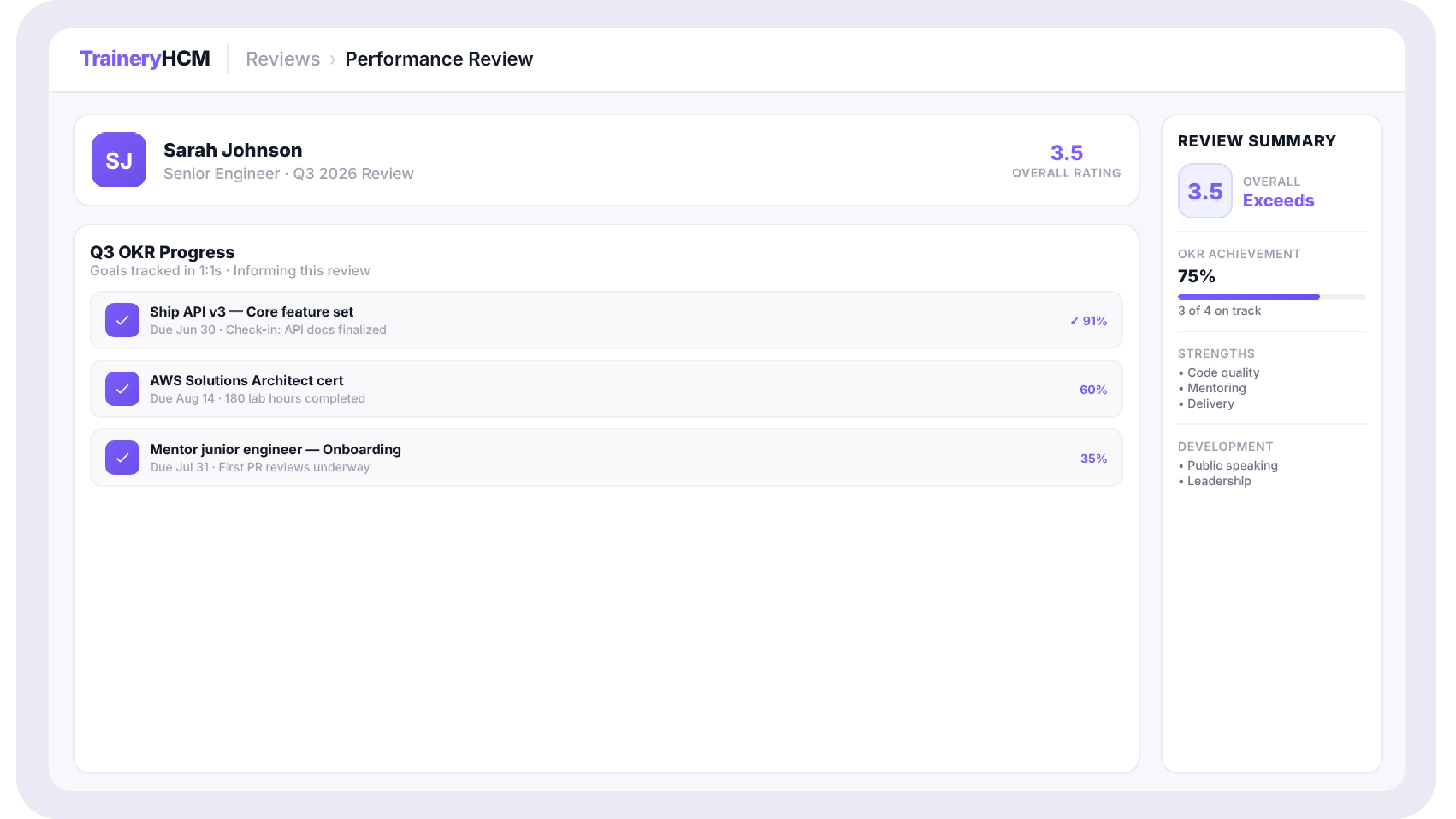
Goal progress can provide evidence and context during a performance conversation. Ask the vendor to demonstrate how goals appear in check-ins and reviews and what happens when a goal changes mid-cycle. Avoid a design that treats every stretch Key Result as an automatic rating formula.
For the specialist review, check-in, and goal workflow, use PerformSpark. Where rating standards need alignment before downstream use, review the HCM calibration connection.
5. Connection to development and learning
Strong goals often expose capability gaps. When an employee needs a new skill to deliver an objective, the platform should make it possible to convert that insight into an IDP action, coaching need, or learning assignment rather than losing it after the review.
For LMS, TMS, coaching, credentials, and learning operations, use Trainery.ai.
6. Connection to compensation
Some organizations use performance and goal outcomes as one input to compensation decisions. If that applies, test how finalized performance context is governed before it reaches the compensation cycle. The compensation workflow itself should remain separate from the goal tool.
For merit planning, budgets, approvals, and compensation governance, use CompBldr Compensation Planning. Within TraineryHCM, the compensation-planning connection explains the HCM handoff without duplicating CompBldr's product intent.
7. Adoption support and time to value
Rollout expertise matters as much as software. Ask what implementation, manager enablement, employee communication, change-management support, and ongoing customer support look like. The strongest feature set will not compensate for a process people do not understand or use. Confirm whether required integrations and reminders are part of the implementation plan.
The OKR Software Landscape: Four Types of Tool
Rather than ranking individual products here, it helps to understand the main tool types that appear in an OKR search. This keeps the comparison useful without making TraineryHCM compete as a standalone OKR software destination.
| Tool Type | What It Does Best | Consider When |
|---|---|---|
| Dedicated OKR trackers | Deep goal authoring, alignment, tracking, and check-ins | Goals are the primary gap and other people processes can stay separate |
| Strategy execution platforms | Connecting goals to portfolios, initiatives, and long-range strategy | Leadership needs a strategy layer above team objectives |
| Project and work tools with goals | Attaching objectives to tasks and existing workflows | Lightweight goal tracking inside day-to-day work is sufficient |
| Performance platforms connected to HCM | Goals connected to check-ins, reviews, development, and employee context | Goals need to participate in a broader employee lifecycle |
Within the Trainery ecosystem, PerformSpark is the specialist performance platform for goals and OKRs. TraineryHCM is the umbrella HCM layer that connects the employee record and the handoffs around performance, learning, compensation, and reporting. That distinction keeps the product architecture clear while preserving the value of a connected operating model.
Common Mistakes When Choosing OKR Software
- Optimizing for the demo, not the operating cycle. A clean interface can still leave teams with a difficult quarter-end or review-season handoff. Test what happens after goals are created.
- Ignoring where performance conversations happen. If managers cannot use goal progress naturally in check-ins and reviews, the organization will end up summarizing the same information twice.
- Treating adoption as only the buyer's problem. Ask how the vendor supports rollout, manager habits, employee education, reminders, and ongoing administration.
- Making goals an automatic pay formula. Goal progress can provide useful performance context, but stretch objectives and changing priorities mean compensation decisions need separate governance.
- Choosing the wrong category. A team that only needs lightweight goal tracking may not need a connected performance platform, while an organization that wants downstream development and HCM connections should test those handoffs explicitly.
Where goals rely heavily on input from peers or project leaders, the surrounding 360-degree feedback context may also matter. Where employee sentiment or manager effectiveness informs the operating model, use the broader feedback and survey connection rather than expanding the OKR tool beyond its purpose.
See goals inside the specialist performance workflow
Use PerformSpark for OKRs, goal progress, check-ins, and reviews. TraineryHCM then provides the wider employee and HCM context around those outcomes.
Choosing the Right OKR Software for Your Team
The best OKR software is not simply the product with the longest feature list. It is the product that fits the way your organization sets goals, maintains progress, involves managers, and uses goal context later in the employee lifecycle.
Start with the category question. If you only need a lightweight place to track objectives, a dedicated tracker may be enough. If goals should participate in check-ins, reviews, development, and wider HCM processes, test a connected performance model. Within the Trainery ecosystem, use PerformSpark for the specialist OKR and performance workflow, Trainery.ai for learning actions, CompBldr for governed compensation planning, and TraineryHCM for the employee-lifecycle context that connects them.
Related TraineryHCM use cases can help teams test those cross-pillar handoffs before selecting software.
Manage goals where performance conversations happen
Use PerformSpark for goal setting, OKRs, check-ins, and performance workflows. Keep TraineryHCM focused on connecting those outcomes with employee data, development, learning, compensation, and reporting.
Explore PerformSparkTo review the HCM-level architecture around those goal handoffs, book a TraineryHCM demo.
.svg)

.svg)
.svg)

